Introduction
Early-stage fintechs and payments companies in 2026 struggle with a brutal constraint: the need to scale technology fast while building compliance infrastructure that can survive regulatory scrutiny. Following the 2024 Synapse bankruptcy and subsequent federal consent orders against BaaS sponsor banks, many sponsor banks now require prior regulatory approval before onboarding new fintech partners.
That single shift rewrote the rules. Companies that once treated compliance as a later-stage problem are now discovering it's a prerequisite for getting a bank partner in the first place — let alone for raising their next round.
Digital transformation consulting for early-stage regulated companies has evolved well beyond technology implementation. It now means building the compliance programs, transaction monitoring systems, and audit-ready documentation that regulators, bank partners, and investors require before they'll engage. Skipping that foundation doesn't just create risk — it closes doors.
This article covers what digital transformation means for early-stage regulated companies in 2026, the market forces driving the shift, the consulting components that matter most, the real cost of treating compliance as an afterthought, and how to choose the right advisory partner.
Key Takeaways
- Early-stage fintechs must build scalable technology and compliance programs in parallel, not as separate phases
- Regulatory scrutiny has intensified in 2026, making compliance infrastructure a core part of the transformation roadmap from day one
- The most common digital transformation failure point is treating compliance as an afterthought during rapid growth phases
- The right consulting partner brings domain-specific financial services expertise and hands-on implementation capability, not generalist frameworks
What Digital Transformation Really Means for Early-Stage Companies in 2026
For early-stage fintechs and payments companies, digital transformation means simultaneously redesigning technology infrastructure, operating models, customer experience, and regulatory posture—built to scale together from the ground up.
Early-stage companies face a unique challenge that enterprises don't: they are building the plane while flying it. Every digital decision made today creates technical and compliance debt tomorrow if not done correctly from the start. Unlike mature organizations that can retrofit compliance programs, early-stage companies must embed compliance into their architecture during the build phase.
Three dimensions matter most for early-stage regulated companies:
- Technology architecture and automation — Core systems, API integrations, data flows, and operational tools designed to handle growing transaction volumes
- Financial crime and AML program infrastructure — Transaction monitoring, KYC/KYB processes, sanctions screening, and case management built to regulatory standards
- Data and reporting capabilities — Systems that support both operational growth and regulatory examination readiness with audit-ready documentation
Getting these three dimensions right defines what success actually looks like at this stage — becoming audit-ready, investor-ready, and partner-ready without sacrificing speed to market. According to Deloitte's 2024 fintech benchmark survey, 46% of early-stage companies (up to Series B) lacked an internal audit function altogether, and only 34% had a dedicated risk committee at the board level. For companies building on that foundation, closing these gaps early is the difference between a smooth exam and a consent order.

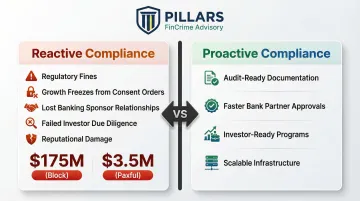
The cost of getting this wrong is measurable. Block's $175 million CFPB penalty in January 2025 and Paxful's $3.5 million FinCEN penalty in December 2025 are both examples of compliance failures that could have been caught earlier with proper infrastructure in place. Building that infrastructure from day one is not optional — it is the entire point.
The 2026 Landscape: Key Forces Shaping Fintech Growth and Compliance
Regulatory Environment Intensifies
The 2026 regulatory environment for fintechs and payments companies has fundamentally shifted. FinCEN's April 2026 AML/CFT Program NPRM proposes requiring financial institutions to establish "effective, risk-based, and reasonably designed" AML/CFT programs, shifting expectations from technical compliance to demonstrated effectiveness.
The CFPB's Larger Participants rule (effective January 2025) subjects nonbank digital payment apps processing over 50 million annual U.S. dollar transactions to direct federal supervision. This regulatory expansion brings early-stage payment fintechs under direct CFPB authority far earlier in their growth trajectory than previous regulatory frameworks allowed.
Following the Synapse bankruptcy, federal regulators issued severe consent orders to BaaS banks. The OCC's 2023 consent order against Blue Ridge Bank prohibited new fintech partnerships without prior written regulatory approval.
That single order effectively froze growth for noncompliant banks and created intense downstream scrutiny for their fintech partners.
AI and Automation Adoption Accelerates
AI adoption in financial services compliance is accelerating. According to Fenergo's 2025 survey, 82% of financial institutions now use advanced AI in KYC and AML operations, up from 42% in 2024. Early-stage companies that integrate AI-driven transaction monitoring, KYC automation, and alert management early gain measurable operational and risk advantages.
The cost impact is equally significant. KPMG research shows institutions can save an average of 25% of annual compliance costs through automation compared to manual processes. For resource-constrained early-stage companies, this efficiency is critical to maintaining lean operations while meeting regulatory obligations.
Investor and Partner Scrutiny Increases
Venture capital firms, bank partners, and enterprise clients now conduct AML/compliance due diligence as part of standard partnership evaluations. A scalable compliance program is a business development asset, not just a regulatory checkbox.
Sponsor banks have become significantly more selective following 2023-2024 bank and fintech failures. According to a 2024 Deloitte report, 80% of sponsor banks find meeting compliance requirements challenging, and 39% lost at least $250,000 due to compliance violations. Banks now require real-time AML transaction monitoring, specific KYC controls, and annual independent compliance program audits before closing partnerships.
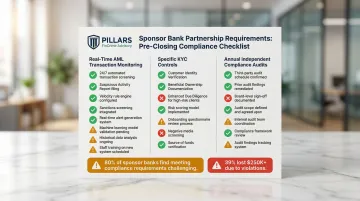
Without proactive compliance infrastructure in place, early-stage companies simply cannot access the bank partnerships required to operate.
Compliance Talent Gap Creates Consulting Demand
Most early-stage fintechs cannot afford to build full-time internal compliance and financial crime teams at the pace they need them. Financial crimes compliance hiring grew 80% year-over-year in 2026, making it the fastest-growing hiring category in fintech. Salary benchmarks show a BSA/AML Analyst commands $75,000–$110,000, while a Head of Financial Crimes Compliance commands $200,000–$300,000+.
For companies not yet at the stage to justify those salaries, an experienced fractional compliance advisor fills the gap — delivering program-level expertise without the overhead of a full-time hire.
Core Components of Digital Transformation Consulting for Early-Stage Fintechs
Strategic Roadmap Development
A good digital transformation consultant helps early-stage companies define what they need to build—and in what order—by assessing the current technology stack, existing compliance posture, and growth trajectory. The deliverable is a prioritized roadmap that aligns innovation goals with regulatory obligations.
This roadmap balances speed to market with compliance infrastructure needs. Rather than choosing between growth and compliance, the roadmap structures both to develop in parallel, preventing the costly remediation cycles that plague companies that defer compliance.
Financial Crime Program Buildout
Financial crime program buildout is a critical transformation component that generalist digital consultants typically overlook. This includes:
- AML policy development and documentation
- BSA/AML risk assessments tailored to business model
- Transaction monitoring design and optimization
- Escalation procedures and case management workflows
Pillars FinCrime Advisory covers this full lifecycle—from policy development and risk assessments through audit readiness—with hands-on implementation rather than advisory-only engagements.
Transaction Monitoring Optimization
Many early-stage fintechs inherit or rush-implement transaction monitoring systems that generate excessive false-positive alerts, creating operational friction and consuming analyst time. A consulting engagement focused on tuning alert thresholds, refining typologies, and improving alert quality is one of the highest-ROI digital transformation activities an early-stage fintech can pursue.
Optimization addresses:
- Alert threshold tuning based on actual transaction patterns
- Typology refinement to match business-specific risk
- False-positive reduction to improve analyst efficiency
- Alert quality improvement for regulatory defensibility
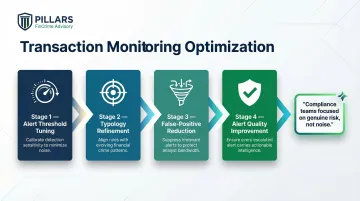
Properly optimized monitoring enables compliance teams to focus on genuine risks rather than chasing noise.
Technology and Process Integration
A transformation consultant helps an early-stage company integrate compliance tools—transaction monitoring, KYC/onboarding platforms, case management—with core technology infrastructure so compliance does not become a manual bottleneck as transaction volume scales.
Key integration outcomes:
- Automated data flows between systems
- Real-time compliance checks embedded in customer workflows
- Scalable processes that grow with transaction volume
- API connectivity that eliminates manual data entry
When compliance tools connect cleanly to core infrastructure, the program grows with the business—not against it.
Audit Readiness and Regulatory Examination Preparation
A well-executed transformation engagement leaves the company with documented policies, defensible procedures, and evidence-ready compliance files. When a regulatory exam or investor due diligence arrives, the company does not need to scramble.
Audit readiness deliverables include:
- Documented AML policies and procedures
- Risk assessment documentation with defensible methodology
- Transaction monitoring alert review evidence
- KYC/KYB customer file documentation
- SAR filing procedures and evidence trails
For early-stage fintechs working with Pillars FinCrime Advisory, this means arriving at regulatory exams with organized documentation and a defensible compliance record—not a last-minute filing effort.
The Hidden Cost of Skipping Compliance During Digital Transformation
The Common Failure Pattern
Early-stage fintechs commonly prioritize product velocity and customer acquisition in the growth phase, deferring compliance infrastructure build-out. This pattern leads to forced remediation, regulatory orders, or bank partner terminations when the gap is discovered—outcomes that cost multiples more than proactive compliance investment would have.
Block's $175 million CFPB penalty for failing to investigate unauthorized transactions and provide effective customer service demonstrates the financial cost of reactive compliance. Paxful's $3.5 million FinCEN penalty for willful failure to register as an MSB and maintain an effective AML program shows that even smaller companies face significant enforcement action.
Emergency remediation is devastating to startups. The OCC's consent order against Blue Ridge Bank prohibited onboarding new fintech relationships without prior regulatory approval, effectively freezing business development during remediation. For early-stage companies dependent on growth, a growth freeze of that kind can end the company before it scales.
Reputational and Business Development Consequences
Beyond direct fines, compliance failures create reputational damage and business development barriers. Three outcomes in particular can end an early-stage company before a fine is ever issued:
- Losing a banking sponsor relationship due to program deficiencies
- Failing a partnership due diligence review at the term sheet stage
- Being excluded from licensing approvals because of unresolved compliance gaps
Each is preventable with proactive compliance infrastructure investment.
The Synapse Financial Technologies bankruptcy demonstrates this risk. Following Synapse's Chapter 11 filing in April 2024, partner banks were unable to reconcile records, resulting in frozen consumer accounts and a shortfall of $60 million to $90 million. The CFPB's subsequent complaint against Synapse highlighted failures to maintain adequate records of consumer funds—a compliance gap that destroyed the company and harmed consumers.
For early-stage companies, the Synapse case is a blueprint of what not to do. Building compliance infrastructure during the transformation phase—not after the first regulatory inquiry—is what separates companies that scale from those that remediate.
How to Choose the Right Digital Transformation Consulting Partner for Your Stage
Prioritize Domain-Specific Expertise Over Firm Size
Early-stage companies should prioritize domain-specific expertise over firm size. A boutique consultant with deep hands-on financial crime and fintech compliance experience will deliver more actionable guidance than a large generalist firm that treats your engagement as a lower-tier project.
Look for:
- CAMS certification — The Certified Anti-Money Laundering Specialist (CAMS) credential demonstrates credibility to regulators and stakeholders, covering risk understanding, global AML frameworks, compliance program building, and financial crime technologies
- Direct implementation experience — Evidence of hands-on work building programs, not just strategy decks
- Growth-stage experience — Demonstrated work with companies at your specific stage, not just enterprises
- Regulatory environment knowledge — Experience with FinCEN, state money transmitter licensing, and relevant regulatory frameworks
Pillars FinCrime Advisory brings CAMS-certified expertise and 12+ years in financial crime to engagements — covering policy development, risk assessments, and transaction monitoring optimization for fintechs at every growth stage.
Evaluate Practical Capability
Assess how the consultant approaches a risk assessment, whether they deliver working policy documents or only recommendations decks, and whether they have experience with your specific regulatory environment.
Critical evaluation criteria:
- Deliverable format — Do they produce working policies and procedures you can implement, or just PowerPoint recommendations?
- Regulatory experience — Have they supported clients through actual regulatory examinations, or only during planning phases?
- Implementation support — Can they help integrate compliance tools with your technology stack, or only advise on what to do?
- Exam credibility — Will they serve as a credible resource during an actual regulatory examination?
According to interagency guidance on third-party relationships, banking organizations cannot outsource regulatory responsibility. The right consultant structures every deliverable — policies, procedures, risk assessments — so your team owns and can defend the program during an exam, not just describe what the consultant built.
Find a Partner Who Balances Innovation with Compliance
The right advisory partner understands that the goal is not to slow down growth but to make growth sustainable. Look for a partner whose value proposition is built around scalability and audit-readiness, not just risk avoidance.
Pillars FinCrime Advisory structures engagements around this model. Their fractional CCO and BSA officer services deliver senior compliance leadership without adding full-time headcount — giving early-stage companies experienced program ownership at a fraction of the cost of an in-house hire.
Client results back this up. One Chief Compliance Officer credited Pillars' "hands-on approach and deep understanding of fintech compliance" with navigating complex regulatory reviews and producing programs that are "scalable and audit-ready."
A VP of Compliance Operations described the outcome more concretely: "alert quality is up, operational friction is down, and we're better prepared for regulatory exams." That's the bar to set when evaluating any compliance partner.
Frequently Asked Questions
What is digital transformation consulting for early-stage companies?
Digital transformation consulting for early-stage companies helps fintechs and payments companies build scalable technology, operating models, and compliance infrastructure simultaneously, guided by consultants with relevant domain expertise. Unlike traditional transformation work, it integrates regulatory requirements from the start rather than treating them as a later-stage project.
When should a fintech startup hire a digital transformation consultant?
Common triggers include post-seed funding rounds, new product launches, market expansions, and first regulatory exams or bank partner due diligence requests. Engage before the gap becomes a crisis, not after.
How is digital transformation different for regulated companies like fintechs?
Unlike non-regulated startups, fintechs must build compliance infrastructure (AML programs, transaction monitoring, KYC processes) as part of the core transformation work, not as a separate later-stage project. Regulatory obligations begin at launch, making compliance a foundational architecture requirement.
What role does compliance play in a fintech's digital transformation?
Compliance is a structural component of digital transformation for regulated companies. It determines how systems are designed, how data is managed, and how operations are documented. Getting it right early enables faster scaling rather than costly remediation later.
How do you build a scalable financial crime program during rapid growth?
Scalability requires intentional design from the start. Key steps include:
- Document a risk assessment before building systems
- Implement transaction monitoring tunable as volume grows
- Build audit-ready policies from day one
- Engage an advisor who can optimize the program as the business evolves
What should early-stage companies look for in a digital transformation consulting partner?
Prioritize domain-specific experience over firm size, hands-on implementation over theory-only advisory, and relevant certifications such as CAMS. The right partner delivers working programs built for long-term scale, not just a deck of recommendations.