Introduction
Financial institutions face mounting regulatory pressure—from AML Act 2020 updates to FinCEN's reformed compliance priorities. Data governance has become the backbone of defensible compliance programs, yet many institutions still struggle to get it right. Recent enforcement actions put the stakes in plain terms:
- TD Bank received a $1.75 billion penalty in 2024 for "significant, long-standing, systemic breakdowns in its transaction monitoring program"
- Citibank was fined $75 million by the OCC for "deficiencies in data governance and internal controls"
Poor data governance drives exam findings and enforcement actions. Weak data lineage, inconsistent customer risk ratings, and untrustworthy transaction monitoring outputs all trace back to governance failures. Regulators scrutinize data integrity closely — and institutions without documented data ownership and enforceable policies face elevated exam risk.
This guide covers the best data governance solutions for compliance in 2026, what to look for, and how to evaluate them through a financial crime lens.
Key Takeaways
- Data governance is foundational to AML, BSA, and regulatory exam readiness for fintechs and financial institutions
- Leading 2026 platforms integrate data cataloging, lineage tracking, policy enforcement, and quality monitoring in one place
- Key platforms: Collibra, IBM OpenPages, Informatica, Ataccama ONE, SAP Master Data Governance
- Evaluate tools on AML/BSA framework alignment, core banking integration, audit trail depth, and scalability
- The right platform depends on your existing tech stack, regulatory obligations, and how fast you need to scale
What Is Data Governance and Why It Matters for Financial Crime Compliance
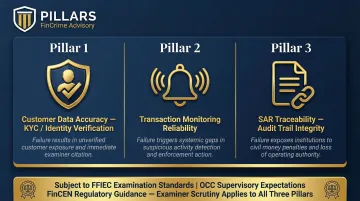
Data governance encompasses the policies, processes, and technologies that keep enterprise data accurate, consistent, secure, and accessible. For financial crime compliance, this translates to three obligations that regulators will test directly:
- Customer data accuracy — clean, complete identity records supporting KYC and onboarding decisions
- Transaction monitoring reliability — alert logic tied to verified, consistent source data
- SAR traceability — every filing traceable back to the originating record with a documented chain of custody
OCC, FinCEN, and FDIC examiners now routinely scrutinize data integrity as part of BSA/AML reviews. The FFIEC BSA/AML Examination Manual directs examiners to verify that IT systems supporting compliance programs are "complete and accurate."
Institutions that cannot demonstrate clear data lineage, documented data ownership, and automated policy enforcement carry measurably higher exam finding risk.
BCBS 239 and Data Quality Standards
The Basel Committee's BCBS 239 establishes principles for effective risk data aggregation and reporting, requiring data accuracy, integrity, completeness, timeliness, and adaptability across the enterprise. A 2023 BIS progress report found that banks remain at different stages of alignment, with data lineage still a persistent gap—a direct result of legacy system dependencies and fragmented data estates that resist centralized control.
The solutions evaluated below are assessed through a compliance lens—audit readiness, regulatory reporting accuracy, and financial crime program integrity—not just technical data management capability.
Best Data Governance Solutions for Compliance in 2026
Choosing a data governance platform for compliance isn't just a technology decision — it's a risk decision. The platforms below were selected based on financial services relevance, compliance-grade auditability, regulatory framework support, and real-world adoption among banks, fintechs, and payments companies.
Collibra
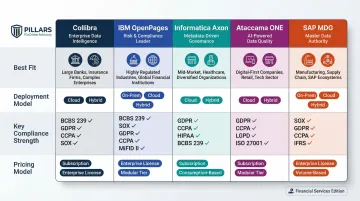
Collibra is an enterprise data intelligence platform widely adopted in financial services for its data catalog, lineage, privacy, and policy management modules. Banks and financial institutions use it to establish a governed, auditable data foundation that meets regulatory standards.
What makes it stand out for compliance:
- Automated policy enforcement workflows that document data handling and access controls
- Data lineage visualization that traces transaction monitoring outputs back to source systems
- Built-in support for GDPR and BCBS 239 regulatory frameworks
- Out-of-the-box data privacy workflows for compliance teams
| Feature | Details |
|---|---|
| Key Compliance Features | Automated policy workflows, data lineage visualization, PII classification, regulatory framework mapping |
| Integration & Deployment | Cloud and on-premises; connectors for Snowflake, Databricks, major core banking platforms |
| Pricing & Availability | Usage-based pricing; no free trial; custom quotes required |
Collibra was named a Leader in the 2025 Gartner Magic Quadrant for Data and Analytics Governance Platforms. Financial services customers include JPMorgan Chase and ASN Bank.
IBM OpenPages
IBM OpenPages is an AI-driven GRC and financial controls management platform used by large financial institutions for regulatory compliance management, operational risk, and financial controls documentation. Available as SaaS on AWS and IBM Cloud, it provides integrated compliance capabilities.
Differentiators for financial crime compliance:
- Dedicated Financial Controls Management (FCM) module for regulatory compliance
- Automated regulatory obligation ingestion
- Single data model connecting risks, controls, and policies
- Exam preparation and internal audit functionality
| Feature | Details |
|---|---|
| Key Compliance Features | Financial Controls Management module, regulatory compliance management, operational risk tracking, audit trails |
| Integration & Deployment | IBM Cloud Pak for Data or SaaS on AWS; integrates with SAP, Oracle, major ITSM platforms |
| Pricing & Availability | Enterprise pricing; 30-day trial available via IBM Cloud |
IBM OpenPages earned a Leader position in the 2025 Gartner Magic Quadrant for Governance, Risk and Compliance Tools. It's best suited for large institutions that need a unified GRC platform across risk, audit, and compliance functions. Customers include Citi and CNP Vita Assicura.
Informatica Intelligent Data Governance (Axon)
Informatica Axon is part of the broader Intelligent Data Management Cloud — an end-to-end governance solution that combines data cataloging, stewardship workflows, lineage, and data quality. Financial institutions use it to manage the data lifecycle from source to report.
For compliance teams, Axon's strength lies in creating traceable, well-defined data across the full regulatory reporting chain:
- Business glossary management that aligns data definitions across compliance teams
- Automated data lineage for regulatory reporting
- Stewardship workflows creating documented accountability
- Data quality scoring for continuous monitoring
| Feature | Details |
|---|---|
| Key Compliance Features | Business glossary, automated lineage, data stewardship workflows, data quality scoring |
| Integration & Deployment | Cloud-native SaaS; integrates with Snowflake, Azure, AWS, major financial data platforms |
| Pricing & Availability | Subscription-based; pricing by module and data volume; contact sales for quote |
Informatica's CLAIRE AI powers the platform, providing unified integration across 300+ sources. Financial services customers include Paycor and Citizens Bank.
Ataccama ONE
Ataccama ONE is a cloud-native AI-powered data management and governance platform that places data quality at the center of its architecture. It unifies data catalog, lineage, quality monitoring, and policy enforcement for enterprises requiring continuous, reliable data for compliance and AI.
What sets it apart:
- AI-powered quality monitoring across customer records, transaction data, and risk scores — continuously, not just at ingestion
- Pushdown processing that runs quality checks directly within cloud data warehouses like Snowflake
- Real-time observability and automated classification
- Proven in financial services environments where data reliability is essential
| Feature | Details |
|---|---|
| Key Compliance Features | AI-powered data quality monitoring, automated classification, lineage, real-time observability |
| Integration & Deployment | Cloud-native with pushdown processing; supports hybrid environments; usage-based pricing |
| Pricing & Availability | Usage-based pricing; free trial available upon request |
Ataccama's ONE AI Agent automates rule creation and anomaly detection. It's a strong fit for fintechs and cloud-native institutions that need quality-first governance without heavy implementation overhead. Financial services customers include Judo Bank and Fifth Third Bank.
SAP Master Data Governance (MDG)
SAP MDG is a centralized master data management solution designed for enterprises needing a single, governed version of critical data domains — including customer, supplier, and financial master data — with embedded audit trails and validation workflows.
Compliance relevance for SAP environments:
- Strong KYC and customer master data governance capabilities
- Domain-specific validation rules and duplicate detection
- Seamless integration with SAP S/4HANA for financial reporting
- Embedded audit trails and approval workflows
| Feature | Details |
|---|---|
| Key Compliance Features | Customer and financial master data governance, audit trails, duplicate detection, validation workflows |
| Integration & Deployment | SAP S/4HANA, SAP BTP cloud, hybrid; limited flexibility for non-SAP environments |
| Pricing & Availability | Object-based pricing starting at $93/month per 5,000 objects; total cost scales with data volume; 30-day free trial via SAP BTP |
Note: SAP MDG is best suited for SAP-centric environments. Institutions outside the SAP ecosystem will find integration options limited. See official pricing details. Customers include Deutsche Börse AG.
Key Features to Prioritize in a Data Governance Solution for Compliance
Data Lineage and Auditability
Financial crime compliance teams should prioritize data lineage and auditability when evaluating any governance platform. The ability to trace any data point—a customer risk score, a transaction alert threshold, a SAR input—back to its source separates defensible programs from ones that fail exam scrutiny.
Regulators treat lineage gaps as control failures. The Wolfsberg Group's CBDDQ Guidance (2023) explicitly requires data integrity checks confirming that data is completely and accurately captured in source systems and transmitted to monitoring systems — making auditability a baseline expectation, not a differentiator.
Automated Policy and Access Management
Critical capabilities include:
- Role-based access controls restricting data access by job function
- Data masking for sensitive PII and CDD data
- Documented approval workflows for data changes
- Comprehensive audit logging of all data access and modifications
Access controls without documented change management won't survive model risk scrutiny. Under the OCC's Supervisory Guidance on Model Risk Management, computer code implementing models must be subject to rigorous quality and change control procedures — meaning only approved parties can alter it, and every change must be traceable.
Integration with Existing Systems
Integration with core banking platforms, transaction monitoring tools, and case management systems often determines whether a governance tool actually gets used or sits idle. Before committing to a platform, verify it has native connectors for your existing stack—including:
- Core banking systems (FIS, Fiserv, Jack Henry, Temenos)
- Transaction monitoring platforms (NICE Actimize, SAS, AML RightSource)
- Case management systems
- Cloud data warehouses (Snowflake, Databricks, Azure Synapse)
- Customer data platforms
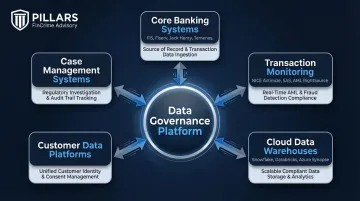
When connectors are missing, compliance teams resort to manual data pulls — and manual processes are exactly what examiners flag when they question the reliability of your transaction monitoring outputs.
How We Chose the Best Data Governance Solutions
The evaluation focused on three dimensions most relevant to financial crime compliance:
- Regulatory framework coverage and auditability features — including BCBS 239 support, automated policy enforcement, and exam-ready reporting
- Proven adoption in financial services environments — including banks, fintechs, and payments firms with documented implementations
- Practical usability for compliance teams — not just data engineers, with compliance-specific workflows like policy attestation and regulatory change management
A common mistake institutions make is choosing governance tools based on brand recognition or IT team preference, then discovering the platform lacks the compliance-specific workflows AML and BSA teams actually need. Policy attestation, regulatory change management, and exam-ready reporting are non-negotiable for financial crime programs.
That's why involving compliance leadership early in vendor evaluation prevents costly mismatches. A specialist who can map tool capabilities against your specific regulatory obligations — the way Pillars FinCrime Advisory does during program assessments — helps ensure you select a platform your compliance team can actually use, not just one IT can deploy.
Conclusion
Effective data governance is no longer optional for financial institutions and fintechs. Regulators expect institutions to demonstrate that compliance programs are built on trustworthy, well-governed data—from customer onboarding records to transaction monitoring logic. Capital One's $390 million penalty in 2021 resulted from failing to file Currency Transaction Reports due to internal system design flaws, highlighting the cost of poor data governance.
The right solution depends on your institution's size, tech stack, and specific regulatory obligations. Features like data lineage, automated policy enforcement, and audit-ready reporting should drive the decision—not just pricing or market positioning.
If your fintech or financial institution needs to strengthen its data governance framework, Pillars FinCrime Advisory can help. The firm brings hands-on financial crime expertise covering policy development, transaction monitoring optimization, and audit readiness — practical support to build a program that holds up under regulatory scrutiny. Reach out at pillarsfincrimeadvisory@gmail.com or call 281-825-1603.
Frequently Asked Questions
What are the 4 pillars of data governance?
The four widely recognized pillars are data quality, data security, data lineage/stewardship, and data policy/compliance. For financial institutions, these translate directly to accurate customer risk ratings, protected PII and transaction data, traceable compliance decisions, and enforced regulatory requirements across the data lifecycle.
What's the best platform for data governance?
The right platform depends on your organization's size, regulatory environment, and existing tech stack — no single solution fits every institution. For financial services compliance, Collibra and IBM OpenPages are frequently cited for their compliance-grade capabilities, regulatory framework support, and proven adoption in banking environments.
How does data governance support AML and BSA compliance?
Strong data governance ensures the accuracy of customer risk ratings, transaction monitoring inputs, and SAR data — all areas regulators scrutinize during exams. Data lineage lets institutions trace decisions back to source data, demonstrate process integrity, and respond confidently to regulatory inquiries.
What data governance features matter most for financial institutions?
Prioritize data lineage and auditability, automated policy enforcement, role-based access controls, and integration with core banking and transaction monitoring systems. These features directly impact compliance outcomes and exam readiness, as demonstrated by recent enforcement actions citing data governance failures.
How do fintechs approach data governance differently from traditional banks?
Fintechs typically rely on scalable, cloud-native governance tools to match their leaner teams and faster growth cycles. That said, regulatory expectations around data integrity and audit readiness are identical regardless of charter type — FinCEN's $1.75 million penalty against crypto-exchange Paxful demonstrates this clearly.
What is the difference between data governance and GRC?
Data governance focuses specifically on ensuring data is accurate, secure, and well-managed throughout its lifecycle. GRC (Governance, Risk, and Compliance) is a broader framework covering enterprise risk management, policy management, and regulatory compliance across the organization. Data governance serves as a foundational component of a strong GRC program.