Introduction
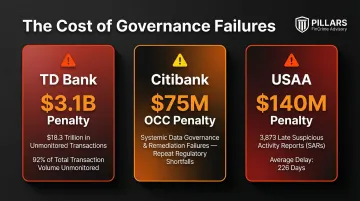
Exam cycles are accelerating, enforcement actions are climbing, and AML/BSA scrutiny has reached boardroom-level urgency. In October 2024, TD Bank agreed to pay $3.1 billion in penalties after regulators found that 92% of its transaction volume — $18.3 trillion — went unmonitored due to systematic compliance failures.
Months earlier, Citibank received a $75 million OCC penalty for failing to meet data governance remediation milestones from a prior consent order.
The common thread: without a structured data governance framework, organizations cannot produce clean, auditable data trails when examiners come calling. The result is exam findings, consent order risk, and costly remediation cycles that could have been avoided.
This guide evaluates the top data governance solutions built for regulatory compliance and audit readiness — covering what each does well, where each fits, and how fintechs, payments companies, and financial institutions can use them to build programs that hold up under scrutiny.
Key Takeaways
- Data governance solutions manage data quality, lineage, access control, and compliance documentation—the core elements regulators look for during exams
- Leading platforms include audit-ready reporting, automated policy enforcement, and role-based access control built for compliance workflows
- Leading solutions include Collibra, Microsoft Purview, Informatica Axon, OneTrust, and Alation—each suited to different institution sizes and compliance needs
- The right fit depends on your regulatory obligations (BSA/AML, OFAC, GDPR, CCPA) and your existing tech stack
What Is Data Governance in Financial Services?
Data governance in financial services encompasses the policies, processes, controls, and technologies that ensure data is accurate, consistent, secure, and auditable across the institution. It covers far more than analytics: regulatory reporting, AML/BSA transaction monitoring, SAR/CTR filing, and examiner reviews all depend on it.
Why Data Governance Is High-Stakes for Fintechs and Payments Companies
Financial crime regulators—FinCEN, OCC, FDIC, and state agencies—expect institutions to demonstrate data integrity and traceability on demand. When governance fails, the consequences are severe. In 2022, USAA Federal Savings Bank received a combined $140 million penalty after filing 3,873 SARs late, averaging 226 days after suspicious activity ended—a direct result of data management and governance breakdowns.
According to DAMA International's Data Management Body of Knowledge (DMBOK), data governance is the "exercise of authority and control" over data assets, while data management is the "execution and supervision" of those plans. For regulators, this distinction matters: governance defines accountability, policies, and controls—the elements examiners test during BSA/AML reviews.
Understanding that framework helps explain what separates adequate governance tools from exam-ready ones. The solutions reviewed below reflect what compliance teams at fintechs, banks, and payments companies are actually deploying—evaluated against institution size, regulatory footprint, and operational complexity.
Top Data Governance Solutions for Regulatory Compliance & Audits
These five platforms were evaluated on audit readiness, regulatory compliance workflows, data lineage, access controls, and scalability—specifically for fintechs, payments companies, and financial institutions. Each profile includes a feature summary, ideal use case, and pricing model to help you identify the right fit for your organization.
Collibra
Collibra is an enterprise-grade data intelligence platform widely adopted in regulated industries including banking, payments, and asset management. It provides a centralized hub for data catalog management, policy enforcement, stewardship workflows, and lineage tracking. That combination makes it a strong fit for institutions managing complex, multi-system data environments under active regulatory scrutiny.
Why It Stands Out for Compliance Teams:
Collibra's automated governance workflows can map controls to specific regulatory requirements (BSA, GDPR, CCPA), generate audit-ready documentation, and enforce data policies at scale. This directly reduces the manual burden on compliance staff ahead of regulatory exams. ASN Bank, for example, uses Collibra to trace data origins and ownership to enable accurate liquidity risk assessments and regulatory compliance.
| Category | Details |
|---|---|
| Key Compliance Features | Automated policy enforcement, data lineage, cross-framework control mapping, audit trail generation |
| Best Fit | Mid-to-large financial institutions and fintechs with complex data ecosystems and multi-regulator obligations |
| Pricing Model | Usage-based; custom enterprise quotes; no public pricing |
Microsoft Purview
Microsoft Purview is a cloud-native governance and compliance platform built for hybrid and multi-cloud environments, with deep integration across Microsoft 365, Azure, and Power BI. For financial institutions already operating within the Microsoft ecosystem, it offers a centralized view of sensitive data assets, access controls, and compliance posture.
Why It Stands Out:
Purview's built-in data classification, sensitivity labeling, and immutable audit logging make it well-suited for institutions that need to demonstrate regulatory accountability—particularly for data residency requirements, insider risk monitoring, and exam-readiness reviews. Rabobank uses Microsoft Purview Data Loss Prevention to protect data confidentiality across its global workforce.
| Category | Details |
|---|---|
| Key Compliance Features | Sensitive data classification, unified audit logs, access policy controls, compliance dashboards, hybrid environment support |
| Best Fit | Financial institutions operating in Microsoft-centric environments needing integrated governance and compliance reporting |
| Pricing Model | Consumption-based; scales with data volume and scanning frequency |
Informatica Axon Data Governance
Informatica Axon is part of the Intelligent Data Management Cloud (IDMC) platform, designed for enterprises managing diverse, high-volume data sources. It integrates governance with master data management, data quality, and lineage in a single workspace.
For financial institutions, that integration matters: data consistency across core banking, CRM, and transaction systems directly impacts regulatory reporting accuracy.
Why It Stands Out:
Automated data quality scoring and stewardship workflows help compliance teams catch and fix data integrity gaps before they surface in regulatory exams or transaction monitoring reviews. ABANCA uses Informatica to establish a business glossary, automatically catalog metadata, and track data lineage. Informatica's CLAIRE AI engine automates data cataloging, quality checks, and governance workflows, which is especially valuable for institutions managing customer data quality for KYC/CDD programs.
| Category | Details |
|---|---|
| Key Compliance Features | Data quality automation, lineage tracking, stewardship workflows, MDM integration, hybrid/multi-cloud support |
| Best Fit | Large financial institutions and payments companies with complex MDM and data quality needs tied to KYC, AML, or reporting obligations |
| Pricing Model | Enterprise licensing; custom quotes based on scale and modules |
OneTrust
OneTrust is a governance, risk, and compliance (GRC) platform that spans privacy management, data security, vendor risk, and regulatory compliance across global frameworks including GDPR, CCPA, BSA, and ISO 27001. Its data governance module helps organizations centralize policies, automate compliance workflows, and build audit-ready documentation at scale.
Where It Fits for Fintechs and Payments Companies:
OneTrust's regulatory research hub (covering 300+ jurisdictions) and automated data mapping capabilities help growing fintechs stay ahead of evolving obligations without building a large internal legal-regulatory team. It is especially effective for institutions managing cross-border data flows and multi-regulator compliance programs. Vanquis Banking Group implemented OneTrust to automate privacy operations and serve as a central repository for GDPR compliance.
| Category | Details |
|---|---|
| Key Compliance Features | Data mapping and inventory, vendor risk assessments, automated regulatory workflows, audit documentation, multi-framework coverage |
| Best Fit | Fast-growing fintechs and payments companies with multi-jurisdictional compliance obligations and limited internal regulatory infrastructure |
| Pricing Model | Solutions-based pricing; custom quotes by module and user count |
Alation
Alation is a data intelligence and governance platform known for its collaborative, user-friendly design and AI-assisted data discovery. It combines a powerful data catalog with governance workflows, data stewardship tools, and lineage visualization—accessible to compliance officers, analysts, and operations staff alike.
The Compliance Case for Alation:
Alation's strength is driving adoption across the institution, not just within the data engineering team. For financial institutions where compliance officers, analysts, and operations staff all need governed, trusted data, Alation lowers the barrier to a governance-first culture. Its ALLIE AI feature uses generative AI to automatically create catalog descriptions for table objects, and its trust flags (Endorsement, Warning, Deprecation) communicate data reliability across teams. Discover Financial Services uses Alation to catalog over 1 million datasets, saving an estimated 200,000 analyst hours.
| Category | Details |
|---|---|
| Key Compliance Features | AI-assisted data discovery, lineage visualization, stewardship workflows, policy management, collaborative glossaries |
| Best Fit | Financial institutions seeking broad organizational adoption of governance practices across both technical and business-user teams |
| Pricing Model | Subscription-based; scales by data volume, user count, and modules selected |
How We Chose the Best Solutions
These solutions were assessed against the specific demands of financial services compliance—not general IT governance. A common mistake institutions make is selecting a tool based on general market reputation (Gartner rankings, analyst reports) rather than its ability to support their regulatory exam cycle, AML/BSA program architecture, or examiner documentation requirements. The result is often a governance platform that looks good on paper but can't produce the audit trails examiners actually request.
Evaluation Criteria
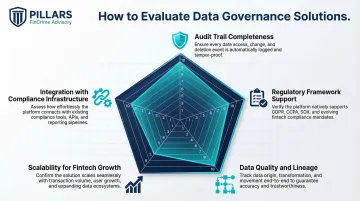
Each solution was scored across five criteria:
- Audit trail completeness: Generates tamper-proof, immutable records of data access, changes, and policy enforcement—so institutions produce actual logs when examiners request documentation, not reconstructed spreadsheets
- Regulatory framework support: Covers BSA/AML, OFAC, GDPR, CCPA, and BCBS 239, including pre-built workflows for SAR/CTR lineage and OFAC screening traceability that generic platforms typically lack
- Data quality and lineage: Automates data quality scoring and provides end-to-end lineage from source systems through regulatory reports, which transaction monitoring and regulatory reporting both depend on
- Scalability for fintech growth: Handles expanding transaction volumes and compliance obligations without requiring complete re-implementation as institutions move from early-stage to heightened regulatory scrutiny
- Integration with compliance infrastructure: Connects with transaction monitoring systems, CRM platforms, core banking systems, and case management workflows rather than operating as isolated data catalogs
Beyond the Tool: Embedding Governance in Your AML Program
Selecting and implementing a data governance tool is only half the equation. Even a well-configured platform falls short if it isn't embedded within a broader financial crime compliance program built around your institution's specific risk profile and regulatory obligations.
Pillars FinCrime Advisory works with fintechs, payments companies, and financial institutions to ensure governance solutions are integrated into AML program architecture—connecting tool capabilities directly to examiner expectations, SAR/CTR workflows, and ongoing compliance operations.
Conclusion
For fintechs, payments companies, and financial institutions, data governance has moved well past back-office IT territory. It is now a front-line requirement for regulatory survival and audit readiness. The right solution must go beyond data cataloging to deliver enforceable compliance controls, immutable audit trails, and the kind of data integrity that withstands examiner scrutiny.
When evaluating tools, look beyond feature lists. Consider how well they align with your regulatory footprint, your institution's growth trajectory, and the specific data challenges—such as transaction monitoring alert quality or KYC/CDD data completeness—that examiners are most likely to probe. The platforms reviewed here represent proven solutions deployed by financial institutions facing the same regulatory pressures you face today.
Choosing the right software is only part of the equation. Pillars FinCrime Advisory partners with fintechs, payments companies, and financial institutions to design and implement financial crime programs that are scalable, audit-ready, and built to hold up under regulatory pressure.
From policy development and transaction monitoring optimization to regulatory exam readiness, the firm provides hands-on expertise to ensure your governance solution delivers real compliance value. Reach out at 281-825-1603 or pillarsfincrimeadvisory@gmail.com to start the conversation.
Frequently Asked Questions
What is data governance in financial services?
Data governance in financial services refers to the policies, controls, and technologies that ensure data is accurate, traceable, and auditable. It covers:
- AML/BSA reporting and SAR/CTR documentation
- KYC/CDD program data integrity
- Regulatory exam readiness
- Financial crime risk management
How do data governance tools support AML compliance?
Governance tools support AML compliance by addressing the data quality and documentation requirements examiners expect:
- Keeping transaction monitoring data clean and consistent
- Maintaining auditable data lineage for SAR/CTR filings
- Enforcing access controls on sensitive financial data
- Generating documentation that satisfies BSA/AML audit requests
What should fintechs look for in a data governance solution?
Fintechs should prioritize scalability, integration with existing compliance infrastructure, support for relevant regulatory frameworks (BSA, GDPR, state money transmission laws), and the ability to generate audit-ready documentation without heavy manual effort—especially as they scale toward higher regulatory scrutiny.
How does data governance help financial institutions prepare for regulatory exams?
Governance platforms create immutable audit trails, enforce data quality standards, and centralize compliance documentation. When examiners request evidence of controls and data integrity, institutions can produce it quickly rather than reconstructing records under time pressure.
What is the difference between data governance and data management for financial institutions?
Data management focuses on how data is stored, moved, and processed, while data governance defines the rules, accountability, and controls over how that data is used. Governance is what makes data management compliant, auditable, and defensible before regulators.
How often should financial institutions review their data governance framework?
Governance frameworks should be reviewed at minimum annually, and also triggered by regulatory changes, significant business model shifts, product launches, or audit findings. Continuous monitoring is more effective than relying on periodic point-in-time reviews alone.