Introduction
Regulators aren't waiting. FinCEN's $37 million fine against Brink's and NYDFS's $40 million penalty against Block/Cash App make one thing clear: non-banks are now held to the same standards as chartered institutions. In 2025, global illicit financial flows reached $4.4 trillion, with fraud losses hitting $579.4 billion. Fintechs and payments companies face the same aggressive enforcement posture that once applied only to traditional banks.
Choosing the wrong payments advisory firm creates real exposure: failed audits, regulatory action, and compliance programs that break under growth pressure. The right partner builds programs that are audit-ready from day one and designed to scale alongside your business.
This guide profiles the top global payments advisory services firms for 2026, explains what to look for, and helps you select the right partner for your organization's regulatory environment and growth stage.
Key Takeaways
- Global payments advisory firms help fintechs and financial institutions build compliant, scalable AML/BSA programs
- Top firms include global consulting giants (Deloitte, Accenture, KPMG) and specialized boutiques (Pillars FinCrime Advisory)
- Key selection criteria: regulatory depth, payments-specific FinCrime expertise, audit readiness support, scalability
- Large firms offer global reach; boutiques deliver payments-focused compliance with faster, hands-on execution
- Right-fit over brand name: match your choice to your risk profile and growth stage
What Are Global Payments Advisory Services Firms?
Global payments advisory services firms specialize in helping payments companies, fintechs, and financial institutions design, implement, and optimize compliance programs. Their scope covers AML/BSA policy development, financial crime risk assessments, transaction monitoring, and regulatory exam readiness—distinct from payment technology consulting or infrastructure modernization.
That scope has become increasingly critical in 2026. 98% of financial institutions reported increased financial crime compliance costs, with total spending reaching $61 billion in the U.S. and Canada. Regulatory enforcement has intensified dramatically. Financial institutions filed 4.7 million Suspicious Activity Reports in FY2024, while non-bank payments companies face consent orders for transaction monitoring backlogs, inadequate customer due diligence, and failed SAR filings.
The regulatory perimeter is also expanding, adding new layers of pressure:
- FinCEN reform requirements: Proposed rules now mandate effectiveness-based, risk-proportionate programs rather than checkbox exercises
- Dual compliance obligations: Non-banks under sponsor bank partnerships must satisfy both the sponsor's oversight requirements and direct regulatory scrutiny
- Evolving exam standards: Regulators increasingly expect documented risk rationale, not just policy existence

Top Global Payments Advisory Services Firms in 2026
We evaluated firms based on depth of FinCrime/AML expertise, regulatory track record, payments sector experience, program delivery capability, and measurable client outcomes. Here's how the leading firms compare.
Deloitte
Deloitte operates one of the deepest regulatory and compliance advisory practices in financial services, serving global banks, payment processors, and emerging fintechs on AML, KYC, and financial crime risk management.
Their edge lies in managing large-scale, multi-jurisdictional compliance transformations — with strong regulator relationships and a track record through complex enforcement actions, consent orders, and BSA/AML program overhauls. Their proprietary Deloitte Enterprise Risk Assessment (DERA) tool provides structured AML and sanctions risk measurement.
| Attribute | Details |
|---|---|
| Focus Area | Enterprise AML/FinCrime compliance, regulatory remediation, risk governance |
| Key Services | BSA/AML program reviews, transaction monitoring, KYC redesign, regulatory strategy |
| Best For | Large financial institutions and payments companies under regulatory scrutiny or undergoing compliance transformation |
Accenture
Accenture has built a dedicated financial crime and compliance advisory practice supporting payment providers, banks, and fintechs on FinCrime strategy, compliance program design, and technology-enabled AML modernization.
Their distinguishing strength is the integration of compliance advisory with hands-on technology deployment. They implement AML platforms, automate transaction monitoring, and build compliance infrastructure aligned with FATF and OFAC standards. Accenture has operationalized GenAI across multiple workflows — including SAR narrative generation and alert summarization — through proprietary tools like the Anti-Fraud Investigator.
| Attribute | Details |
|---|---|
| Focus Area | FinCrime strategy, compliance technology integration, AML modernization |
| Key Services | Compliance program design, AML system implementation, sanctions screening, regulatory reporting |
| Best For | Mid-to-large payments companies and fintechs seeking to modernize compliance infrastructure at scale |
KPMG
KPMG's well-established financial crimes practice specializes in AML risk assessments, BSA/AML model validation, and regulatory compliance for payments companies, money service businesses, and digital finance platforms.
KPMG brings a rare combination of forensic accounting depth, regulatory intelligence, and analytical rigor to FinCrime risk. Their look-back reviews, independent testing, and gap assessments help organizations prepare for exams and build defensible compliance programs. A growing focus on model governance addresses explainability requirements — increasingly critical as AI-based monitoring becomes standard.
| Attribute | Details |
|---|---|
| Focus Area | AML risk assessment, model validation, regulatory exam preparation |
| Key Services | Independent testing, look-back reviews, BSA/AML gap analysis, transaction monitoring optimization |
| Best For | Payments companies and fintechs preparing for regulatory examinations or requiring third-party model validation |
Oliver Wyman
Oliver Wyman's Anti-Financial Crime practice works with Heads of Anti-Financial Crime and senior executives on strategy definition, organizational change, and project execution for financial institutions and payments companies.
Oliver Wyman excels at translating complex regulatory requirements into right-sized compliance strategies that reflect actual business risk. This makes them particularly valuable for organizations navigating new payments rails, embedded finance models, or cross-border regulatory complexity. Their emphasis on analytical rigor extends to deploying next-generation capabilities and reviewing existing program elements.
| Attribute | Details |
|---|---|
| Focus Area | Payments strategy, FinCrime risk frameworks, compliance operating model design |
| Key Services | Risk appetite setting, compliance operating model design, regulatory strategy, FinCrime program benchmarking |
| Best For | Payments companies and financial institutions seeking strategic compliance advisory without large-scale technology implementation |
Pillars FinCrime Advisory
Pillars FinCrime Advisory is a specialized boutique firm purpose-built for fintechs, payments companies, and financial institutions navigating FinCrime compliance with confidence. Founded by Joshua Douglas — CAMS Certified, with 12+ years in financial crime and nearly 20 years across financial services — the firm is headquartered in Houston, Texas and serves clients nationwide.
Where large consulting firms bring scale, Pillars brings depth. The firm provides hands-on, end-to-end FinCrime program support — from policy development and risk assessments to transaction monitoring optimization and audit readiness. Solutions are built to grow alongside fast-moving payments businesses, not handed off as generic templates. Clients report sharper alert quality, less operational friction, and compliance programs that hold up under exam conditions.
| Attribute | Details |
|---|---|
| Focus Area | Full lifecycle FinCrime compliance for fintechs and payments companies |
| Key Services | Policy development, AML risk assessments, transaction monitoring optimization, audit readiness, BSA/AML program build-out |
| Best For | Fintechs, payments companies, and financial institutions seeking specialized, end-to-end FinCrime advisory from a CAMS-certified expert with deep payments sector experience |

How We Chose the Best Payments Advisory Firms
Common mistakes organizations make when selecting advisory firms include prioritizing brand name over specialization, overlooking direct payments or fintech experience, and underestimating the importance of audit-ready, operationally practical deliverables rather than theoretical frameworks.
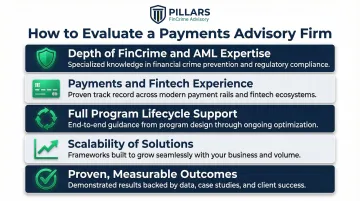
Our evaluation criteria:
- Depth of FinCrime and AML expertise — including relevant certifications like CAMS (Certified Anti-Money Laundering Specialist)
- Demonstrated payments and fintech experience — not just financial services broadly
- Full program lifecycle support — from policy development through exam readiness
- Scalability of solutions — ability to grow with your business model
- Proven, measurable outcomes — reduced alert backlogs, improved monitoring effectiveness, successful regulatory exams
The Financial Crime and Compliance advisory market reached roughly $4.8 billion in 2024. Within this crowded market, firms differentiate on regulatory track record, technology tooling, and personnel credentials. These criteria reflect that reality. FinCEN's April 2026 proposed rule shifts focus to effectiveness and risk-based program design. That makes practical, operationally sound solutions more critical than ever.
Conclusion
The right payments advisory firm functions as a strategic partner—helping your organization build a financial crime program that scales with growth, adapts to evolving payment rails, and stays ahead of tightening regulatory expectations. Strong compliance infrastructure doesn't slow innovation; it enables it.
Evaluate advisory firms on the depth of their FinCrime and payments-specific expertise, their ability to deliver practical and audit-ready solutions, and whether their approach scales with your business model. Brand recognition matters far less than proven, hands-on experience with the compliance challenges specific to fintechs and payments companies.
If that's the kind of partner you're looking for, Pillars FinCrime Advisory offers end-to-end support — from policy development and KYC/KYB program design to transaction monitoring optimization and regulatory exam readiness. Reach out at pillarsfincrimeadvisory@gmail.com or call 281-825-1603 to start the conversation.
Frequently Asked Questions
What do global payments advisory services firms do?
They help fintechs, payments companies, and financial institutions design and strengthen AML/BSA compliance programs, manage financial crime risk, and prepare for regulatory examinations. This differs from technology consulting, which focuses on infrastructure and payment rails rather than regulatory compliance programs.
How is payments advisory different from payments technology consulting?
Compliance advisory focuses on AML policies, risk frameworks, financial crime programs, and regulatory readiness. Technology consulting focuses on infrastructure modernization, API integration, and payment rails. Some firms offer both, but they serve different operational needs.
What should a fintech look for when hiring a payments compliance advisory firm?
Prioritize relevant certifications (such as CAMS), direct experience with payments companies or fintechs, ability to deliver scalable and audit-ready solutions, and a track record of practical compliance outcomes—not just theoretical frameworks.
When does a payments company need a financial crime advisory partner?
Common triggers include rapid growth, new product launches, regulatory exam preparation, transaction monitoring alert backlogs, and identified BSA/AML program gaps. Early engagement prevents costly remediation later.
What is CAMS certification and why does it matter for advisory firms?
CAMS (Certified Anti-Money Laundering Specialist) is the most widely recognized credential in financial crime compliance, issued by ACAMS. It signals that an advisor has demonstrated expertise in AML risk, typologies, and regulatory frameworks.
Can a boutique advisory firm serve the needs of a growing fintech better than a Big Four firm?
Boutique firms often provide more hands-on, payments-specific expertise, faster execution, and direct access to senior advisors. Large firms offer scale for complex, multi-jurisdictional programs. The right choice depends on your organization's size, risk profile, and compliance maturity.