
Introduction
Every fintech and payments startup founder knows the tension: you need expert help — especially in specialized areas like compliance — but every consulting firm seems to want a 12-month retainer and a six-figure commitment before they'll answer a single question.
That assumption is rooted in how enterprise consulting worked a decade ago. Today, a growing number of senior compliance and advisory professionals offer project-scoped engagements — work with a defined start, clear deliverables, and a fixed end date. Early-stage companies can access that expertise without the overhead of a full-time hire or the commitment of a long-term contract.
Getting there takes three things: knowing when you actually need outside help, scoping the work tightly before you engage anyone, and identifying consultants who are built for project-based work rather than perpetual retainers. This guide walks through all three.
Key Takeaways
- Access expert consultants through project-based, milestone-based, or light-touch advisory engagements without long-term commitments
- Vet consultants who prioritize defined deliverables over open-ended retainers in regulated fintech and payments industries
- Project-scoped AML, BSA, and transaction monitoring specialists deliver immediate, measurable value
- Short-term agreements with clear scope, deliverables, and payment terms protect both parties from day one
Why Startups Avoid Hiring Consultants (And Why That Hesitation Can Backfire)
Consultants Don't Automatically Mean Long-Term Commitments
The most common misconception startup founders carry is that hiring a consultant automatically means a long-term, expensive commitment. Founders base this belief on outdated experiences with large enterprise consulting firms — the current market of independent and boutique specialists looks very different. Most structure engagements around specific deliverables and defined timelines, not open-ended retainers.
The Real Cost Comparison
The fully-loaded cost of a full-time employee significantly exceeds base salary. According to the Bureau of Labor Statistics' December 2025 report, benefits add a 42.6% premium on top of base wages for private industry workers. SHRM's 2025 Benchmarking Report shows that executive hires cost $35,879 on average — and new hires typically require six months to reach full productivity.
Cost breakdown:
- Median compliance officer salary: $78,420 annually
- Benefits premium: Additional 42.6% ($33,397)
- Recruiting cost: $35,879 (one-time)
- Time to productivity: 6 months
- Total first-year cost: $147,696+
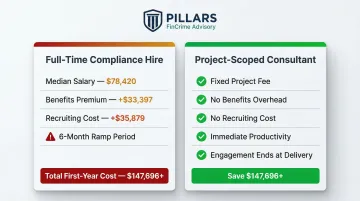
For early-stage startups, a project-scoped consultant delivering a specific risk assessment or policy framework in 8-12 weeks is often the more cost-effective path.
Waiting for a Crisis Before Getting Help
Many startup founders delay getting external help until a problem becomes a crisis — in regulated industries, that delay carries real financial consequences.
Waiting too long on compliance gaps can result in:
- Regulatory action and fines
- Failed audits
- Lost partnerships with sponsor banks
In 2025, 48 state regulators issued an $80 million penalty to Block (Cash App) for BSA/AML violations, citing insufficient KYC, transaction monitoring failures, and a backlog of up to 169,000 suspicious activity alerts. Wise US received a $4.2 million fine for AML/CFT program deficiencies. These penalties far exceed the cost of proactive compliance consulting.
Protecting Flexibility Through Contract Structure
The fear of losing flexibility is valid — but it's a reason to negotiate contract terms carefully, not a reason to avoid consultants altogether. Look for engagements structured around specific deliverables or milestones, with defined exit clauses built in from the start. That kind of structure gives you expert help without locking in ongoing spend.
The Specialized Skills Gap
Early-stage startups rarely have deep in-house expertise in specialized domains like financial crime compliance, cybersecurity, or regulatory risk. A 2024 Deloitte survey found that 46% of early-stage fintechs (up to Series B) completely lack an internal audit function. Trying to build that expertise internally from scratch is both slower and more expensive than accessing it through a specialist engagement.
Flexible Consulting Models That Don't Require Long-Term Commitment
Project-Based Engagements
The consultant is hired to deliver a specific, defined output (e.g., a risk assessment, a policy framework, an audit-readiness review) within a set timeline. Payment is tied to the project, not to ongoing availability.
For startups, the appeal is straightforward:
- Budget is fixed from day one
- Engagement ends when deliverables are accepted
- No ongoing obligation after completion
This is the most common model for compliance work like AML program buildouts or transaction monitoring assessments.
Milestone-Based Billing
Payment is released only when specific deliverables are completed and approved by the client. This structure gives startups maximum budget control and keeps the consultant directly accountable for output quality.
Example milestones for an AML program buildout:
- Risk assessment completion and approval
- Policy framework draft delivered
- Final policies approved and implemented
- Audit readiness review completed
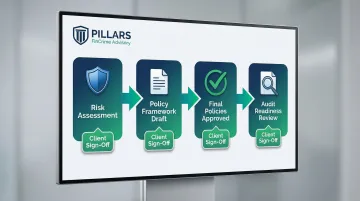
Each milestone triggers payment only after the client signs off.
Light-Touch Advisory Retainer
Four to ten hours per month at a fixed fee, with no long-term lock-in clause.
This model fits well for:
- Quick-turn regulatory questions
- Compliance gut-checks before product launches
- Document reviews (policies, contracts, vendor agreements)
- Ongoing regulatory monitoring and updates
It's not a substitute for full program buildouts, deep operational integration, or hands-on implementation work.
Fractional or Interim Consulting
A specialist fills a part-time role for a defined period (e.g., 3–6 months), ideal when a startup needs someone to build a program or function from scratch but isn't ready to hire full-time. The engagement has a defined end point built in.
According to Revelio Labs, fractional executive roles have tripled since 2018. Typical monthly retainers range from $8,000 to $22,000, with hourly rates from $150 to $350.
For fintechs and payments companies tackling AML program buildouts, transaction monitoring optimization, or audit preparation, firms like Pillars FinCrime Advisory structure fractional engagements around defined deliverables and phases — so the scope and exit point are clear before the work begins.
Knowing When Your Startup Actually Needs a Consultant
The Clearest Signal
The clearest signal is when your internal team is blocked on a problem outside their core expertise, and the cost of staying stuck — in time, risk, or missed opportunity — exceeds the cost of expert help. Apply the 80/20 test: if 20% of your unresolved problems are consuming 80% of your team's bandwidth, that's your trigger.
External Pressure Events
Specific events should prompt a startup to bring in a consultant rather than waiting:
Regulatory triggers:
- Upcoming regulatory exam or licensing application
- FinCEN's April 2026 proposed rule requiring U.S.-based AML compliance officers and risk-based program effectiveness
- State licensing applications under the Money Transmission Modernization Act (now enacted in 31 states covering 99% of reported money transmission activity)
Business triggers:
- Investor due diligence requiring demonstrated compliance
- Significant jump in transaction volume exposing gaps in existing risk controls
- Internal audit finding requiring remediation on a timeline
- Sponsor bank requesting compliance program documentation or threatening offboarding
Recent FDIC and OCC consent orders against sponsor banks like Blue Ridge Bank and Lineage Bank for third-party risk and BSA/AML failures have forced banks to abruptly offboard non-compliant fintech partners. If your sponsor bank is under regulatory scrutiny, you need compliance help immediately.
When a Consultant Is NOT the Right Answer
If the work is ongoing, deeply integrated into daily operations, and your budget can support a full-time salary, hiring is often the smarter move. Ask one question: is this a bounded project with a clear endpoint, or a permanent function the business can't run without? If it's the latter, a consultant is a stopgap — not a solution.
How to Find and Vet a Flexible, Specialized Consultant
Start With Specialization, Not Size
Boutique or independent consultants typically offer more flexibility in contract structure than large firms. They're often open to project-scoped, deliverable-driven engagements because their business model supports it. A generalist management consulting firm is rarely the right match for a seed-stage startup.
Verify Domain Credentials
For financial crime and AML compliance, look for:
- CAMS certification: Over 57,000 professionals globally hold the Certified Anti-Money Laundering Specialist credential, recognized by regulators as the benchmark for AML expertise
- Direct regulatory experience (not just general financial services exposure)
- A track record with fintech or payments companies specifically
Pillars FinCrime Advisory checks each of these boxes — CAMS certified, with 12+ years in financial crime and nearly 20 years across financial services, focused exclusively on fintechs and payments companies.
Ask About Engagement Structure First
Once you've confirmed credentials, test how the consultant thinks about scope. One who defaults to "12-month retainer" before understanding your needs is a poor fit. A good specialist will ask what you're trying to accomplish, then propose a structure that matches — whether that's a one-time assessment, a phased buildout, or periodic advisory hours.
Request References From Companies at a Similar Stage
Enterprise experience doesn't automatically translate to startup fit. A consultant with a 20-year bank background may struggle with the resource constraints, speed requirements, and regulatory profile of an early-stage fintech. Ask for references from startups specifically — not just banks or large institutions.
How to Structure a Consulting Agreement That Protects Your Startup
Defining the Scope and Exit
The single most important element of a short-term consulting agreement is a clearly defined scope of work. Without it, "advisory services" can drift into an open-ended commitment neither party intended.
Every scope-of-work clause should define:
- Specific deliverables (not vague descriptions)
- Completion date or milestone triggers
- What "done" looks like — acceptance criteria, not assumptions
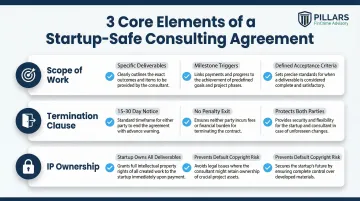
Vague language like "ongoing advisory services" is how open-ended commitments get created unintentionally.
Clean termination clause: Include a provision allowing either party to end the engagement with reasonable notice — typically 15–30 days — without penalty. This protects your startup if the engagement stalls or the consultant's focus shifts, without triggering a legal dispute.
IP and work product ownership: Specify that your startup owns all deliverables produced during the engagement. Without this clause, ownership can default to the consultant under standard copyright rules — a costly oversight for early-stage companies building proprietary processes or compliance programs.
Payment terms tied to milestones: Avoid large upfront retainers. Structure payments around defined milestones or deliverable acceptance so you retain leverage throughout the engagement.
These three elements — scope, termination, and ownership — form the backbone of any short-term consulting agreement that actually protects you.