Introduction
When a regulatory deadline hits or examiners start asking questions, fintechs, payments companies, and financial institutions need deep compliance expertise immediately—not six months from now. But the price of full-time talent makes that a hard call: the median total compensation for a Chief Compliance Officer in tech reached $770,000 in 2025, and CCOs at public companies earned $419,000 in base and bonus alone.
For organizations navigating rapid growth or regulatory scrutiny, that cost can be hard to justify. The alternative—leaving a staffing gap—carries its own risks. FinCEN found just four employees managing millions of transaction alerts at Canaccord Genuity, a lapse that ultimately cost the firm $80 million.
Finding experienced consultants on a flexible, project-based basis is entirely achievable—but results vary widely depending on how you define the need, where you look, and how you structure the engagement. This guide walks through each of those steps so you can move quickly without locking into a contract you'll regret.
Key Takeaways
- Project-based consulting works best for specific, bounded problems — not open-ended operational coverage
- Define scope, credentials, and deliverables before searching—vague briefs attract generic candidates
- The best channels are professional networks, referrals, and specialized advisory firms, not generic freelance platforms
- Use a clear Statement of Work, fixed timeline, and deliverable-based payments to keep engagements on track
- 38% of US financial institutions now outsource compliance work, driven by cost and skill gaps
How to Find Experienced Consultants Without Long-Term Contracts
Step 1: Define the Scope of Work Before You Start Searching
The most common sourcing failure starts before outreach begins—hiring managers cast too wide a net because they haven't defined what "done" looks like. A request for "AML program support" could mean anything from a policy document refresh to rebuilding transaction monitoring from scratch. Without clarity, you'll attract consultants who specialize in the wrong things or promise solutions to problems you don't actually have.
Before you reach out to anyone, answer these questions:
- Identify the root cause, not just the symptom — "our monitoring rules haven't been tuned in 18 months" rather than "our alerts are overwhelming"
- Define success as a concrete deliverable: a completed policy manual, a tuned alert model, or a passing regulatory exam
- Match credentials to the work — CAMS certification for AML engagements; fintech or payments experience for fraud prevention roles
- Set the timeline: a 4-week sprint ahead of an exam, or a 3-month program buildout?
- Specify the output format — strategy document, audit-ready program manual, gap assessment report, or hands-on system configuration
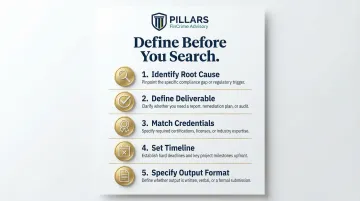
Turn vague requests into specific, scoped deliverables. "We need transaction monitoring optimization" becomes "Reduce false-positive alerts by 30% and document the tuning methodology for regulatory review within 8 weeks."
Step 2: Target the Right Sourcing Channels for Your Domain
The right sourcing channel depends on the domain. Generic freelance platforms like Upwork or Fiverr rarely surface deep domain expertise in regulated industries. A $50/hour "compliance consultant" with a generic resume won't navigate FinCEN guidance or rebuild an AML program that survives regulatory scrutiny.
High-signal sourcing channels for financial crime compliance include:
- Professional associations: ACAMS maintains a public graduate directory of over 80,000 CAMS-certified professionals across 200+ jurisdictions and a dedicated career center for anti-financial crime roles
- LinkedIn outreach to credentialed practitioners: Search for professionals with CAMS or specific regulatory experience in your vertical (fintech AML, payments fraud, sponsor bank compliance)
- Peer referrals from compliance networks: Ask your compliance peers, legal counsel, or industry contacts who they've worked with successfully
- Specialized advisory firms: Unlike generalist consultancies, firms like Pillars FinCrime Advisory operate on engagement-based models without long-term lock-in, offering fractional CCO services, transaction monitoring optimization, and audit readiness support tailored to fintechs and payments companies
For financial crime compliance work, specialized firms bring senior-level expertise with institutional accountability and structured deliverables — without the overhead of a generalist consultancy.
Step 3: Vet Candidates Efficiently Without a Lengthy RFP Process
You don't need a 40-page RFP to vet a consultant effectively. A fast, focused process will surface the right expertise faster than a lengthy procurement process.
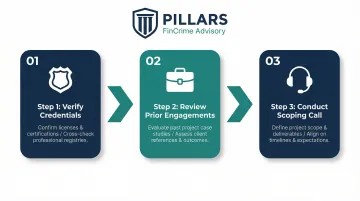
Run this three-step vetting process:
- Verify credentials and certifications: For CAMS-certified professionals, use the ACAMS verification lookup. For other credentials, confirm with the issuing body
- Request 2-3 comparable prior engagements: Not generic case studies, but specific examples where the consultant solved a problem similar to yours—ideally with similar company types (fintech vs. traditional bank matters)
- Conduct a 30-minute scoping call: Assess how quickly they grasp your problem, whether they ask the right questions, and if they communicate clearly
In regulated industries, add one more check: verify the consultant has no conflicts of interest with regulators or competing firms before sharing sensitive program details. A consultant who recently left a competitor or worked directly with your regulator may create compliance risks you can't afford.
Step 4: Structure the Engagement to Avoid Long-Term Dependency
A well-structured short-term engagement gives your organization flexibility while giving the consultant a clear picture of what success looks like.
Your engagement agreement should include:
- A Statement of Work (SOW) with specific deliverables and milestones — "deliver revised BSA policy manual and risk assessment by March 15," not "AML support"
- A fixed end date or clear exit criteria, so the engagement has a defined finish line
- Payment tied to deliverable completion rather than hourly time — this aligns incentives and prevents billing drift
- No automatic renewal or retainer obligation — ongoing support, if needed, should be a separate conversation
Organizations that skip this groundwork face scope creep and unexpected cost overruns. According to the 2024 SPI/Rocketlane Professional Services Maturity Benchmark, projects with poor scope definition experience scope creep 40% of the time and waste 25% of their budget to project failure.
When Should You Hire a Consultant Without a Long-Term Contract?
Project-based consulting isn't always the right fit. It works best for specific, bounded challenges—not ongoing operational needs that require embedded staff.
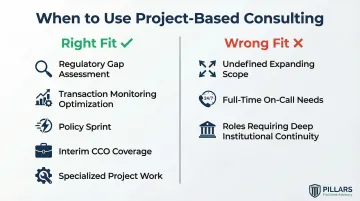
Flexible consulting is clearly the right choice when you need:
- A one-time regulatory gap assessment ahead of an exam or program audit
- Transaction monitoring optimization to reduce false positives and improve alert quality
- A policy development sprint to document your AML/BSA program before a regulatory deadline
- Interim expertise during a hiring gap while you search for a permanent CCO or BSA Officer
- Specialized project work: KYC redesign, sanctions screening optimization, or fraud model validation
Flexible consulting is the wrong fit when:
- The scope is undefined and keeps expanding — if you can't articulate what "done" looks like, you need a different engagement model
- You need someone available full-time and on-call; project consultants work on defined deliverables, not open-ended availability
- The work requires deep institutional knowledge that takes months to build — some roles need continuity that project-based arrangements can't provide
The regulatory framework also matters. The FFIEC mandates that a financial institution's board designate a qualified BSA Officer, and while operational tasks can be outsourced, the institution retains ultimate responsibility. For fractional or interim BSA Officer coverage, Pillars FinCrime Advisory provides fractional BSA Officer and CCO coverage specifically structured to satisfy that regulatory requirement — without the overhead of a full-time hire.
What to Look for When Vetting a Flexible Consultant
Credentials alone are insufficient—a CAMS certification tells you someone passed an exam, not that they can execute in a fast-moving fintech or payments environment. Focus on signals of real-world competence.
Relevant Domain Depth
Hands-on experience in your specific problem area matters far more than broad industry experience. A consultant who has actually rebuilt a transaction monitoring alert model is more valuable for that project than one who has managed compliance teams generally but never tuned rules or validated scenarios.
Look for evidence they've done the work, not just supervised it.
Track Record with Similar Organizations
A consultant's experience with large banks may not translate to fintechs or payments companies, which operate under different risk profiles, technology stacks, and regulatory timelines. A compliance leader from a top-tier bank may struggle with the resource constraints and speed requirements of a 50-person fintech.
Ask for examples from companies at your scale and stage, not just brand-name institutions.
Communication and Knowledge Transfer
A good short-term consultant should leave your organization more capable, not more dependent. Before hiring, assess whether they can:
- Explain their methodology clearly in plain language during the scoping call
- Document their work as they go—not just deliver a finished product you can't maintain
- Train your team on what was built, so the work holds up after they leave
If they can't articulate their approach upfront, the deliverables won't be any clearer.
Why These Standards Matter Now
The compliance consulting market has grown sharply—the global financial crime compliance market reached $28.6 billion in 2025 and is projected to hit $72.4 billion by 2034, driven by a 10.9% compound annual growth rate. The services segment alone—managed compliance and professional consulting—accounts for 38.7% of total revenue, or over $11 billion.
That growth means more consultants entering the market with varying levels of actual experience. In the US, 43% of financial institutions now outsource some or all compliance functionality, citing the need for additional assurance (52%), cost management (43%), and lack of in-house skills (42%). With demand this high, vetting carefully isn't optional—it's how you avoid hiring someone who looks qualified on paper but can't deliver under your conditions.

Common Mistakes When Hiring Consultants Without Long-Term Contracts
Skipping Scope Definition and Starting with a Vague Brief
Undefined deliverables are the single biggest driver of disappointment and unexpected cost overruns in short-term consulting engagements. When you hire a consultant to "help with AML," you've set yourself up for misaligned expectations, missed deadlines, and billing disputes.
Fix this up front: Write a one-page scope document before you contact anyone. Define the problem, the deliverable, the timeline, and the success criteria. Share it during the first call and make sure the consultant can commit to it.
Defaulting to the Cheapest Option in a Specialized Domain
In highly regulated fields like financial crime compliance, low rates often signal a consultant who lacks current regulatory knowledge or limited real-world implementation experience. A $75/hour "compliance expert" won't deliver the same quality as a $250/hour CAMS-certified specialist who has navigated actual FinCEN exams.
Price should reflect the complexity of the risk being managed. Underpaying for compliance expertise produces unusable deliverables — or worse, regulatory findings that a qualified specialist would have caught.
Treating the Engagement as Fully Hands-Off
Even project-based consultants need internal access, stakeholder time, and feedback loops. Without a designated internal owner, consultants stall waiting on data, approvals, and context — and the engagement produces far less than expected.
Set clear expectations before work begins:
- Assign one internal owner who can answer questions and review drafts
- Budget 5–10 hours per week of internal time, even for "outsourced" projects
- Establish a check-in cadence (weekly is usually enough) to catch misalignments early
Ignoring Knowledge Transfer and Documentation Requirements
Without clear documentation requirements, organizations end engagements holding outputs they can't maintain or defend. A transaction monitoring tuning project with no documented methodology leaves you unable to justify threshold decisions when an examiner asks.
Require the following as standard deliverables, not afterthoughts:
- Written methodology explaining all analytical decisions
- Alert threshold justifications tied to your risk appetite
- Handoff documentation the next reviewer can follow without assistance
- A brief training session for internal staff before the consultant exits
Conclusion
Finding experienced consultants without long-term contracts is highly achievable when the process starts with a clearly defined scope, targets the right sourcing channels, and structures the engagement around deliverables rather than time.
For fintechs, payments companies, and financial institutions facing regulatory pressure or program gaps, flexible advisory relationships (like those Pillars FinCrime Advisory provides) can deliver audit-ready outcomes and scalable programs without a permanent commitment.
The key is treating the engagement as a strategic project. Define what success looks like, find consultants who've solved the same problem before, and structure agreements that protect both parties. Done right, project-based consulting delivers senior-level expertise exactly when and where you need it, with none of the overhead or lock-in that comes with traditional hiring.
Frequently Asked Questions
What are the 5 C's of consulting?
The 5 C's—Clarity, Competence, Commitment, Communication, and Client focus—offer a practical lens for vetting short-term consultants. Strong candidates clarify ambiguous problems quickly, demonstrate competence through prior work, commit to defined timelines, and keep your outcomes ahead of their process.
What is the difference between a consultant and a contractor?
Consultants provide strategic advice; contractors execute defined tasks as part of an operational team. The distinction matters legally—contracting arrangements can trigger different tax obligations under IRS common-law rules, so clarify the nature of the engagement before signing.
How do you structure a short-term consulting engagement to avoid scope creep?
Use a Statement of Work with defined deliverables, a fixed timeline, and milestone-based payment rather than open-ended hourly billing. Tie payments to completed deliverables (e.g., "50% upon draft policy delivery, 50% upon final approval") to align incentives and create natural checkpoints for scope review.
How much does it typically cost to hire a consultant on a project basis?
Project-based fees vary by domain, seniority, and scope complexity. In the US, senior AML and BSA consultants typically charge $150–$400+ per hour, with daily rates for interim compliance leadership often ranging from $1,000–$2,000 depending on regulatory complexity and specialization. Fixed-project pricing is also common for well-scoped engagements.
How do you verify a consultant's credentials and experience before hiring?
Verify credentials through the issuing body—use the ACAMS CAMS verification lookup for AML certifications. Review 2-3 prior engagements with similar organizations, then run a focused 30-minute scoping call to assess problem comprehension and technical depth before committing.
When does it make more sense to hire a full-time compliance employee instead of a consultant?
Full-time hires are better suited for ongoing operational needs, continuous regulatory monitoring, and roles requiring deep institutional knowledge. If you need someone embedded in daily operations, available for ad-hoc questions, and building long-term relationships with regulators, hire full-time. For defined projects, program buildouts, or interim coverage, consultants deliver faster, more cost-effective results.