
Introduction
Sanctioned entities received $15.8 billion in cryptocurrency in 2024 — roughly 39% of all illicit crypto transactions that year, according to Chainalysis. OFAC has made its position clear: compliance obligations are identical whether a transaction is denominated in digital currency or traditional fiat. For any fintech, payment company, or financial institution touching crypto, sanctions screening software is a regulatory requirement, not optional infrastructure.
The challenge is that crypto doesn't behave like traditional finance. Transactions settle in seconds across dozens of blockchains, wallet addresses are pseudonymous, and sanctioned actors actively use mixers, cross-chain bridges, and stablecoins to obscure their activity. A generic or poorly matched screening tool won't catch what examiners are trained to look for.
This guide walks through the specific criteria compliance leaders should use when evaluating crypto sanctions screening software — from blockchain coverage and wallet screening depth to real-time alerting and examiner-ready documentation.
Key Takeaways
- Sanctioned entities received $15.8B in crypto in 2024 — OFAC treats digital currency and fiat screening obligations identically
- Multi-chain coverage, real-time list updates, and pre-transaction blocking capability are non-negotiable technical requirements
- False positive rates and alert calibration directly affect exam readiness, not just operational workload
- Your screening tool must generate examiner-ready documentation, including OFAC blocking reports within 10 business days
- A CAMS-certified advisory firm can map your risk profile to the right vendor before any purchase decision
What Is Crypto Sanctions Screening Software?
Crypto sanctions screening software automatically checks cryptocurrency wallet addresses, transaction counterparties, and entities against government-maintained sanctions lists — including OFAC's SDN List, which now includes specific digital currency address fields — to identify and block prohibited transactions before or as they occur.
OFAC confirmed this directly: sanctions compliance obligations apply equally to digital currency and fiat transactions. Any firm that facilitates or processes crypto transactions must screen for sanctioned parties. Compliance is a legal obligation, not an optional best practice.
Three Screening Functions Every Program Needs
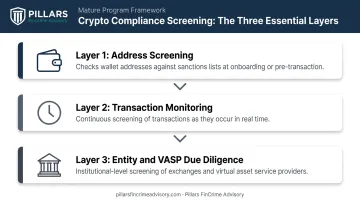
Mature compliance programs require three distinct layers:
- Address screening — checks a wallet address against sanctions lists at onboarding or before a transaction initiates
- Transaction monitoring — real-time or near-real-time screening of transactions as they occur, catching counterparties that become sanctioned after onboarding
- Entity and VASP due diligence — screens the exchanges and virtual asset service providers your organization transacts with at the institutional level
Relying on address screening alone creates a documented gap. The Kraken enforcement action is instructive: OFAC cited controls applied at onboarding but not to subsequent transactional activity, resulting in a $362,158.70 settlement plus $100,000 in required compliance investment.
Why Traditional Screening Tools Fall Short
That enforcement gap points to a broader tooling problem. Standard financial sanctions screening tools cannot parse blockchain addresses, handle multi-chain activity, or detect mixer and bridge exposure — the exact techniques sanctioned actors rely on to move funds.
The scale of the risk makes this concrete. Treasury sanctioned Tornado Cash after it laundered more than $7 billion since 2019, including $455 million stolen by the Lazarus Group from Axie Infinity's Ronin Bridge. Neither typology is detectable with a tool built for correspondent banking.
More recently, Elliptic identified A7A5 — a ruble-backed stablecoin issued on Ethereum and TRON by sanctioned Russian and Kyrgyz entities — crossing $100 billion in cumulative transactions. Again, generic screening infrastructure would miss it entirely.
Key Factors to Consider When Choosing Crypto Sanctions Screening Software
Selecting crypto sanctions screening software is a compliance architecture decision. The tool you choose affects alert quality, operational efficiency, regulatory exam readiness, and exposure to enforcement action. A high-volume payment processor and a bank just beginning to offer digital asset services have different needs — and each must match technical specifications to their specific risk profile. Six evaluation criteria determine whether a tool is fit for that purpose.
Blockchain and Asset Coverage
This is the most foundational selection criterion. A tool that covers Bitcoin and Ethereum but misses TRON, or that cannot screen stablecoin transactions, creates unscreened exposure your examiners will flag.
When evaluating vendors, ask specifically:
- Which blockchains does the tool natively support?
- Does coverage include TRON-based USDT transactions and ERC-20 tokens?
- Can the tool screen Ethereum smart contract addresses, including sanctioned mixer contracts?
- What is the vendor's roadmap for adding emerging blockchain coverage?
The A7A5 stablecoin case illustrates why this matters. The asset operated on both Ethereum and TRON. A tool covering only one chain would have missed half the exposure.
Sanctions List Coverage and Update Frequency
OFAC can add new crypto wallet addresses to the SDN List on any business day. A tool that updates its list data on a 24-hour or 48-hour delay creates a window of unscreened exposure — and regulators treat that window as a program deficiency, not an acceptable operational constraint.
At minimum, your screening tool must cover:
| List | Jurisdiction |
|---|---|
| SDN List and Consolidated Sanctions List | OFAC (U.S.) |
| EU Consolidated Financial Sanctions List | European Union |
| UK Sanctions List | OFSI (UK, replacing former OFSI Consolidated List as of January 2026) |
| UN Security Council Consolidated List | United Nations |
| Section 314(a) information sharing | FinCEN (where applicable) |
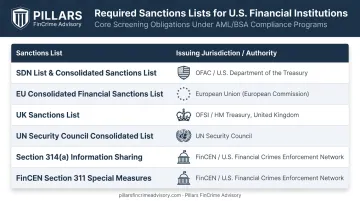
Ask vendors to provide documentation on their average list update latency. That documentation belongs in your vendor due diligence file for examiner review.
Alert Quality and False Positive Rate
A high false positive rate is not just an operational nuisance. It creates alert fatigue, drives uninvestigated queues, and increases the probability that a genuine match goes unactioned. Regulators view chronic over-alerting as a symptom of poor program design — not a sign of diligent compliance.
When evaluating vendors:
- Request false positive rate data for organizations with a similar risk profile and transaction mix
- Understand how the tool's risk-scoring methodology can be calibrated to your customer base
- Confirm whether threshold adjustments require vendor involvement or can be managed internally
- Assess whether the tool distinguishes between high-confidence and low-confidence matches before generating an alert
Real-Time Processing Capability
Batch processing is structurally insufficient for crypto. Bitcoin blocks confirm approximately every 10 minutes. Ethereum slots are 12 seconds. Solana slots run between 400 and 600 milliseconds. By the time a batch-processed alert fires on a prohibited transaction, the funds have already moved — and your ability to block the transaction has passed.
Two capabilities matter here — and they are not equivalent:
- Pre-transaction screening — the tool screens before the transaction is executed, enabling a block
- Post-transaction alerting — the tool flags after the transaction settles, enabling investigation but not prevention
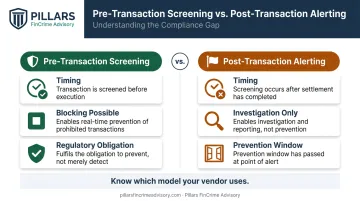
The regulatory implications differ significantly. Know which model each vendor uses, and understand whether that matches your obligation to block, not just report.
Integration, Scalability, and API Architecture
A tool with strong screening capabilities but poor integration creates operational fragility. Manual data routing, duplicate entry, and delayed alert handoffs increase human error risk and undermine the program's defensibility in an exam.
Key integration questions to ask:
- Does the tool offer a REST API with documented rate limits and uptime SLAs?
- How does the tool route alerts to your case management system?
- What happens to screening performance at 10x your current transaction volume?
- Has the vendor provided references from organizations at your scale or growth trajectory?
For fintechs and payments companies experiencing rapid growth, scalability is as important as current functionality. A tool that performs well today but degrades under volume creates a gap precisely when your regulatory exposure is growing.
Audit Trail, Reporting, and Exam Readiness
Regulatory examiners expect documented evidence of every screening decision: when an alert was generated, who reviewed it, what information was used to clear or escalate it, and how long the review took. Software that cannot produce this record creates a documentation gap — and examiners treat documentation gaps as compliance failures regardless of whether an actual violation occurred.
OFAC's reporting requirements are specific:
- Blocked virtual currency must be reported within 10 business days of the blocking event
- Annual blocked property reports are due by September 30 each year
Evaluate whether the tool's reporting module can generate these outputs directly, or whether your team will need to reconstruct records manually every time a report is due. Manual reconstruction introduces error and consumes the compliance capacity you need for actual investigations.
How Pillars FinCrime Advisory Can Help
Choosing the right crypto sanctions screening software requires more than comparing vendor feature sheets. It requires understanding how your organization's specific risk profile, transaction types, customer base, and regulatory obligations should map to a tool's technical capabilities. That's where CAMS-certified financial crime advisory expertise makes a practical difference.
Joshua Douglas and Pillars FinCrime Advisory work directly with fintech, payments, and financial institution leadership teams to assess existing compliance program gaps, define the right screening requirements for their risk appetite, and evaluate vendor solutions against regulatory expectations. The result is a defensible, exam-ready purchasing decision made before an examiner finds the gap for you.
Pillars FinCrime Advisory supports the software selection process through:
- Pre-purchase compliance gap assessments — pinpointing specific screening exposures in your current program so you enter vendor negotiations with clear requirements, not assumptions
- OFAC and FinCEN alignment — converting regulatory expectations into concrete RFP questions and diligence criteria that reflect what examiners actually evaluate
- Vendor proposal review — stress-testing technical claims against your actual transaction types, blockchain exposure, and compliance obligations
- Post-implementation alert tuning and calibration — reducing false positive rates and improving alert quality after deployment
- Exam readiness preparation — coaching compliance teams to clearly articulate screening methodology decisions and document the rationale examiners expect to see
To discuss your organization's crypto compliance program, contact Pillars FinCrime Advisory at 281-825-1603 or pillarsfincrimeadvisory@gmail.com.
Conclusion
The right crypto sanctions screening software aligns with your organization's specific blockchain exposure, transaction volumes, customer risk profile, and regulatory obligations — not the vendor with the biggest marketing budget.
Software selection is not a one-time event. Sanctions lists evolve, new blockchains gain adoption, and enforcement priorities shift. The tool that fits your program today may create gaps as your business scales.
Build screening performance review into your compliance calendar. Revisit your vendor relationship when:
- Your annual compliance program assessment reveals coverage gaps
- Your transaction mix or customer base changes significantly
- New blockchains or asset types enter your product scope
Frequently Asked Questions
What is AML compliance for crypto?
AML compliance for crypto requires virtual asset businesses and financial institutions to implement a risk-based program covering customer due diligence, transaction monitoring, sanctions screening, and suspicious activity reporting — the same obligations that apply to fiat under FinCEN and OFAC guidance.
What is crypto sanctions screening software?
It is technology that checks cryptocurrency wallet addresses, transactions, and entities against government sanctions lists — including OFAC's SDN List, which includes specific crypto address fields — to identify and block prohibited activity before or as it occurs.
Is sanctions screening legally required for crypto businesses?
Yes. OFAC has stated that compliance obligations are identical for digital currency and traditional fiat. Any U.S. person or entity subject to OFAC jurisdiction that facilitates crypto transactions must screen for sanctioned parties and block prohibited transactions.
What is the difference between address screening and transaction monitoring?
Address screening checks a wallet against sanctions lists at a specific point in time, typically at onboarding or before initiating a transaction. Transaction monitoring continuously analyzes activity in real time, catching counterparties who become sanctioned after the initial onboarding screen.
How often should crypto sanctions screening lists be updated?
OFAC can add new crypto addresses to the SDN List on any business day, so use a tool with real-time or near-real-time list updates. Delayed updates create a compliance exposure window that regulators treat as a program deficiency.
Can a single screening tool cover all blockchains?
Coverage varies significantly by vendor. Map the blockchains and token standards your customers actually use against each vendor's supported networks, paying close attention to chains linked to sanctioned activity, and request documentation of their roadmap for emerging blockchains.