Introduction
Nearly half of all startups don't make it to their fifth year. According to Bureau of Labor Statistics data, only 51.4% of private-sector establishments opened in March 2020 survived to March 2025 — meaning roughly one in two failed within five years across all industries. In regulated sectors like fintech and payments, the consequences of early mistakes are compounded by enforcement risk, partner termination, and loss of banking access.
That's where startup consultants earn their keep. For high-stakes industries, consulting isn't a luxury — it's risk management.
Most founders hesitate at the cost — understandably so. But for a fintech or payments company, a single compliance misstep can far exceed any consulting fee.
FinCEN's enforcement actions against companies like Bittrex ($29 million) and Brink's Global Services ($37 million) weren't anomalies. They were the result of programs that weren't built right from the start.
This guide covers what startup consulting actually is, which services it should include, when to hire a consultant (and when not to), and how to choose the right one for your business.
Key Takeaways
- Startup consultants provide strategic guidance, not day-to-day execution — knowing the difference prevents wasted budget
- Hire earlier than most founders expect, especially in regulated industries
- Domain-specific expertise outweighs general business credentials every time
- Good consulting pays for itself by preventing costly mistakes, delays, and regulatory failures
- Vet consultants on track record and specialization — not just credentials on paper
What Does a Startup Consultant Actually Do?
Startup consulting is the engagement of an external expert to assess your business's current state, diagnose specific challenges, and deliver structured recommendations. It's not freelance execution work, and it's not informal mentorship. Getting clear on which one you need changes what you hire for — and what you can reasonably expect.
Consulting vs. Contracting vs. Mentorship
| Role | Compensation | Deliverable | Involvement |
|---|---|---|---|
| Consultant | Project or retainer fee | Strategic recommendations | Defined scope, time-limited |
| Contractor | Hourly or project rate | Completed tasks/output | Ongoing execution |
| Mentor | Typically unpaid | Informal guidance | Relationship-based, no formal deliverable |
Choosing the wrong type of support is one of the most common founder mistakes. A consultant won't run your daily operations. A contractor won't tell you whether your strategy is wrong. A mentor won't give you a compliance framework.
How Consulting Engagements Typically Work
Most structured consulting engagements follow a predictable flow:
- Discovery and assessment — The consultant reviews your current state: operations, financials, compliance posture, or whatever the defined scope covers
- Analysis — Data and observations are synthesized to identify gaps and root causes
- Recommendations delivery — Findings are presented with prioritized, actionable guidance
- Follow-through support — Some engagements include a retainer for ongoing advisory questions after the initial recommendations phase
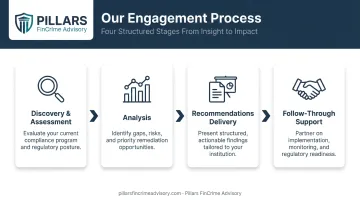
A good consultant will articulate this process clearly before you sign anything. If they can't explain their methodology upfront, that's a signal to keep looking.
Self-Diagnosing What You Actually Need
The right starting point is knowing whether you need direction or execution:
- Unclear on strategy, market fit, or regulatory requirements → consultant
- Strategy is clear but execution is stalling → contractor or operator
- Want a sounding board and long-term relationship → mentor
Misreading this doesn't just cost money — it burns time on both sides and rarely produces what either party expected.
Core Services a Startup Consulting Engagement Should Cover
Not every consulting engagement covers every service. But there are five areas where external expertise consistently delivers the most value for early-stage companies.
Idea and Market Validation
Before deploying significant capital, a good consultant will stress-test your business idea against real market conditions. This includes identifying product-market fit gaps, analyzing competitive positioning, and pressure-testing your value proposition.
CB Insights research found that 43% of failed VC-backed startups cited poor product-market fit as a primary failure factor. That's a market research and validation problem — one a consultant can surface before it becomes fatal.
Financial Modeling and Cost Planning
The same CB Insights research found that 70% of failed startups ran out of capital. Cash flow mismanagement isn't always caused by bad spending — it's often caused by unrealistic projections and unplanned costs that weren't modeled out in advance.
An experienced consultant helps founders:
- Build financial projections grounded in operational reality
- Identify budget blind spots (regulatory costs, vendor fees, staffing ramp)
- Model different growth scenarios with associated cash requirements
Operations and Process Setup
Retrofitting operational infrastructure during a growth phase is expensive and disruptive. Consultants help startups build systems that hold up under growth: HR workflows, vendor management, tech stack decisions, and workflow documentation designed to survive when headcount doubles.
Regulatory and Compliance Advisory
For fintech and payments startups, this isn't just one service among many — it's often the most consequential.
Compliance programs cannot be bolted on after the fact. Under 31 CFR 1022.210, money services businesses must implement a written AML program within 90 days of establishment. That's a regulatory clock that starts running at launch, not after your first regulatory notice.
A specialized compliance consultant helps establish:
- Governance frameworks and policy documentation
- Risk assessments and internal controls
- KYC/KYB program design
- Transaction monitoring setup and optimization
- Audit readiness documentation
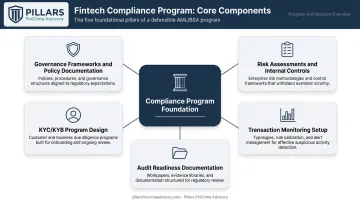
Firms like Pillars FinCrime Advisory provide this kind of full-lifecycle financial crime compliance support — from initial program design through transaction monitoring optimization and exam preparation — giving fintech and payments startups the regulatory foundation they need before problems surface.
Network and Stakeholder Access
Seasoned consultants bring professional networks that accelerate introductions to investors, strategic partners, legal advisors, and subject matter experts. For fintech founders navigating an unfamiliar regulatory environment, a warm introduction to the right compliance counsel or banking partner can shave months off the process.
Benefits of Startup Consulting — and the Honest Tradeoffs
The Real Benefits
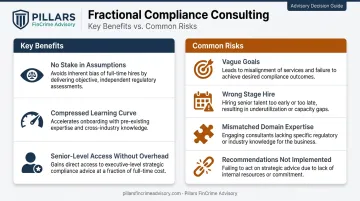
A good consultant brings three things that are genuinely hard to source internally:
- No stake in your assumptions — they'll surface blind spots and challenge weak strategies before costly decisions are locked in, something internal team members rarely do freely
- A compressed learning curve — domain experience means founders skip trial-and-error; a consultant who's navigated compliance-heavy environments before translates that knowledge into faster, more confident decisions
- Senior-level access without full-time overhead — fractional models let early-stage companies bring in a Chief Compliance Officer or seasoned strategist at a fraction of the hiring cost
As Sarah Wagner, a compliance leader at a fintech client of Pillars FinCrime Advisory, noted: it provided "exactly what we needed — senior-level expertise without the overhead."
The Honest Risks
The benefits above are real — but they depend on getting the basics right. Most consulting engagements disappoint for reasons that have nothing to do with consulting itself:
- Vague goals set at the outset with no measurable outcomes defined
- Hiring at the wrong stage, before the company is ready to act on what it hears
- Choosing someone without genuine relevant experience in the specific domain
- Receiving solid recommendations and failing to implement them
On cost: the right question isn't "can we afford this?" It's "what does this prevent, and what is that worth?" An engagement that helps avoid a regulatory fine, a failed product launch, or an operational rebuild often looks like a bargain in hindsight.
The ROI calculation depends heavily on stage, domain, and consultant quality — all of which are within your control to evaluate before signing.
When (and When Not) to Hire a Startup Consultant
Situations Where Consulting Makes Sense
You're entering unfamiliar territory with real consequences. If you're launching in a domain where getting it wrong carries material risk — regulatory enforcement, partner termination, loss of banking relationships — an expert who's navigated that environment is worth engaging before you enter it.
For fintech and payments startups, launching without a functioning compliance program is exactly this kind of situation. Enforcement actions against Evolve Bank & Trust (Federal Reserve, 2024), Thread Bank (FDIC, 2024), and Community Federal Savings Bank (OCC, 2026) all centered on compliance deficiencies in fintech partnership operations.
The problems didn't start at audit — they started at program design.
A specific function is stalled and internal fixes haven't worked. Consultants are effective at diagnosing localized problems — a broken sales funnel, a compliance gap, a weak financial model — and delivering actionable remediation plans. If your team has already attempted a fix and it hasn't held, an outside perspective often moves it forward.
Situations Where Consulting Is the Wrong Move
Skip the consultant if any of these apply:
- You need execution, not strategy. If tasks aren't getting done, you need an operator or contractor — not a 30-page recommendation document. That's a mismatch, not a solution.
- You're seeking validation, not input. Consulting only works when a founder is willing to hear findings that contradict their current plan. A good consultant will challenge your assumptions. If that's not what you want, save the fee.
- The scope is too vague to scope. If you can't articulate the problem you're hiring for, the engagement will drift. Start with an internal diagnosis before bringing in outside help.
How to Choose the Right Startup Consultant for Your Business
Prioritize Practitioner Experience Over Credentials
The most effective consultants have personally navigated the environment they're advising on — whether that's founding a company, running compliance programs, or operating in a specific regulated industry.
Be cautious of consultants whose credibility rests entirely on a name-brand employer rather than documented outcomes. For fintech and payments companies, look for domain-specific credentials like CAMS certification — recognized as the global AML competency benchmark in more than 180 countries — as evidence of genuine subject matter expertise. A general business consultant cannot provide the regulatory guidance a CAMS-certified specialist can.
Evaluate Track Record with Specificity
Ask for examples of engagements similar to yours. Talk to past clients if possible. Look for evidence that their recommendations produced measurable results.
A consultant who can't point to concrete outcomes is a red flag regardless of how impressive the bio reads. Ask for specifics — improved alert quality, regulatory exam passage, a successful product launch. Those outcomes tell you far more than broad claims about "helping companies grow."
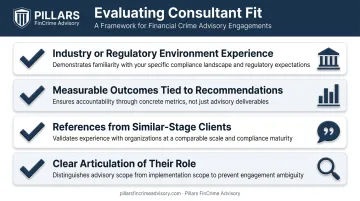
When evaluating fit, look for evidence of:
- Engagements in your industry or regulatory environment
- Measurable outcomes tied to their recommendations
- References from clients at a similar stage or risk profile
- Clear articulation of what they did (not just what happened)
Assess Communication Fit and Process Clarity
A good consultant explains their engagement process before you sign anything. They communicate findings in plain language — not jargon-heavy reports that require a translator. And they demonstrate genuine interest in your specific situation rather than applying a generic framework.
This is especially important when the work involves translating complex regulatory requirements into business decisions. If a consultant can't explain compliance expectations in terms a non-lawyer can act on, that gap will show up in every deliverable they produce.
Frequently Asked Questions
What does a startup consultant do?
A startup consultant assesses your current strategy, operations, or specific challenges, then delivers targeted recommendations to support better decision-making. The focus is high-level guidance and structured deliverables — not day-to-day task execution.
Is $100 an hour good for consulting?
Rates vary widely based on domain expertise, experience, and engagement scope. Specialized consultants advising in regulated industries like fintech compliance typically charge more, and those rates reflect the cost of the mistakes they help prevent. Hourly rate alone is a poor measure of value.
When should a fintech startup hire a compliance consultant?
Before launching, not after receiving a regulatory notice. Under federal rules, money services businesses must implement a written AML program within 90 days of establishment. Building a compliant foundation early is far less expensive than remediating deficiencies under examiner scrutiny.
What's the difference between a startup consultant and a business mentor?
A consultant is engaged for a defined scope, is compensated, and delivers structured recommendations. A mentor provides informal, ongoing guidance without a formal deliverable or financial arrangement. Both are useful, but for different stages and needs.
How do I know if a startup consultant is worth the investment?
Measure ROI against the cost of the problem being solved. If the engagement prevents a regulatory fine, a failed product launch, or an operational rebuild, the value typically exceeds the fee. Clear goal-setting before engagement begins is what makes that measurement possible.
What should I look for when hiring a startup consultant for a fintech or payments company?
Prioritize verifiable regulatory experience, industry-specific credentials like CAMS certification for financial crime compliance, and a demonstrated track record with companies at a similar stage and risk profile. General business experience is not a substitute for domain expertise in a regulated environment.