Introduction
Most startups don't fail because the idea was wrong. They fail because of execution gaps: strategic blind spots, operational missteps, or regulatory oversights that quietly compound over time. According to CB Insights, poor product-market fit accounts for 43% of startup failures, bad timing for 29%, and unsustainable unit economics for 19%. None of these are problems a great idea alone can prevent.
That's where startup consulting firms come in. They give early-stage teams access to expertise they can't afford to keep on payroll full-time: market strategists, compliance specialists, technology architects, and growth advisors who've navigated these exact problems before.
The stakes are highest for startups in regulated industries. A fintech or payments company that skips compliance consulting doesn't just risk fines — it risks losing licenses, failing investor due diligence, and shutting down entirely.
This list covers 10 of the top startup consulting firms, from global strategy powerhouses to boutique specialists. Each was selected based on demonstrated expertise, service depth, industry relevance, and client outcomes — not reputation alone.
Key Takeaways
- Startup consulting firms fill expertise gaps founders can't cover internally, from fundraising strategy to regulatory compliance.
- The best fit depends on your industry, stage, and the specific problem you need to solve — not just brand recognition.
- General consulting giants offer broad reach; boutique firms deliver targeted, domain-specific outcomes.
- Fintech and payments startups face AML, BSA, and KYC obligations that general consultants aren't equipped to handle — and getting it wrong affects licensing, investor readiness, and survival.
What Is Startup Consulting and Why Does It Matter?
Startup consulting means bringing in specialized external advisors — to solve high-stakes problems that founders lack the bandwidth or expertise to address internally. That might mean preparing for a Series A, entering a new market, or building out a compliance program before a regulator asks why you don't have one.
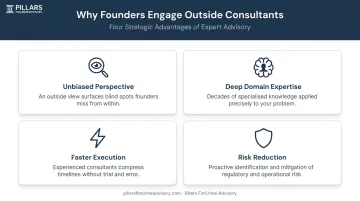
Founders typically seek outside consulting for four reasons:
- Unbiased perspective — External advisors aren't invested in protecting internal decisions
- Deep domain expertise — Access to specialists without full-time hiring costs
- Faster execution — Consultants who've solved the same problem a dozen times move faster than a team figuring it out for the first time
- Risk reduction — Avoiding costly mistakes is often worth more than the consulting fee itself
For regulated startups — fintechs, payments companies, money service businesses — the calculus is different. Compliance consulting isn't a nice-to-have. State regulators issued an $80 million penalty against Block/Cash App in 2025 for BSA/AML violations. FinCEN assessed $100 million against BitMEX in 2021 for similar failures. Getting compliance wrong early creates problems that are exponentially harder and more expensive to fix later.
The 10 firms below were selected to reflect that range — from general strategy and growth to technology and specialized financial crime compliance — so founders can identify the right type of partner for their specific challenge.
Top 10 Startup Business Consulting Firms
These firms were selected for demonstrated expertise, service depth, industry relevance, and ability to address real startup challenges across different growth stages.
1. GrowthRocks
London-based GrowthRocks specializes in growth hacking and data-driven marketing for early-stage startups across SaaS, eCommerce, and B2B markets. The firm built its own SaaS product — Viral Loops, a template-based viral marketing platform — which gives them founder-side credibility that pure advisory firms can't replicate.
| Category | Details |
|---|---|
| Key Services | Growth hacking, SEO, conversion rate optimization, product-led growth, paid advertising |
| Best For | Early-stage SaaS, eCommerce, and B2B startups seeking rapid user acquisition |
| Notable Differentiator | Built Viral Loops, their own SaaS product — advisors who've shipped products, not just advised on them |
2. L.E.K. Consulting
L.E.K. is a global management consulting firm with 2,300+ professionals across 27 locations in 16 countries. Its evidence-based philosophy — rigorous research, benchmarking, and financial modeling — makes it particularly useful for startups that need data-backed analysis to support investor conversations or strategic pivots rather than opinion-led recommendations.
| Category | Details |
|---|---|
| Key Services | Market strategy, pricing strategy, competitive benchmarking, sales force effectiveness |
| Best For | Startups in healthcare, financial services, and technology seeking research-backed strategic direction |
| Notable Differentiator | Analytical rigor applied to complex, first-of-kind business challenges — not templated frameworks |
3. IBM Garage
IBM Garage is IBM's collaborative engagement model for digital transformation, combining design thinking, Agile/DevOps methodology, and hybrid cloud and AI integration to move organizations from idea to MVP. More than 500 enterprises have used the Garage model globally.
| Category | Details |
|---|---|
| Key Services | MVP launch and testing, AI and cloud integration, digital product co-creation, business automation |
| Best For | Tech-forward startups needing to build and deploy scalable digital products |
| Notable Differentiator | IBM's full technical stack applied at startup speed through a co-creation model |
4. Bain & Company
Founded in 1973 and headquartered in Boston, Bain is one of the most recognized strategy consulting firms globally. Its Venture Capital as a Service (VCaaS) offering is genuinely unusual: Bain acts as the VC arm of a company — providing consultants, sector expertise, and startup/investor ecosystem access — while clients retain full fund strategy and investment decision control.
| Category | Details |
|---|---|
| Key Services | Growth strategy, VCaaS, ecosystem mapping, Digital Innovation Hubs, operational model development |
| Best For | Funded startups and pre-IPO companies seeking institutional-grade strategic guidance and investor network access |
| Notable Differentiator | VCaaS model lets clients access Bain's VC network without giving up strategic control |
5. Deloitte Catalyst
Deloitte Catalyst bridges innovative startups and large enterprises, with verified operations in Israel and global hubs including Silicon Valley, New York, and London. The program provides end-to-end incubation support — from audit and tax to government incentives, M&A advisory, and strategy validation — through Deloitte's worldwide network.
| Category | Details |
|---|---|
| Key Services | Strategic planning, financial resilience consulting, M&A advisory, government incentives, fundraising support |
| Best For | Growth-stage startups seeking enterprise partnerships, regulatory compliance, and capital through one network |
| Notable Differentiator | Global ecosystem access with localized delivery; strong track record connecting startups with enterprise clients |

6. Accenture Ventures
Accenture Ventures manages a $250 million fund with 70+ active venture investments, connecting emerging technology companies with the Global 2000 through its Project Spotlight program. Rather than purely advisory support, Project Spotlight gives portfolio startups direct access to Accenture's internal domain expertise and enterprise client base — making it an active market-entry channel.
| Category | Details |
|---|---|
| Key Services | Startup-enterprise matchmaking, strategic innovation consulting, technology scaling, go-to-market support |
| Best For | High-growth startups addressing enterprise innovation gaps and seeking Fortune 500 client exposure |
| Notable Differentiator | Dual role as investor and consultant; startups gain enterprise access, not just strategic advice |
7. Ernst & Young (EY)
EY is one of the largest professional services firms globally with 400,000 people across assurance, consulting, strategy, transactions, and tax. Its fintech and ecosystems practice specifically supports startup and scale-up fintech companies alongside financial institutions — covering digital transformation, regulatory compliance, and growth strategy under one roof.
| Category | Details |
|---|---|
| Key Services | Digital strategy, regulatory compliance, financial services advisory, tax strategy, assurance |
| Best For | Startups in financial services, health sciences, and technology needing a globally recognized advisory partner |
| Notable Differentiator | Compliance, tax strategy, and growth consulting integrated across one global organization |
8. ScienceSoft
ScienceSoft is a McKinney, Texas-based software development and IT consulting firm that has operated since 1989 and delivered 4,000+ projects. Its MVP services page commits to clickable prototypes in 2–4 weeks and market-ready MVPs in 2–6 months. The firm holds ISO 9001, ISO/IEC 27001, ISO/IEC 27701, and ISO 13485 certifications — giving startups a credible technical foundation for investor due diligence and regulatory audits. Rated 4.8 on Clutch across 42 verified reviews.
| Category | Details |
|---|---|
| Key Services | MVP development, software consulting, cloud application development, data analytics, custom engineering |
| Best For | Tech startups needing investor-ready prototypes or a first scalable software product |
| Notable Differentiator | ISO-certified quality assurance with startup-speed delivery timelines |
9. Booz Allen Hamilton
Booz Allen Hamilton, founded in 1914 and headquartered in McLean, Virginia, employs approximately 32,500 people. The firm is deeply embedded in defense, intelligence, energy, space, and civil government sectors — making it a strong fit for startups in government-adjacent or defense-related industries where sector relationships and security clearances matter.
| Category | Details |
|---|---|
| Key Services | Strategic consulting, advanced analytics, change management, organizational design, resource management |
| Best For | Startups in defense, government-adjacent industries, or regulated sectors requiring sector-specific expertise |
| Notable Differentiator | 110-year operational history in national security and government sectors; relationships that boutique firms can't replicate |
10. Pillars FinCrime Advisory
Pillars FinCrime Advisory is a Houston-based boutique advisory firm founded by Joshua Douglas — a CAMS-certified compliance professional with 12+ years in financial crime and nearly 20 years across financial services. Pillars serves fintech, payments, and financial institution clients nationwide with one specific focus: financial crime compliance, built right from the start.
Unlike the generalist firms on this list, Pillars works exclusively in AML, BSA, KYC/KYB, transaction monitoring, and related compliance disciplines. Every engagement draws on deep regulatory experience — not generalists assigned to a compliance project.
The fractional CCO/BSA Officer service is particularly valuable for early-stage companies. Clients get senior-level compliance leadership with direct access to Joshua Douglas, without the cost of a full-time executive hire. Scope covers policy development, risk assessments, audit readiness, and sponsor bank representation.
| Category | Details |
|---|---|
| Key Services | AML program development, transaction monitoring optimization, KYC/KYB program design, audit readiness, fractional CCO/BSA Officer, sponsor bank representation, fraud risk management |
| Best For | Fintech startups, payments companies, and financial institutions navigating AML/BSA compliance, regulatory scrutiny, and exam preparation |
| Notable Differentiator | CAMS-certified advisor with direct C-suite and board engagement — no intermediary layers, no junior staff handoffs |

How We Chose the Best Startup Consulting Firms
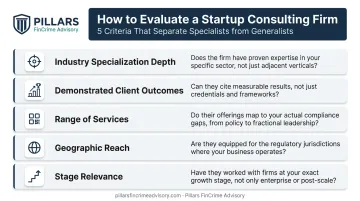
Each firm on this list was evaluated against five criteria:
- Industry specialization depth — Does the firm have genuine expertise in the sectors it claims to serve?
- Demonstrated client outcomes — Can they point to specific, measurable results?
- Range of services — Do they address the full problem or just one piece of it?
- Geographic reach — Can they serve clients where they operate?
- Stage relevance — Are their services priced, scoped, and structured for startups?
The most common mistake founders make is selecting a consulting firm based on brand name alone. A globally recognized firm may have limited experience with your specific industry or regulatory environment — and at the early stage, the wrong advice is worse than no advice at all.
Firm size is not a proxy for quality. A boutique specialist with deep domain expertise (like a financial crime compliance advisor embedded in the fintech space) delivers more targeted outcomes than a large generalist firm that treats compliance as one of a hundred service lines. The better questions to ask: Has this firm solved this exact problem before? And who will actually be working on your engagement?
Conclusion
The startup consulting landscape runs from global giants with thousands of employees and century-long track records to boutique specialists who work with a narrow set of clients on a narrow set of problems — and do it exceptionally well. Neither extreme is universally better. The right fit depends entirely on your startup's stage, industry, and the specific gap you're trying to close.
When evaluating any firm, keep three things front of mind:
- Prioritize fit over reputation
- Confirm which consultant will personally lead your engagement
- Ask for examples of measurable outcomes from clients at your same stage
If financial crime compliance is your gap, Pillars FinCrime Advisory provides CAMS-certified, hands-on advisory support to fintechs, payments companies, and financial institutions — covering AML program development, transaction monitoring optimization, audit readiness, and fractional compliance leadership.
Reach out to Joshua Douglas directly at 281-825-1603 or pillarsfincrimeadvisory@gmail.com to discuss where your program stands and how to move it forward.
Frequently Asked Questions
What is startup consulting?
Startup consulting means bringing in specialized external advisors — on a project or retainer basis — to solve challenges founders lack the expertise or bandwidth to handle internally. Engagements are scoped around a defined problem and deliverable, not open-ended advisory relationships.
When should a startup hire a consulting firm?
The right time is when a startup faces a high-stakes challenge outside the founding team's core competency — entering a regulated market, preparing for a funding round, or building a compliance program from scratch. If the cost of getting it wrong outweighs the cost of outside expertise, bring in a specialist.
How much does startup consulting typically cost?
Pricing structures vary — hourly, project-based, and monthly retainers are all common. Clutch's marketplace data shows rates starting around $25–$49 per hour, though specialized compliance and strategy firms charge considerably more based on scope and seniority. Always confirm who will do the work and what the deliverables are before signing.
What is the difference between a startup consultant and a business advisor?
Consultants are engaged for defined deliverables — a strategy document, a remediation plan, an MVP — and charge fees for their work. Advisors or mentors typically provide ongoing guidance, often informally, and may receive equity or no compensation at all. The accountability structures are different: consultants are contractually committed to outcomes, advisors are not.
Do fintech startups need a specialized consulting firm?
Yes. Regulated industries like fintech and payments carry AML, BSA, and KYC obligations that general business consultants are not equipped to address. Mishandling these requirements can result in civil penalties, licensing issues, and failed regulatory exams — risks no amount of general strategy advice can prevent. Specialized financial crime advisory is the only reliable path forward.
How do I evaluate whether a startup consulting firm is the right fit?
Check the firm's direct experience in your industry and startup stage, and confirm who will personally lead the engagement — not just who pitched you. Ask for specific, measurable examples of outcomes delivered for clients at a comparable stage and regulatory environment.