ACH debits appeared as a fraud vector for 34% of organizations hit by business email compromise in 2025, up from 26% the year before, according to AFP's 2026 Payments Fraud and Control Survey. Overall, 30% of organizations reported ACH-debit fraud exposure last year.
For fintechs, payments companies, and financial institutions, this isn't just a loss-prevention issue. Examiners now expect documented, risk-based fraud controls, and Nacha's 2026 Fraud Monitoring Rule makes that expectation binding.
This guide covers the common fraud types draining ACH programs, the warning signs that precede losses, and the layered controls that actually work, including what the 2026 rule requires and when.
Key Takeaways
- ACH fraud stems from three root causes: social engineering, account compromise, and governance gaps
- BEC/vendor impersonation, account takeover, and weak authorization practices drive most losses
- Real-time monitoring, dual controls, MFA, and independent verification form the core defense
- Nacha's 2026 Fraud Monitoring Rule phases in March 20 and June 19, mandating risk-based detection
- Recurring audits, training, and documentation separate durable programs from reactive ones
Common Types of ACH Fraud Targeting Businesses and Financial Institutions
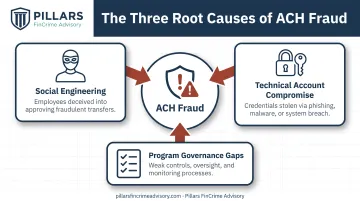
ACH fraud is the unauthorized or fraudulently induced use of the ACH network to move funds. It almost always traces back to one of three root issues:
- Social engineering — tricking a human into authorizing a payment
- Technical account compromise — stealing credentials to access systems directly
- Program governance gaps — weak onboarding, monitoring, or authorization controls that let fraud slip through
Business Email Compromise & Vendor/Payroll Impersonation
Criminals spoof or hack executive, vendor, or HR email accounts, then send a payment-change request that looks completely routine.
A common vendor scenario: an invoice is due Friday, and Thursday afternoon an email arrives from "accounting@vendor.com" (one letter off from the real domain) asking to update the bank account for future payments.
Payroll variants look just as routine. HR gets a message that appears to come from an employee, requesting a direct-deposit change right before payday.
The timing is deliberate. It exploits normal business urgency to bypass scrutiny.
Account Takeover Fraud
Criminals steal online banking credentials through phishing, malware, or credential stuffing, then use that access to initiate or redirect ACH transactions directly.
Reports of account takeover fraud increased more than 36% in 2024 compared to 2023, based on Suspicious Activity Reports filed with FinCEN, according to Federal Reserve Financial Services.
The Fed flags credential stuffing, targeted phishing using breached data, and AI-enabled impersonation—including deepfakes—as the leading methods.
When account takeover involves ACH specifically, FinCEN instructs institutions to note it on the SAR as "account takeover fraud - ACH."
Unauthorized Debits & Weak Consumer Authorization Controls
Missing or poorly documented authorizations create a direct path to unauthorized debit disputes. This shows up in two return codes:
- R10 — the receiver says the originator isn't authorized to debit their account
- R11 — the entry doesn't match the terms of the authorization
For R11 returns specifically, the RDFI must obtain a signed Written Statement of Unauthorized Debit (WSUD), and the extended return window runs 60 days.
Scenario: A recurring-billing originator notices unauthorized return rates creeping upward. The root cause is thin consent documentation, meaning no clear proof the customer agreed to recurring debits under the current terms. Each dispute chips away at the originator's standing with their ODFI.
Inadequate Originator & Third-Party Sender Due Diligence
ODFIs and third-party senders sometimes onboard high-risk originators, or nested TPS relationships, without proper underwriting, background checks, or exposure limits.
Nacha scrutinizes originators exceeding specific thresholds:
| Return Type | Threshold |
|---|---|
| Unauthorized (R05, R07, R10, R11, R29, R51) | 0.5% |
| Administrative (R02, R03, R04) | 3.0% |
| Overall returns | 15.0% |
Source: Nacha ACH Network Risk and Enforcement Topics
Scenario: An originator's unauthorized return rate climbs past 0.5% over several months. Without active monitoring, that signal, which often points to undetected fraud, goes unnoticed until Nacha or the ODFI flags it during a review.
OCC guidance is direct on this point: management should implement underwriting standards for every originator, including background checks, business-legitimacy validation, credit analysis, and exposure limits, per OCC Bulletin 2006-39.
What Happens If ACH Fraud Risk Is Ignored
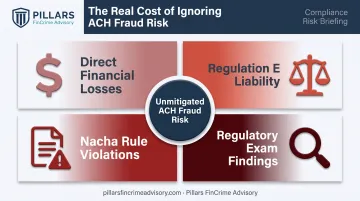
Ignoring ACH fraud risk creates exposure on four fronts at once:
- Direct financial losses from fraudulent transactions that go undetected until settlement
- Regulation E liability for consumer accounts, including provisional credit obligations
- Nacha rule violations tied to excessive return rates, which can trigger fines
- Regulatory exam findings that flag weak fraud controls as a program deficiency
ACH fraud represented 9% of aggregate fraud losses in 2024 among financial institutions surveyed by the Federal Reserve, according to ABA Banking Journal's coverage.
For consumer accounts, the clock starts ticking the moment a customer reports an unauthorized transfer. Under 12 CFR 1005.11, institutions generally have 10 business days to investigate. If more time is needed (up to 45 days), they must issue provisional credit within that initial 10-day window and notify the consumer within two business days.
Early Warning Signs of ACH Fraud
Those liabilities escalate quickly when fraud goes unnoticed. Early indicators give institutions a chance to intervene before losses compound.
- Return rate spikes — unauthorized returns exceeding Nacha's 0.5% threshold, signaling a fraud pattern rather than isolated disputes
- Unexpected banking-detail change requests — vendor or employee emails asking to update direct deposit or payment routing, especially when framed as urgent
- Anomalous transaction patterns — volume, timing, or geographic activity that doesn't match an originator's established profile
None of these signs alone confirms fraud. Together, they're a pattern worth investigating immediately.
How to Prevent ACH Fraud: Core Risk Mitigation Strategies
Effective ACH fraud prevention layers technology, governance, and human awareness. No single control carries the full load.
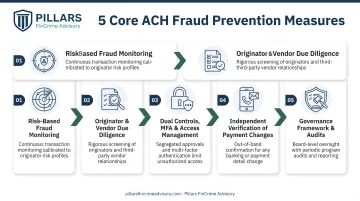
Prevention Measure 1: Implement Risk-Based Fraud Monitoring
Real-time transaction monitoring tied to established behavioral baselines catches atypical activity before settlement, not after.
This directly satisfies Nacha's 2026 Fraud Monitoring Rule, which requires originating-side participants to implement role-relevant, risk-based processes for identifying suspicious entries. RDFIs face the same obligation for incoming credits. Processes must be reviewed at least annually.
Prevention Measure 2: Strengthen Originator & Vendor Due Diligence
KYC/CDD, background checks, and credit exposure limits for originators and third-party senders block high-risk relationships before they ever touch the network.
Per OCC guidance, a thorough underwriting program includes:
- Business legitimacy validation and tax-ID documentation
- Credit and financial analysis
- Exposure limits with over-limit approval procedures
- Termination procedures and audit rights
Prevention Measure 3: Enforce Dual Controls, MFA & Access Management
Requiring multi-person approval for ACH file releases, plus MFA for banking system access, removes the single points of failure that make account takeover and internal fraud possible.
If one compromised credential can move funds, the control has already failed. Dual controls force a second set of eyes before money leaves.
Prevention Measure 4: Verify Payment Changes Through Independent Channels
Mandate out-of-band verification, meaning a phone call to a known, previously verified number, for any vendor or payroll banking-detail change request.
This is the single most effective counter to BEC and vendor impersonation. It's also the cheapest control on this list; it costs nothing but a five-minute phone call.
Prevention Measure 5: Build a Governance Framework with Regular Audits & Expert Oversight
Board-reported ACH risk policies, annual Nacha compliance audits, and documented incident response plans turn ad hoc controls into a defensible program.
Many fintechs and payments companies build this governance layer with outside expertise. Pillars FinCrime Advisory helps those teams structure fraud risk management around the GAO's five-component framework:
- Governance
- Risk assessment
- Control activities
- Investigation and corrective action
- Monitoring
That support covers risk assessments, transaction monitoring optimization, and audit readiness so compliance leaders can put a program in front of examiners that holds up under scrutiny.
Tips for Long-Term ACH Fraud Prevention and Control
Building the controls is step one. Keeping them effective as volumes grow requires ongoing discipline.
- Reassess routinely: Update originator risk ratings and transaction thresholds as volumes and risk profiles shift
- Train continuously: Run recurring phishing simulations and refresh staff training as fraud tactics evolve
- Document everything: Keep audit trails of authorizations, monitoring alerts, and remediation actions for examiner readiness
- Track rule changes: Monitor Nacha updates and the 2026 fraud monitoring phases so baseline controls keep pace with industry expectations
Programs that treat these as one-time projects fall behind quickly. Fraud tactics shift; static controls don't.
Conclusion
ACH fraud has identifiable, preventable root causes, whether they're social engineering, technical compromise, or governance gaps. Map those causes to specific controls and you can stop most losses before they hit the ledger.
Layered controls—real-time monitoring, dual approval, independent verification, and strong governance—cut direct losses. Aligning those controls to NACHA's 2026 rule also reduces the risk of adverse exam findings.
Organizations building a scalable, audit-ready ACH fraud risk program don't have to do it alone. Pillars FinCrime Advisory, founded by CAMS-certified compliance expert Joshua Douglas, brings 12+ years of financial crime experience to help fintechs, payments companies, and financial institutions design programs that scale with growth and stand up to examiner scrutiny.
Frequently Asked Questions
What is ACH fraud?
ACH fraud is the unauthorized or fraudulently induced use of the ACH network to move funds. It includes account takeover, business email compromise, and unauthorized debits stemming from weak authorization controls.
How can businesses protect against ACH fraud?
Combine real-time transaction monitoring, dual controls and MFA, independent verification of payment-detail changes, and ongoing staff training. Layering these controls closes gaps that any single measure would miss.
What are the risks associated with ACH payments?
ACH participants face credit risk (originator default), compliance risk (Nacha rule violations), operational risk (processing errors), and fraud risk (unauthorized transactions). Each risk type needs its own controls—not a one-size-fits-all fix.
Who is liable for unauthorized ACH transactions?
Under Regulation E, consumer liability is capped based on how quickly the fraud is reported. On the network side, the ODFI provides the authorization warranty, and RDFIs must obtain a signed WSUD before returning unauthorized debits.
What is Nacha's 2026 Fraud Monitoring Rule?
It requires risk-based fraud detection processes for ODFIs, originators, and TPSPs. Phase 1 takes effect March 20, 2026, for higher-volume participants; Phase 2 on June 19, 2026, extends the requirement to everyone else.
How is ACH fraud different from wire fraud?
ACH transactions can be reversed within limited windows for specific errors, and processing typically spans one to two business days. Wire transfers settle in real time and are final and irrevocable once processed, leaving far less room to recover stolen funds.