
Demand for this kind of outsourced expertise keeps climbing. A 2023 survey highlighted by Compliance Week found that three out of four financial institutions that outsourced portions of their financial crime compliance work were satisfied with the results. That's a sign fractional compliance leadership isn't a stopgap anymore. It's a legitimate long-term strategy.
Fractional CCO pricing, though, is anything but standardized. Costs swing widely based on your regulatory risk profile, how mature your compliance program already is, your company's size, and whether you need advisory guidance or hands-on remediation. This 2026 guide breaks down what fractional CCOs typically charge, what pushes those numbers up or down, what's included at each price point, and how to budget correctly.
Key Takeaways
- Fractional CCO retainers typically run $2,500 to $35,000+ per month, depending on complexity and scope
- Regulatory risk, program maturity, and remediation needs drive cost more than raw hours worked
- Early-stage fintechs pay far less than multi-state MSBs or bank-partner programs facing exam prep
- Cutting corners on compliance leadership often costs more later in fines or lost banking relationships
- A CAMS-certified financial crime specialist costs more than a generalist, and usually pays off in stronger exam and remediation outcomes
How Much Does a Fractional CCO Cost? (Pricing Overview)
Unlike a full-time CCO salary, which follows predictable bands, fractional CCO pricing depends on three variables: hours committed, regulatory exposure, and whether the work is advisory or hands-on program building. Two companies the same size can pay very different rates depending on their licensing footprint alone.
Misjudging this gets expensive fast. Common mistakes include:
- Underbudgeting for exam prep, then scrambling once a regulator sets a date
- Hiring a compliance generalist instead of a CAMS-certified financial crime specialist
- Getting blindsided by remediation costs after an examination finding
Use the ranges below as a starting point, then adjust for your licensing footprint and how hands-on the work needs to be.
Typical Cost Ranges
| Engagement Type | Typical Monthly Cost | Hourly Equivalent |
|---|---|---|
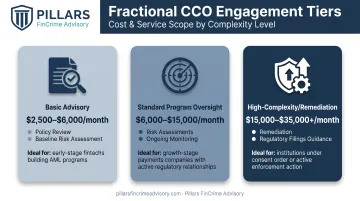
| Basic advisory retainer | $2,500 – $6,000 | $150 – $250/hour |
| Standard program oversight | $6,000 – $15,000 | $200 – $300/hour |
| High-complexity/remediation | $15,000 – $35,000+ | $250 – $400+/hour |
These ranges cover advisory hours, policy review, and board reporting. They usually exclude transaction monitoring software, outside counsel, and independent testing or audit fees — costs that get layered on top.
Basic Advisory Retainer ($2,500 – $6,000/month)
Typically included: periodic policy review, light board or leadership guidance, occasional regulatory Q&A.
Best for: early-stage fintechs or MSBs with a lean compliance function and low transaction complexity.
Standard Program Oversight ($6,000 – $15,000/month)
Typically included: ongoing risk assessments, transaction monitoring tuning oversight, SAR/CTR quality review, staff training.
Best for: growth-stage fintechs and payments companies scaling volume and adding new products or markets.
High-Complexity / Remediation Engagement ($15,000 – $35,000+/month)
Typically included: consent order or MRA remediation, hands-on program rebuild, regulator liaison, intensive exam preparation.
Best for: companies facing regulatory findings, preparing for a bank partnership review, or going through an acquisition or licensing process.
Key Factors That Affect the Cost of a Fractional CCO
Pricing isn't just about hours on a timesheet. It reflects regulatory risk exposure, operational complexity, and how much strategic depth the engagement actually requires.
Regulatory Risk Profile & Industry
- MSBs, payments processors, and bank-sponsored fintechs each face different scrutiny under BSA/AML, OFAC, and state money transmitter licensing rules
- Third-party payment processors aren't directly subject to BSA requirements, but sponsor banks must monitor and audit them closely, which raises the compliance workload around them
- Higher-risk verticals like crypto and cross-border payments generally demand more specialized expertise, pushing fees toward the higher end of the range
Program Maturity, Scope & Complexity
A company with an established program needs light oversight. One recovering from a finding needs a rebuild. Remediation work such as updating policies, correcting monitoring gaps, and backfiling missed SARs significantly increases monthly cost.
Consider FinCEN's 2024 consent order against TD Bank, which required a four-year independent monitor and a multi-year SAR lookback stretching back to 2018. Few companies face that scale of remediation, but it shows how far scope can expand beyond routine oversight.
Engagement depth drives cost just as hard. A few advisory hours per month costs far less than a near full-time embedded role. Billing structure matters too: hourly, monthly retainer, or project-based work (such as an exam response) each affects total spend differently.
More products, more state licenses, higher transaction volume, and riskier customer segments all add workload. One-time engagements, like a new product launch risk assessment, are typically priced separately from continuous oversight.
Credentials & Provider Type
CAMS certification, prior regulatory examiner experience, and specialized financial crime expertise command premium pricing over a general compliance consultant. Hiring a specialist upfront usually reduces rework later. A generalist who misses a red flag can cost far more than their hourly rate suggests.
A solo freelance fractional CCO may charge less per hour but has limited bench strength during surge periods like exam season. Boutique advisory firms offering full lifecycle support, from policy development through audit readiness, price differently but provide continuity if your main point of contact is unavailable.
Cost Breakdown: What's Included in a Fractional CCO Engagement
The retainer's sticker price often doesn't reflect the full cost of running a complete compliance program. Here's how the pieces typically break down.
| Component | Billing Type | What It Covers |
|---|---|---|
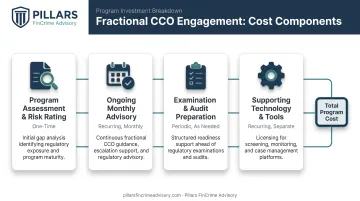
| Program Assessment & Risk Rating | One-time | Gap analysis, risk assessment, and roadmap (usually billed separate from the retainer) |
| Ongoing Monthly Advisory/Oversight | Recurring | Governance meetings, policy updates, monitoring oversight, board/investor reporting |
| Examination & Audit Preparation | Periodic | Pre-exam or audit support, often at a premium or as a separate project fee |
| Supporting Technology & Tools | Recurring, separate | Monitoring systems, case management, and training platforms billed outside the CCO fee |
Budget for all four categories, not just the recurring retainer. Companies that only plan for monthly oversight often get caught off guard when exam season or a new product launch triggers a separate project fee.
Fractional CCO vs. Full-Time CCO vs. Other Compliance Support
Many companies default to either a full-time hire or a generalist consultant without weighing a third option: a specialized fractional CCO.
| Factor | Fractional CCO | Full-Time CCO | Generalist Consultant |
|---|---|---|---|
| Cost structure | Monthly retainer | Salary, benefits, and equity | Project or hourly fees |
| Financial crime depth | Specialized | Varies by hire | Often limited |
| Engagement model | Part-time executive leadership | Daily dedicated oversight | Scoped, deliverable-based work |
| Best fit | Scaling fintechs, payments firms, mid-market FIs | High volume, multi-state, or consent-order programs | One-off policy or checkbox work |
The Cost Gap
BarkerGilmore's 2025 Chief Compliance Officer Compensation Report, based on nearly 300 CCOs, found median total cash compensation reached $419,000 at public companies and $299,541 at private companies, before benefits or equity.
Even a high-complexity fractional retainer ($15,000–$35,000/month) rarely approaches that annualized figure. The gap narrows during intensive remediation work, but it rarely disappears.
Where Generalists Fall Short
General compliance consultants or CPA firms offering "compliance services" often lack financial crime specialization, examiner experience, or the ability to build a program that scales. They may produce a policy document but miss the operational nuance a bank partner or examiner expects in practice.
Specialized Fractional Advisory
Firms like Pillars FinCrime Advisory fill that gap with financial crime–focused fractional leadership instead of a generalist add-on. Support typically covers the full program lifecycle:
- Policy development and risk assessments
- Transaction monitoring optimization
- Audit and exam readiness
You get specialized, end-to-end coverage without a full-time executive salary. That scope is what separates a dedicated financial crime advisory practice from compliance offered as a side service.
When Full-Time Becomes the Better Investment
A full-time CCO becomes more cost-effective once transaction volume, licensing footprint, or regulatory scrutiny demands daily, dedicated oversight. Clear examples: a multi-state MSB processing billions annually, or a program operating under an active consent order.
How to Estimate the Right Budget for Your Fractional CCO
The right budget depends on fit and risk tolerance more than the lowest hourly rate on the table.
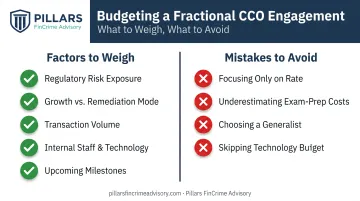
Factors to Weigh
Match spend to your actual compliance load:
- Regulatory risk exposure and licensing footprint
- Growth mode versus remediation mode
- Transaction volume and product complexity
- Internal compliance staff and technology already in place
- Upcoming milestones such as bank partner reviews, licensing applications, and exams
Budgeting Mistakes to Avoid
- Focusing only on the hourly or monthly rate without evaluating experience
- Underestimating exam-prep or remediation costs
- Choosing a generalist over a financial crime specialist
- Skipping budget for the technology stack that supports CCO oversight
Measure the investment by reduced regulatory risk, faster exam readiness, and a program that scales with the business. The monthly invoice is only one input.
Frequently Asked Questions
Is a fractional CCO worth it?
For most growth-stage fintechs and payments companies, yes. You get senior-level financial crime expertise and regulatory credibility at a fraction of full-time cost. That arrangement stays worthwhile until complexity justifies an in-house hire.
Is a fractional CCO cheaper than a full-time CCO?
Generally, yes. A fractional retainer typically costs far less than a full-time CCO's salary plus benefits, which can exceed $400,000 in total cash compensation alone. That gap narrows during intensive remediation work, though.
How do fractional CCOs get paid?
Most bill through a monthly retainer, hourly rate, or project-based fee for specific deliverables like exam prep or program remediation. The structure usually depends on how predictable the scope of work is.
How many hours per month does a fractional CCO typically work?
It varies widely, from a few hours a month for light advisory support to 20+ hours for growth-stage companies or active remediation engagements.
Can a fractional CCO satisfy regulatory requirements for a BSA Officer or CCO role?
Many regulators accept fractional or outsourced arrangements, provided the person has sufficient authority, access, and dedicated time to fulfill the role. Confirm specifics with legal counsel and your regulator before finalizing the structure.
What's included in a fractional CCO's monthly fee?
Typically included: policy oversight, risk assessments, monitoring review, and board reporting. Usually excluded: monitoring software, outside counsel, and independent audit fees.