Hiring a full-time BSA/AML Officer too early can eat into runway you need for product and growth. Wait too long, though, and you risk something worse: a failed sponsor bank due diligence review, an exam finding, or a terminated banking relationship.
This article breaks down the concrete warning signs that it's time to bring in fractional BSA leadership, plus what that engagement should actually look like once you do.
Key Takeaways
- A fractional BSA Officer delivers senior-level program ownership and regulator-facing credibility without a six-figure executive salary.
- Timing, not cost, is usually the real trigger: sponsorship diligence, a new product, fundraising, or a first exam finding.
- Regulators and sponsor banks care about documented authority and independence, not employment status.
- Fractional engagements should be scoped to your actual risk exposure, not a generic policy template.
What Is a Fractional BSA Officer (and Why It's Different From a Compliance Consultant)?
A fractional BSA Officer is a senior, credentialed compliance professional who owns your BSA/AML program on a part-time or retainer basis. They carry the same designation and regulatory weight as a full-time BSA Officer under the Bank Secrecy Act, without the full-time salary.
That's a meaningful distinction from a project-based consultant.
Ownership, Not Just Deliverables
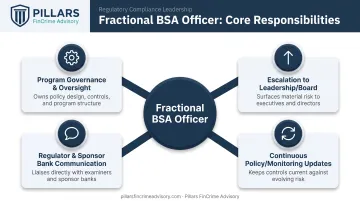
A consultant hands you a risk assessment or a policy manual, then exits. A fractional officer stays. They hold ongoing accountability for:
- Program governance and day-to-day oversight
- Escalation of issues to leadership and the board
- Direct communication with regulators and sponsor banks
- Continuous updates to policies, monitoring rules, and training as your business changes
That ongoing presence matters because BSA/AML compliance isn't a document you file away. It's a living program that has to keep pace with new products, new customer segments, and new risks.
Why This Matters More If You Bank Through a Sponsor
Most fintechs don't hold a bank charter. They operate through a sponsor bank relationship, and their BSA/AML program has to mirror what the sponsor expects—not just what feels reasonable internally.
That's a much higher bar than most founders realize until they're sitting across from a bank's risk team.
A fractional officer is often the fastest way to close that gap. They already know what sponsor banks look for because they've built programs against that exact standard before.
Signs Your Fintech Needs a Fractional BSA Officer
If two or more of the following apply to your business, it's worth having the fractional BSA leadership conversation now, before a bank, regulator, or investor forces the issue for you.
Your Growth Has Outpaced Your Compliance Infrastructure
Every new customer segment, transaction corridor, or geography adds AML risk. Internal teams rarely hire and train fast enough to keep up, which means policies and monitoring thresholds set 18 months ago may no longer reflect what's actually running through your platform.
This isn't a fringe problem. A 2023 Thomson Reuters survey of more than 180 risk and compliance professionals found that 61% ranked keeping up with regulatory and legislative change as their top strategic priority, even as 62% reported their compliance headcount had already grown in recent years.
More staff doesn't automatically solve the pacing problem.
Watch for these warning signs:
- Monitoring thresholds haven't been reviewed since your last product launch
- Policies still describe a business model you've since expanded past
- New states or products went live without a documented risk assessment update
You Don't Have a BSA/AML Officer With Real, Documented Authority
A "BSA Officer" title means little without escalation rights, board access, and independence from revenue pressure. Federal examination standards call for exactly that: a designated officer with the authority, independence, and resources to identify issues and report them up the chain without interference.
Ask yourself one question: can anyone at your company currently halt a risky product launch on compliance grounds alone? If the honest answer is no, that gap is itself the sign fractional leadership is overdue.
You're Entering, Renewing, or Expanding a Bank Sponsorship Relationship
Sponsor banks expect a documented, operational BSA/AML program before onboarding, and that scrutiny doesn't end once you're approved. Recent interagency guidance treats third-party oversight as continuous, with more frequent monitoring for higher-risk activities throughout the life of the relationship, not just at signing.
Founders are rarely equipped to credibly respond to a due diligence questionnaire, walk a bank through their policy framework, or commit to remediation timelines. A fractional BSA Officer can own that entire exchange, which changes how a sponsor bank perceives your program's maturity.
Suspicious Activity Alerts Are Piling Up or Red Flags Keep Slipping Through
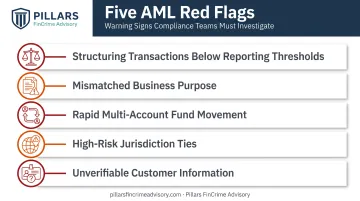
Common red flags your team should be catching include:
- Structuring transactions to stay just under reporting thresholds
- A mismatch between stated business purpose and actual account activity
- Rapid movement of funds through multiple accounts with no clear reason
- Transactions tied to high-risk or financial-secrecy jurisdictions
- Customer information that can't be verified or doesn't hold up under review
Without senior oversight, alert backlogs grow and SAR filing timelines slip. This isn't hypothetical.
FinCEN's enforcement action against TD Bank found a backlog contributing to more than 6,000 untimely SARs covering over $500 million in suspicious activity. Delayed alert investigation is a recurring theme in enforcement findings, not an isolated failure.
You're Preparing for Fundraising, M&A, or a New Money Transmitter License
Investors, acquirers, and state regulators expect a functioning, risk-based BSA/AML program as part of diligence. A gap discovered mid-process can delay closing, or kill the deal outright.
A fractional officer can build or pressure-test your program on a compressed timeline that matches your funding round or licensing deadline, rather than starting a hiring search that won't finish in time.
You've Received Exam Findings, an MRA, or a Regulatory Inquiry
Once a bank or regulator flags a deficiency, remediation requires a named, accountable leader who can interpret the finding, build a corrective action plan, and manage follow-up. Founders trying to do this themselves, on top of running the business, tend to slow the process down.
The Federal Reserve assessed Metropolitan Commercial Bank a $14,478,676 civil money penalty over BSA customer-identification and third-party risk failures tied to its prepaid card program. Fraudsters ultimately collected more than $300 million through the gap.
A regulatory finding is not the place to figure out your response plan from scratch.
Fractional vs. Full-Time BSA Officer: How the Trade-Offs Compare
The choice between fractional and full-time is situational. It depends on your current risk exposure, product complexity, and where you sit in the regulatory scrutiny lifecycle.
| Factor | Fractional BSA Officer | Full-Time BSA Officer |
|---|---|---|
| Time to deployment | Fast; expertise is already in place | Slower, tied to a full executive search and onboarding cycle |
| Cost structure | Scoped fee or retainer, sized to actual workload | Full salary, benefits, and overhead year-round |
| Flexibility | Scales up or down as risk and volume change | Fixed cost regardless of workload fluctuation |
| Regulatory credibility | Equal, provided authority and independence are documented | Equal, assuming the same authority is in place |
The credibility line matters most. Sponsor banks and examiners aren't grading employment status. They're grading whether the officer has real authority, independence from business-line pressure, and a direct line to leadership.
A fractional arrangement that documents those three things holds up the same as a full-time one, at a fraction of the all-in cost.
Choosing the Right Fractional BSA Partner for Your Fintech
Not every fractional arrangement delivers the same value. When evaluating a partner, look for:
- CAMS certification or equivalent credentials that reflect tested AML competency
- Full compliance lifecycle experience spanning policy development, risk assessments, transaction monitoring optimization, and audit readiness
- A track record advising boards and executive teams directly, not just producing reports for a file
Avoid partners who only deliver isolated documents. A one-time policy or a single audit doesn't give you ongoing program ownership, and it won't hold up when a sponsor bank asks who's accountable day to day.
Pillars FinCrime Advisory is built around this model. Founded by Joshua Douglas, a CAMS-certified advisor with 12+ years of financial crime experience and nearly 20 years across financial services, the firm works directly with fintechs, payments companies, and financial institutions.

Engagements cover the full program lifecycle and are designed to scale as volume and complexity grow, so you own the program day to day instead of rebuilding it at every stage.
The right partner translates regulatory expectations into language a founder or board can act on. Done well, compliance supports growth instead of slowing it down.
Frequently Asked Questions
What are some common red flags for money laundering?
Common red flags include structuring below reporting thresholds, unexplained movement across multiple accounts, activity that doesn't match the stated business purpose, and ties to high-risk jurisdictions. Unverifiable customer information is another frequent signal.
How much does a fractional BSA officer cost compared to a full-time hire?
Fractional engagements are typically priced monthly or by scope, sized to your actual risk and workload. That usually costs far less than the salary, benefits, and overhead of a full-time BSA Officer.
Can a fractional BSA officer file SARs or sign regulatory filings on our behalf?
Authority depends on how the engagement is documented. In most bank-sponsored fintech models, SAR filings are ultimately submitted by the sponsor bank, with the fractional officer supporting identification, investigation, and documentation.
How quickly can a fractional BSA officer be brought on board?
Experienced fractional officers can typically begin an engagement within days to a couple of weeks. That's far faster than a multi-month executive search and onboarding process for a full-time hire.
Is a fractional BSA officer acceptable to sponsor banks and examiners?
Yes. Regulators and sponsor banks focus on documented authority, independence, and escalation rights, not whether the officer is full-time or part-time. A clearly scoped engagement satisfies that standard.
When should a fintech transition from a fractional to a full-time BSA officer?
Transition once regulatory activity becomes continuous, product complexity increases, or transaction volume needs daily in-house oversight. Until then, fractional leadership usually covers the need.