Introduction
Trust in the financial system starts with a simple question: who exactly is on the other side of the transaction? Trust in the financial system starts with a simple question: who exactly is on the other side of the transaction?
When a business opens an account, processes payments, or signs on as a merchant, banks and fintechs need to know it's real, legally operating, and not a front for something else.
Shell companies, layered ownership structures, and undisclosed beneficial owners can slip through incomplete vetting. That gap has consequences. In September 2024, the OCC entered a formal enforcement agreement with Wells Fargo, citing deficiencies in customer due diligence, customer identification, and beneficial-ownership programs.
This guide breaks down what Know Your Business (KYB) actually is, how the verification process works, why it matters for risk and trust, and how to build a program that scales as your company grows.
Key Takeaways
- KYB verifies legal entities and their ultimate owners, going beyond individual KYC identity checks.
- Identifying beneficial owners (typically 25%+ ownership or control) is the most complex, failure-prone step.
- Financial-crime compliance now costs US and Canadian institutions $61 billion annually, making weak KYB costly to ignore.
- Trigger-based monitoring catches ownership changes and new sanctions hits faster than fixed periodic reviews.
- A mature KYB program speeds sponsor bank approvals and market expansion instead of slowing them down.
What Is KYB? Definition, Core Objectives, and How It Differs From KYC
Know Your Business (KYB) is the process of verifying a company's legitimacy, ownership, and risk profile before or during a financial relationship. It's the entity-level counterpart to the identity checks banks and fintechs run on individual customers.
KYB answers three core questions:
- Does the business actually exist and operate as claimed? This means confirming legal registration, licensing, and operational legitimacy.
- Who ultimately owns or controls it? Ownership needs to trace back to real, identifiable people, not just holding companies or nominees.
- Are there red flags tied to financial crime or regulatory risk? Sanctions exposure, adverse media, or a history of enforcement action all matter here.
KYB vs. KYC: Understanding the Distinction
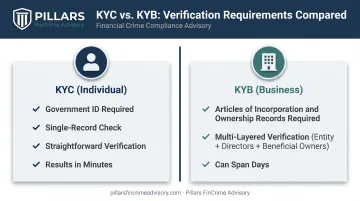
KYC verifies individual identities. KYB verifies legal entities and the people who own or control them. The two aren't separate tracks. Every KYB check eventually leads back to KYC, since someone has to be identified as the actual human behind the business.
The complexity gap between the two is significant:
| Factor | KYC (Individual) | KYB (Business) |
|---|---|---|
| Core documents | Government ID, date of birth, address | Articles of incorporation, business license, ownership records |
| Verification layers | One person, one identity | Entity + directors + beneficial owners |
| Typical complexity | Straightforward, single-record check | Multi-layered, sometimes cross-border |
| Timeline | Often minutes | Can span days when ownership is unclear |
For financial institutions, fintechs, and payments companies onboarding both individual users and business partners, KYC and KYB aren't competing priorities. They're complementary pillars of the same AML/CFT framework—and weak coverage on either side leaves a real gap in the program.
Why KYB Matters: Managing Risk and Establishing Trust
The Regulatory Foundation
KYB obligations in the US trace back to the Bank Secrecy Act and the USA PATRIOT Act, particularly Section 326, which set minimum identity-verification standards for financial institutions. FinCEN's 2016 Customer Due Diligence Rule built on that foundation, becoming mandatory on May 11, 2018, requiring banks and other covered institutions to identify beneficial owners for legal-entity customers.
The landscape keeps shifting. The Corporate Transparency Act's beneficial ownership reporting requirements have changed significantly. FinCEN's March 2025 interim rule exempted US-created entities and US persons from BOI reporting while keeping foreign entities registered to do business in the US in scope.
Meanwhile, the EU's new Anti-Money Laundering Authority (AMLA) became operational in summer 2025 and will directly supervise select high-risk entities by 2028.
Reducing Business Risk and Building Trust
Rigorous KYB exposes shell companies, undisclosed owners, and sanctioned entities before a relationship is ever formalized. The Wells Fargo enforcement action mentioned earlier is a clear signal of what happens when beneficial-ownership programs fall short, even at institutions with mature compliance infrastructure.
A strong KYB program does more than mitigate risk. It signals credibility to:
- Regulators, who expect defensible, risk-based controls
- Sponsor banks, who won't extend partnerships without confidence in a fintech's compliance maturity
- Investors, who increasingly view compliance readiness as part of due diligence
Growth Speed and Rising Compliance Costs
Companies with mature KYB programs expand into new markets and partnerships faster, simply because they're not scrambling to fix compliance gaps mid-deal. That speed advantage compounds over time.
The cost of getting this wrong keeps climbing. LexisNexis Risk Solutions reported that financial-crime compliance costs US and Canadian financial institutions $61 billion annually, with 99% of surveyed institutions reporting rising costs year over year. Weak KYB creates regulatory exposure and makes every future compliance dollar work harder to catch up.
How KYB Works: The Verification Process Step-by-Step
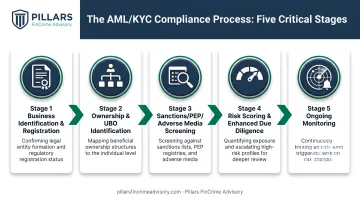
KYB verification follows a clear sequence: confirm the entity exists, map who owns and controls it, screen for risk, score the relationship, then keep watching after onboarding.
Business Identification and Registration Verification
Compliance teams start by confirming the business legally exists. They cross-reference company registries, incorporation filings, and licensing records using documentary evidence (certified articles of incorporation or an unexpired business license) and non-documentary sources such as public databases or financial statements.
Ownership Structure and UBO Identification
This is where things get complicated. Teams identify Ultimate Beneficial Owners: generally anyone owning 25% or more of the entity, plus at least one person with significant control over management decisions.
Layered or offshore structures make this step the most complex and the most likely to fail. The goal is tracing ownership back to real people, not the next holding company in the chain.
Screening Against Sanctions, PEP, and Adverse Media
Once the business and its UBOs are identified, teams screen them against:
- Sanctions lists (OFAC, UN, and other international designations)
- Politically exposed person (PEP) databases
- Adverse media sources that might surface reputational or criminal risk
Risk Scoring and Enhanced Due Diligence
Not every business carries the same risk. A risk-based approach scores entities on factors such as:
- Industry
- Geography
- Ownership complexity
Higher-risk businesses move into enhanced due diligence. That work digs deeper into source-of-funds documentation and ownership verification.
Ongoing Monitoring
KYB doesn't stop at onboarding. Effective programs use trigger-based, near-continuous monitoring instead of fixed periodic reviews alone. They watch for ownership changes, new sanctions hits, or adverse media as those events happen—not months later on the next scheduled cycle.
Who Needs to Perform KYB Checks?
KYB obligations extend well beyond traditional banks:
- Financial institutions — banks and credit unions face direct obligations under the Bank Secrecy Act and USA PATRIOT Act, including FinCEN's CDD Rule for legal-entity customers.
- Fintechs and payment processors — firms onboarding merchants, vendors, or platform sellers face rising scrutiny, and sponsor banks increasingly expect defensible KYB programs.
- Other high-value sectors — real estate, insurance, and B2B marketplaces increasingly require verification even for smaller vendors, including under FinCEN's 2024 residential real estate rule on certain non-financed transfers to legal entities or trusts.
The common thread: any business relationship where the counterparty could be used to mask illicit funds is a candidate for KYB scrutiny — regardless of company size.
Common Challenges in KYB Programs
Three challenges show up again and again:
- Data fragmentation: ownership and registration data sits across international registries, proprietary databases, and inconsistent formats—slowing manual verification and creating room for error.
- Complex ownership structures: FATF guidance on beneficial ownership flags shell companies, nominee directors, and multi-jurisdictional entities used to hide true owners. Many registries are passive filing repositories, not verified sources of current information.
- The friction trade-off: thorough due diligence takes time, but slow onboarding costs business. As frameworks like the Corporate Transparency Act and EU AMLA keep evolving, that tension between speed and rigor isn't going away.
None of these problems disappear with better software alone. They take judgment and experience, plus a program built to handle ambiguity.
Building a Scalable, Trust-Ready KYB Program
Technology and checklists help, but they don't solve KYB on their own. What actually makes a program defensible to regulators and examiners is sound risk-based policy, real governance structure, and experienced oversight guiding the decisions software can't make by itself.
This is where independent, hands-on compliance advisory earns its place. Pillars FinCrime Advisory, founded by CAMS-certified compliance professional Joshua Douglas, works directly with fintech, payments, and financial institution leadership to design, remediate, or audit-proof KYB programs.
Rather than handing clients a generic template, the approach centers on policies and risk assessments built around each organization's actual risk profile. That holds whether the client is an early-stage fintech building its first KYB framework or an established payments company preparing for a regulatory exam.
Services relevant to KYB maturity include:
- KYC/KYB program design covering policies, procedures, and governance
- Fractional CCO/BSA Officer support for senior-level oversight without a full-time hire
- Sponsor bank representation to keep partner communication and regulatory alignment on track
- FinCEN reporting and beneficial ownership support tied to evolving CTA requirements
The goal is to turn KYB into a strategic asset that reassures regulators, sponsor banks, and investors a company's compliance program can support whatever growth comes next.

Frequently Asked Questions
What does KYB stand for in banking?
KYB stands for Know Your Business. It's the process financial institutions and fintechs use to verify a company's legitimacy, ownership, and risk profile before establishing or continuing a business relationship.
Is KYC mandatory in the US?
Yes. Customer identification and due diligence are legally mandatory for US financial institutions under the Bank Secrecy Act and the USA PATRIOT Act, which set minimum identity-verification standards for regulated entities.
Is KYB legally required in the US?
KYB obligations stem from the same AML framework that requires KYC, reinforced by FinCEN's CDD Rule for legal-entity customers. The Corporate Transparency Act has also layered beneficial ownership reporting requirements onto that foundation.
What is the difference between KYB and KYC?
KYC verifies individual identities, while KYB verifies businesses and the people who ultimately own or control them. KYB is typically more complex because it layers entity verification on top of individual identity checks.
What documents are typically required for a KYB check?
Common documents include articles of incorporation, business licenses, partnership agreements or trust instruments, and identification for beneficial owners, such as a driver's license or passport.
How often should KYB records be reviewed or updated?
KYB records should be refreshed based on risk-triggered events (such as ownership changes, new sanctions hits, or adverse media) rather than relying solely on a fixed calendar schedule.