Many teams treat compliance review as a final checkbox before launch, not a design input. That approach is expensive. Klaros Group found that formal enforcement odds for fintech partner banks reached 15% for FDIC-supervised institutions, 10% for OCC-supervised institutions, and 9% for Federal Reserve-supervised institutions between Q1 2023 and Q1 2024 — a period defined by rapid product expansion across the sector.
Innovation risk assessment is what separates confident, compliant growth from costly post-launch remediation, consent orders, and examiner findings. This article breaks down what it is, why it matters, and how to run one that actually holds up under regulatory review.
Key Takeaways
- Assess new products, technologies, and partnerships for financial crime and operational exposure before you scale
- Unproven models, incomplete data, and shifting rules set it apart from standard risk review
- A repeatable process keeps growth aligned with regulatory confidence
- Independent, CAMS-certified review validates assumptions that examiners and boards will scrutinize
- Ongoing monitoring sustains audit-ready compliance programs over the long term
What Is Innovation Risk Assessment?
Innovation risk assessment is the structured process of evaluating new products, technologies, customer segments, or partnerships for financial crime, regulatory, and operational exposure before they scale. It answers a simple question: what could go wrong here, and are we prepared for it?
This type of review typically applies to:
- New product or feature launches (instant payments, BNPL, embedded lending)
- Fintech-bank sponsor relationships and partnership onboarding
- New payment rails or real-time transfer capabilities
- AI/ML-driven underwriting or transaction monitoring models
- Crypto and digital asset product offerings
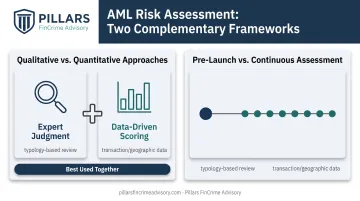
Qualitative vs. Quantitative Approaches
Some assessments rely on subject-matter expert review, where compliance officers and financial crime specialists evaluate a product against known typologies and regulatory expectations. Others use quantitative risk-scoring models built on transaction data, customer characteristics, and geographic exposure.
Neither approach works well alone. Effective programs blend both: data-driven scoring for scale and consistency, paired with expert judgment for context a spreadsheet can't capture.
Pre-Launch vs. Continuous Assessment
A pre-launch assessment happens before a product goes live. Continuous assessment revisits that analysis as volume grows, new geographies open up, or the customer base shifts. Both matter. A product that looked low-risk at 500 users can look very different at 50,000.
Why Innovation Risk Assessment Is Critical for Fintechs, Payments Companies & Financial Institutions
Regulators no longer wait for a problem to surface before asking questions. The OCC's guidance on new, modified, or expanded bank products makes clear that management should conduct due diligence and establish internal controls before implementing a new activity, not after examiners find gaps.
That expectation isn't theoretical. In its 2023 consent order, New York's Department of Financial Services fined Coinbase $50 million after finding serious control failures. Customer sign-ups grew 15-fold in a single year, and the transaction-monitoring alert backlog exceeded 100,000 cases. Growth outpaced controls, and regulators noticed.
A strong assessment process flips that script. It turns innovation from a liability into evidence of program maturity. Specifically, it:
- Improves go/no-go decision quality for new product launches
- Reduces regulatory exposure by catching gaps before they compound into backlogs
- Increases speed-to-market confidence by avoiding costly post-launch redesigns
- Surfaces AML, fraud typology, and sanctions gaps before bad actors exploit them
- Supports audit-ready compliance programs as volume and complexity grow
- Builds confidence with examiners, sponsor banks, investors, and boards
The pattern across recent enforcement actions is consistent: rapid scaling without matching risk-management investment. Innovation risk assessment exists to catch that mismatch early.
How Innovation Risk Assessment Works – Step by Step
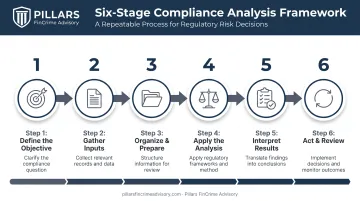
This is a practical sequence teams can run for every meaningful product change. The most common failures aren't in any single step. They're in skipping the financial crime lens entirely, rushing to launch without documentation, or treating the assessment as a one-time event instead of a living process.
Step 1 – Define the Objective
Identify the specific product, feature, geography, or partnership under review, and the regulatory questions it raises. Is this a new payment rail? A new customer segment? A sponsor-bank relationship?
Impacted metrics: regulatory alignment, clarity of risk appetite.
Step 2 – Gather Inputs
Collect data on the customer base, transaction types and volumes, geographies served, third-party or sponsor-bank relationships, and the underlying technology stack. Incomplete inputs at this stage undermine everything downstream.
Impacted metrics: data completeness, reliability, speed of collection.
Step 3 – Organize & Prepare
Map the collected risk factors against categories like AML/BSA, fraud, sanctions, consumer protection, and operational resilience. This step turns raw data into something a review team can actually work with.
Impacted metrics: consistency, usability for review teams.
Step 4 – Apply the Analysis
Score inherent risk, layer in existing or planned mitigating controls, and apply a documented methodology that combines judgment with data-driven scoring.
Impacted metrics: insight quality, depth of analysis.
Step 5 – Interpret Results
Translate risk scores into a go/no-go decision, required controls, and monitoring thresholds business leaders can act on. A risk score without a clear recommendation is just a number.
Impacted metrics: decision confidence, error reduction.
Step 6 – Act & Review
Implement required controls, monitor performance post-launch, and revisit the assessment as the product or customer base scales. Most programs fail here. They treat the assessment as done rather than ongoing.
Impacted metrics: performance improvement, speed of iteration.
Innovation Risk Assessment – Example Case Walkthrough
Consider a payments company launching a new instant-transfer feature. Here's how the six-step framework works in practice.
- Define the objective: The team identifies the specific risk question: does instant settlement create new money-laundering exposure by removing the delay that once gave fraud teams time to review?
- Gather inputs: Compliance pulls transaction data from the existing standard-transfer product, projected volume for the new feature, and the geographies where it will launch first.
- Organize & prepare: The team maps risk factors against AML/BSA (faster movement of illicit funds), fraud (reduced review windows), and sanctions (real-time screening feasibility).
Two gaps often show up at this stage:
- Stress-testing the product experience without checking whether existing monitoring rules can catch a new pattern at instant speed
- Skipping sanctions screening review for a newly added geography because "it's the same product"
- Apply the analysis: The team scores inherent risk as elevated given the removal of settlement delay, then adjusts it downward based on planned velocity limits and enhanced monitoring rules.
- Interpret results: The findings support a conditional go-live: launch approved, but only with a phased rollout to a limited customer segment first.
- Act & review: The company launches to 5% of eligible users, monitors alert volume and false-positive rates for 90 days, then expands based on performance data.
The outcome: an adjusted risk rating, updated monitoring thresholds calibrated to the new transaction pattern, and a phased rollout that limited exposure while the controls proved themselves.
How Pillars FinCrime Advisory Can Help
Running an innovation risk assessment internally is possible. Running one that survives examiner scrutiny, sponsor-bank review, and board questioning is harder, especially when the team building the product is also the team assessing its risk.
Pillars FinCrime Advisory works alongside boards, executive teams, and compliance leadership to design and run innovation risk assessments that balance growth with regulatory confidence. Founder Joshua Douglas brings 12+ years of specialized financial crime experience and nearly 20 years across financial services. He applies that background to hands-on product and partnership risk work with fintechs, payments firms, and financial institutions.
What sets the engagement apart:
- CAMS-certified expertise used on live product and partnership reviews—not generic industry templates
- Full lifecycle program support: from policy development and risk assessments through transaction monitoring optimization and audit readiness
- Custom frameworks built to scale with fintech, payments, and financial institution growth, rather than one-size-fits-all checklists
- Business-language translation of regulatory expectations so boards and CEOs can act on findings without a compliance background

Clients working with Pillars on related transaction monitoring and KYC engagements have reported higher alert quality, reduced operational friction, and stronger regulatory-exam preparation.
Innovation risk assessment is an ongoing discipline. Revisit it whenever products, regulations, or risk exposure change.
Frequently Asked Questions
What are the 5 things a risk assessment should include?
A solid risk assessment should include:
- Scope and objectives
- Data inputs
- Risk categories evaluated (AML, fraud, sanctions, consumer protection, operational)
- Mapping of mitigating controls
- Documented conclusions with clear action items
What are the four types of risk assessment?
Most programs blend four approaches:
- Qualitative review based on subject-matter expert judgment
- Quantitative scoring with data-driven models
- Enterprise-wide assessment for a holistic organizational view
- Targeted or product-specific review for a single launch or partnership
How often should fintechs conduct an innovation risk assessment?
Run one before every meaningful product launch, then revisit periodically as transaction volume grows, new geographies open, or regulations change. There's no fixed interval. The triggers are what matter, not the calendar.
Who should be involved in an innovation risk assessment?
Compliance and risk leadership, executive and board stakeholders, and, where relevant, product and legal teams should all contribute. Independent expert review adds a layer of objectivity examiners and boards tend to value.
What's the difference between innovation risk and traditional compliance risk?
Innovation risk deals with unproven products, incomplete data, and evolving regulatory expectations. Traditional compliance risk relies on established, measurable processes with a longer track record to draw on.
How does innovation risk assessment affect regulatory exam readiness?
Documented, proactive assessments demonstrate program maturity to examiners during exam scoping and planning. Without one, examiners often have to build their own assessment from available records, which is rarely a favorable outcome.