
The number isn't fixed. It shifts based on your institution's size, whether you're a traditional bank, a fintech, or a payments company, how many jurisdictions you touch, and how mature your technology stack is. A community bank with $80 million in assets and a fast-scaling payments platform processing millions of transactions face wildly different compliance math, even though both answer to overlapping regulatory frameworks.
This article breaks down 2026 compliance cost benchmarks by institution size, the forces pushing costs higher, the trends reshaping budgets this year, and practical ways leadership teams can plan smarter.
Key Takeaways
- Compliance costs range from 2.9% of non-interest expense at larger institutions to 8.7% at small community banks
- Technology, staffing, and regulatory complexity are the top three cost drivers heading into 2026
- Fintechs and payments companies face higher relative costs due to limited scale
- 2026 is a transition year: costs still climb short-term, but AI and automation begin offsetting spend for institutions that invest strategically
How Much Do Banks Spend on Compliance in 2026? (Cost Overview)
There's no universal figure for compliance spend because asset size, business model, and jurisdiction all pull the number in different directions. What research does show consistently is that most institutions dramatically underestimate what compliance actually costs them.
That's because they're only counting the compliance department's direct budget: salaries, software licenses, and a few consultants. What they're missing is everything compliance touches indirectly: legal review, IT support, board time, front-line staff who spend hours on customer due diligence instead of sales.
A 2025 study from PwC and TheCityUK put real numbers behind this gap. Directly attributable compliance costs across UK financial services firms came in at 2.6% of operating costs. But when researchers measured the full, organization-wide cost of compliance, the figure jumped to more than 13% of operating costs, over four times the headline number.
Across the sector, that totaled roughly £33.9 billion annually.
That gap matters. If your institution is budgeting compliance based only on the compliance team's line item, you're likely planning against a number that's a fraction of your true exposure.
Compliance Costs by Institution Size
Scale changes everything in compliance economics. Regulatory obligations largely apply regardless of asset size, which means smaller institutions absorb the same fixed compliance requirements as billion-dollar banks — just with far less revenue to spread the cost across.
Federal Reserve research on U.S. bank compliance spending illustrates this clearly:
| Asset Size | Compliance Cost as % of Non-Interest Expense |
|---|---|
| Under $100M | 8.7% |
| $100M–$250M | 5.9% |
| $250M–$500M | 5.3% |
| $500M–$1B | 4.2% |
| $1B–$10B | 2.9% |
As assets grow, compliance cost as a share of expenses shrinks, because larger banks spread fixed regulatory costs across a bigger revenue base.
Very large institutions often report compliance budgets in the hundreds of millions of dollars in absolute terms. Verified public benchmarks at that scale are still hard to find.
Fintechs and payments companies sit in a different category. Standardized cost benchmarks are still scarce, largely because business models and risk profiles vary so widely.
Many front-load heavy RegTech spend to meet sponsor bank and regulator expectations before they have the transaction volume to absorb those costs. How expensive that work can get shows up clearly in financial crime operations: UK Finance reported firms spending roughly £21,400 per hour on average fighting financial crime and fraud, a reminder of how resource-intensive this work is in fast-growing digital markets.
Where the Budget Goes: Cost Breakdown by Category
Community bank data offers one of the clearest pictures of how compliance dollars actually get spent. A widely cited study covering 2015–2017 found total compliance costs averaging 7.2% of non-interest expense, broken down like this:
- Personnel — averaging 5.1% of non-interest expense, by far the largest slice
- Data processing and technology — around 1.0%
- Accounting support — roughly 0.6%
- Consulting — 0.3%
- Legal — 0.2%
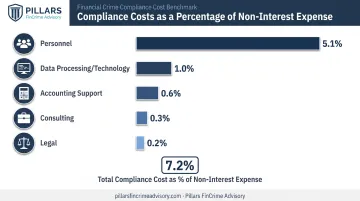
Staff costs dominate. That tracks with what most compliance leaders already know: skilled AML analysts, BSA officers, and investigators are expensive and hard to find, and they represent the single biggest recurring line in most compliance budgets.
Indirect costs rarely show up in headline numbers, but they still matter. Board and senior management time on regulatory reporting and supervisory matters has been climbing for years.
Thomson Reuters research found that among the largest global institutions, many compliance leaders spend more than a full day per week on board-level reporting alone. That time almost never appears in the compliance department's stated budget, yet it is a real cost to the organization.
Key Factors That Affect Compliance Costs
Compliance spend isn't governed by a single formula. It's shaped by a mix of structural, regulatory, and operational variables that interact differently depending on your institution.
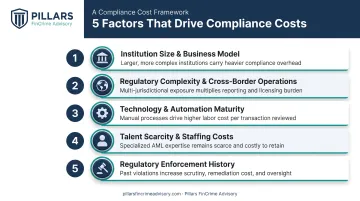
Institution Size and Business Model
A traditional bank, a fintech, and a payments company can face overlapping regulatory obligations while carrying entirely different cost structures. Banks typically have compliance infrastructure built over decades, with legacy systems and established relationships with examiners. Fintechs and payments companies, by contrast, often need to build a full compliance program from scratch while scaling rapidly. Many also rely on sponsor bank relationships that bring their own compliance expectations.
This is where sponsor bank representation becomes relevant for fast-growing fintechs and payments companies. Getting "bank-ready" (meaning your compliance program can withstand a sponsor bank's own scrutiny) requires aligning your controls with what the partner bank expects, then maintaining that communication over time. Skipping this step is one of the most common reasons fintech compliance budgets balloon unexpectedly mid-growth.
Regulatory Complexity and Cross-Border Operations
Operating across multiple jurisdictions multiplies monitoring, reporting, and legal costs fast. Every additional country or state can mean a separate sanctions list to screen against, separate reporting thresholds, and separate examiner relationships to manage.
This gets more complicated as AML/CTF and ESG requirements continue evolving globally. Sanctions programs illustrate the challenge well:
- Screening must keep pace with OFAC, United Nations, and international sanctions lists simultaneously
- Calibration has to balance false-positive reduction against genuine-match protection
- Case disposition workflows need to scale as transaction volume grows
Get the calibration wrong in either direction, and you either drown your team in false positives or miss something a regulator will find later.
Technology and Automation Maturity
Firms further along in RegTech adoption tend to see lower long-term costs, despite higher upfront investment. The tradeoff is real: automation isn't cheap to implement, but manual processes don't scale, and labor costs keep climbing regardless.
The mismatch problem is common here too. Institutions often buy technology that doesn't fit their actual transaction volume or risk profile, then pay twice: once for the tool, and again for the workarounds needed to make it usable. An independent vendor evaluation against your actual risk profile, volume, and budget avoids that trap before the contract gets signed.
Talent Scarcity and Staffing Costs
Skilled AML and compliance talent remains scarce and expensive. As shown in the cost breakdown above, personnel routinely represents the largest recurring cost line in any compliance budget, often more than double every other category combined.
This scarcity is why fractional compliance leadership has gained traction. A fractional CCO or BSA officer gives growing organizations senior-level expertise (regulatory oversight, program accountability, strategic guidance) without the full-time salary, benefits, and overhead of an in-house executive.
For fintechs and payments companies that don't yet need a full-time compliance lead, that model often decides whether the program scales cleanly or buckles the first time an examiner arrives.
Regulatory Enforcement History
A prior fine or consent order doesn't just cost money once. It creates a multi-year cost tail through remediation, independent monitorships, and complete system overhauls.
TD Bank's 2024 AML resolution shows the scale this can reach. The bank's total AML settlement came to approximately $3.09 billion, and TD had already disclosed spending more than $500 million on AML remediation and platform enhancements before the resolution was finalized. That sits on top of an OCC-mandated growth restriction and an independent monitor overseeing progress for years.
Smaller institutions will not face billion-dollar penalties. Remediation still adds up fast: new systems, added headcount, consultant fees, and monitor requirements routinely dwarf what proactive investment would have cost in the first place.
2026 Trends: What's Changing in Bank Compliance Spending
Compliance costs are still climbing. Deloitte research points to retail and corporate banks' compliance operating costs running more than 60% higher than pre-financial-crisis levels. More recent survey data from LexisNexis Risk Solutions found that 99% of U.S. and Canadian institutions reported increased financial crime compliance costs. Total regional spend reached an estimated $61 billion.
A few forces are reshaping how that spending gets allocated heading into 2026:
AI-driven compliance is arriving, but savings aren't instant. McKinsey research suggests automation can cut KYC workflow effort by 20–30%. Some modeling shows agentic AI could eventually deliver major productivity gains for institutions willing to restructure how teams operate. Short-term, though, most institutions will see costs rise as they invest in these tools before efficiency gains materialize.
Regulatory reform is coming, but slowly. FinCEN proposed rule changes in April 2026 aimed at shifting toward more risk-based AML program requirements. The FCA has also committed to eliminating certain recurring regulatory returns for thousands of UK firms. Meaningful relief from these efforts will likely land in 2026–2027 rather than immediately.
New cost frontiers are emerging, including:
- ESG and sustainability disclosure requirements
- AI governance and model audit obligations
- Expanding sanctions and cross-border complexity
Third-party and vendor risk management costs are climbing too. As more institutions outsource KYC, screening, and monitoring functions, the same LexisNexis survey found that 79% of mid-size and large institutions experienced rising costs tied specifically to outsourcing arrangements.
Most analysts expect this pressure to plateau or ease later in the decade as automation matures and reforms take hold. That positions 2026 as a transition year: not a turning point yet, but the setup for one.
How to Optimize Your Compliance Budget for 2026
Smart budgeting starts with resisting the urge to mirror what larger competitors spend. A $50 million fintech doesn't need a Tier-1 bank's compliance infrastructure. It needs a program sized to its actual risk profile and growth stage.
A few practical moves worth prioritizing:
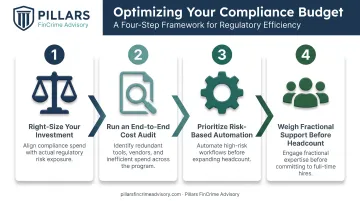
- Right-size your investment. Match spending to your actual transaction volume, customer risk profile, and growth trajectory, not to what a peer institution twice your size is doing.
- Run an end-to-end cost audit. Capture indirect and organization-wide expenses, not just the compliance department's stated budget. This is the exact underestimation trap covered earlier, and most institutions fall into it without realizing.
- Prioritize risk-based automation. Focus technology spending on transaction monitoring, onboarding, and screening, where ROI is measurable, rather than broad, unfocused platform investment.
- Weigh fractional support before headcount. Building a full in-house executive compliance team is expensive and slow. Many fintechs, payments companies, and financial institutions get more value from an experienced financial crime compliance advisory partner.
Pillars FinCrime Advisory is built for that model. Instead of a generic full buildout, Pillars supports the full compliance lifecycle: policy development, risk assessments, transaction monitoring optimization, and audit readiness, sized to what the organization actually needs.
Independent vendor evaluation matches compliance technology to real risk profile, transaction volume, and budget. That reduces tooling mismatches that inflate tech spend without improving outcomes.
Through a fractional CCO/BSA officer model, growing institutions get senior regulatory oversight and program accountability without a full-time executive hire. That directly addresses the staffing cost pressure covered earlier in this article.
Conclusion
Compliance costs vary enormously depending on institution size, business model, and regulatory footprint — from roughly 2.9% of non-interest expense at larger banks to nearly 8.7% at small community institutions. 2026 will bring continued near-term cost pressure, even as automation begins to deliver efficiency gains for institutions that invest with intent.
Understanding your true end-to-end compliance costs, not just your department's headline budget, is the foundation for accurate benchmarking and realistic planning. The right compliance budget balances regulatory confidence, operational efficiency, and room to scale. Institutions usually reach that balance faster with an experienced advisory partner who can connect program design to real operating costs.
Frequently Asked Questions
What does cost of compliance mean?
Cost of compliance refers to the total direct and indirect expenses an organization incurs to meet legal, regulatory, and internal policy obligations. This includes staffing, technology, training, audits, and legal support.
What are the true costs of compliance?
True costs extend well beyond a compliance department's direct budget to include organization-wide expenses like staff time, technology, and opportunity costs. Research shows these full costs can run four times higher than direct spending alone.
How much does AML compliance cost?
AML compliance is typically the single largest driver of financial crime compliance budgets. Large banks can spend well into the hundreds of millions of dollars annually once technology, staffing, and monitoring are all accounted for.
What percentage of a bank's budget is spent on compliance?
It ranges from roughly 2.9% of non-interest expense at institutions with $1 billion to $10 billion in assets. At small community banks under $100 million in assets, that figure can reach 8.7%.
Will bank compliance costs go down in 2026?
Costs are expected to keep rising in the near term. Automation and regulatory reform efforts show promise, but meaningful relief likely won't materialize until 2026–2027 or later.
How can smaller banks and fintechs reduce compliance costs without increasing risk?
Focus on risk-based prioritization and targeted automation in high-impact areas like transaction monitoring and onboarding. Specialized compliance advisory support often beats overbuilding in-house infrastructure on both cost and results.