Leadership teams know compliance matters. What they're less sure about is how to staff it. Do you need a full-time Chief Compliance Officer? A fractional advisor? Someone internal who can wear the hat part-time?
This guide breaks down what a CCO actually does, the warning signs that you've outgrown ad hoc compliance, when the role becomes a legal requirement, and the staffing models available, from in-house hires to outsourced advisory support.
Key Takeaways
- Hire a CCO when regulatory complexity, growth, or licensing outpaces a generalist or part-time function
- RIAs, MSBs, and money transmitters must legally designate a compliance officer
- Staff the role in-house, promote internally, or engage a fractional CCO
- Outsourced compliance delivers senior expertise and audit readiness without full-time executive cost
What Is a Chief Compliance Officer?
A Chief Compliance Officer designs, implements, and oversees an organization's compliance management system. That means writing and enforcing policy, monitoring for violations, managing regulatory relationships, and reporting risk exposure to leadership.
The role has changed shape over the past two decades. What began as a policy-custodian function, largely reactive and document-driven, has become a strategic leadership role. Today's CCOs work directly with the CEO, CFO, and board on decisions that affect product launches, market expansion, and fundraising.
A quick note on terminology: smaller organizations often use "CCO," "Compliance Officer," and "Chief Compliance Officer" interchangeably. But a formal CCO designation typically implies something more specific:
- Board-level authority and visibility
- Independence from operational business lines
- Escalation power to flag issues without retaliation risk
That distinction separates someone who manages compliance tasks from someone with authority to stop a risky product launch.
Signs Your Company Needs a Chief Compliance Officer
Not every company needs a dedicated executive on day one. But certain patterns suggest you've outgrown whatever informal system got you this far.
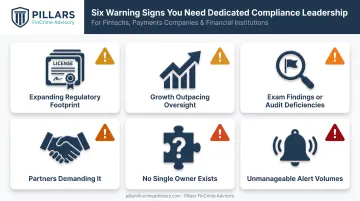
Your regulatory footprint is expanding. If you're holding or applying for multiple state money transmitter licenses, registering as an MSB, or pursuing a bank charter, each one carries ongoing compliance obligations that don't run themselves.
Your growth is outpacing oversight. Rapid transaction volume increases, new product lines, or geographic expansion tend to stretch a compliance function that was built for a smaller, simpler business.
You've had exam findings or audit deficiencies. TD Bank's record $1.3 billion FinCEN penalty in 2024 was tied to an AML program regulators found "neither appropriately designed nor adequately resourced." Under-resourced compliance gets expensive fast.
Other signals worth taking seriously:
- Partners are demanding it — sponsor banks, card networks, and investors increasingly require dedicated compliance leadership before closing deals
- No single owner exists — duties split across operations, legal, and finance leave accountability gaps and uneven enforcement
- Alert volumes are unmanageable — transaction monitoring and KYC queues grow faster than your team can clear them
That last signal shows up constantly. When monitoring and KYC backlogs compound month over month, fintechs and payments companies often need clearer ownership—full-time or fractional—to tighten alert quality before the queue becomes the next exam finding. That's a pattern Pillars FinCrime Advisory sees repeatedly in hands-on monitoring work.
When a Chief Compliance Officer Is Legally Required
Some businesses don't get to debate this. The law, or a contract, decides for them.
SEC-Registered Investment Advisers
Under Investment Advisers Act Rule 206(4)-7, adopted in 2003, any adviser registered under Section 203 must designate an individual to administer its compliance policies and procedures.
The SEC's adopting release goes further: that person should be competent, knowledgeable about the Advisers Act, and senior enough to compel adherence—not merely recommend it.
Bank Secrecy Act Obligations
Financial institutions and money services businesses face parallel requirements:
- Financial institutions, under 31 U.S.C. 5318(h)(1), must designate a compliance officer as part of a broader AML/CFT program
- MSBs, under 31 CFR 1022.210(d)(2), must designate a person responsible for day-to-day compliance, including reporting, recordkeeping, and training
Neither statute demands the specific title "Chief Compliance Officer." Both require someone accountable.
State Licensing and Contractual Requirements
Many state money transmitter regimes require a named compliance officer as well:
- State licensing: Oregon, for example, requires applicants to name a compliance officer among the minimum elements of an AML program
- Contracts: Sponsor bank and card network agreements frequently impose compliance leadership requirements even when no statute does
Operating internationally? The EU's AMLD framework requires appointing a compliance officer "where appropriate with regard to the size and nature of the business." U.S.-focused companies should still treat this as a secondary consideration, not a primary driver.
Your Options for Filling the Compliance Leadership Role
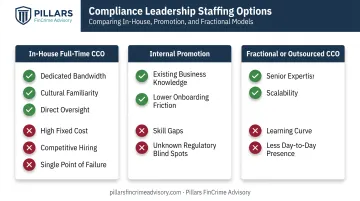
Once you've decided you need dedicated compliance leadership, three paths exist. Each comes with real tradeoffs.
Hiring an In-House, Full-Time CCO
Pros:
- Dedicated bandwidth focused entirely on your business
- Deep cultural and operational familiarity over time
- Direct, day-to-day oversight of compliance activities
Cons:
- High fixed cost, including salary, bonus, and benefits
- A competitive hiring market for experienced compliance talent
- A single point of failure if that person leaves
Promoting or Training an Internal Staff Member
Pros:
- Existing knowledge of your business, products, and culture
- Lower onboarding friction than an outside hire
Cons:
- Potential gaps in compliance-specific skills or leadership experience
- The risk of not knowing what you don't know in a complex, shifting regulatory environment
Outsourcing to a Fractional or Advisory CCO Model
Pros:
- Senior expertise in AML, financial crime, monitoring, and exam readiness without a full-time executive salary
- Scalability as the business grows or regulatory demands shift
Cons:
- An outside advisor still needs time to learn your business
- Less day-to-day presence than a full-time internal hire
This is the model Pillars FinCrime Advisory operates under. Founded by Joshua Douglas, a CAMS-certified professional with 12+ years in financial crime and nearly 20 years across financial services, Pillars gives fintechs, payments companies, and financial institutions hands-on fractional CCO support across the full compliance lifecycle.
Before you engage any advisor, check their depth in fintech or payments—not just traditional banking. Regulatory expectations, product structures, and risk profiles differ enough that generic banking experience does not always translate cleanly.
Decision pointer: Early-stage or scaling companies typically get the most value from a fractional model. Larger, more complex institutions eventually reach a point where a full-time in-house CCO makes more sense.
In-House vs. Outsourced CCO: Cost Considerations
Numbers make this decision concrete.
According to BarkerGilmore's 2024 Chief Compliance Officer Compensation Report, median base-plus-bonus compensation runs $419,000 at public companies and $299,541 at private companies. Financial services salaries rose 5% that year alone. And that's before benefits, equity, or the cost of a lengthy search in a tight talent market.
Outsourced and fractional models work differently. Rather than fixed overhead, engagements are typically structured as:
- Recurring retainers for ongoing fractional leadership
- Hourly or project-based fees for scoped assessments and remediations
- Hybrid arrangements that combine a base retainer with additional hourly work
Cost scales with actual need rather than a fixed annual salary—often the better fit for companies not ready to carry a six-figure executive on payroll year-round.
Treat compliance leadership as risk mitigation, not a discretionary expense. Recent enforcement actions show why:
| Action | Year | Penalty |
|---|---|---|
| OCC – TD Bank | 2024 | $450M |
| FinCEN – TD Bank | 2024 | $1.3B |
| FinCEN – Binance | 2023 | $3.4B |
A $299,541 median compliance salary looks far more reasonable next to hundreds of millions—or billions—in penalties. Whether you build in-house or bring in fractional support, investing early is usually the cheaper path.
Frequently Asked Questions
Is a chief compliance officer a CCO?
Yes. "CCO" is the standard abbreviation for Chief Compliance Officer, and the title always refers to the executive responsible for organizational compliance oversight.
Who does a CCO report to?
Most CCOs report to the CEO or Chief Legal Officer. Some regulatory frameworks, particularly for registered investment advisers, expect a direct line to the board to preserve independence.
What size company actually needs a dedicated CCO?
Need is driven more by regulatory obligations and complexity than by headcount. A 20-person MSB can face the same designation requirements as a 200-person company.
Can one person serve as CCO while holding another title, like COO or General Counsel?
Yes, this is common in smaller organizations. Regulators still expect the role to carry sufficient independence and authority, regardless of what other title sits alongside it.
How much does it cost to hire a chief compliance officer?
Costs vary widely by company size and regulatory complexity, with median full-time compensation often exceeding $299,000 at private companies. Outsourced or fractional models offer a lower-cost entry point that scales with need.
What's the difference between a compliance officer and a Chief Compliance Officer?
"Compliance officer" can refer to any staff member handling compliance tasks. "CCO" denotes the senior executive with ultimate accountability and authority for the entire compliance program.