Introduction
Bank examiners no longer ask fraud and compliance teams separate questions during exams. Increasingly, they want to know one thing: does this institution see financial crime risk as a single, connected picture?
Many organizations can't answer that with confidence. When fraud detection and compliance operate as separate departments, the cracks show fast — duplicate alerts, red flags one team catches and the other misses, and exam findings that cite a lack of coordination.
A 2019 KPMG survey of 43 retail banks worldwide found that 43% reported no integration at all between their fraud and financial-crime compliance functions. That figure is a global snapshot, but one that plenty of U.S. fintechs and financial institutions still resemble.
This article covers why integration matters, the core components of a unified framework, and the step-by-step best practices fintechs, payments companies, and financial institutions can use to build one.
Key Takeaways
- Regulators expect fraud detection and AML to run as one connected system, not parallel silos
- 80% of U.S. mid-market banks now take a collaborative fraud-AML approach (Celent 2025)
- Four pillars drive integration: unified governance, shared risk assessments, centralized data, and audit-ready documentation
- Board and C-suite engagement keeps an integrated program funded and scalable
- Outside financial crime advisory support can speed the path from siloed controls to audit-ready integration
Why Fraud Detection and Compliance Can No Longer Operate in Silos
Fraud teams and compliance teams grew up with different missions. Fraud teams stopped losses in real time — chargebacks, account takeover, payment fraud. Compliance and AML teams handled regulatory obligations: SARs, CTRs, sanctions screening, exam prep.
Different KPIs, different reporting lines, often different software entirely.
That divide made sense when fraud and money laundering looked like separate problems. They aren't anymore.
A Regulatory Push for One Financial Crime Picture
The OCC's Fall 2024 Semiannual Risk Perspective makes the point directly: when multiple departments investigate unusual account activity, including BSA compliance and fraud prevention, open communication between them can speed resolution and close gaps.
FinCEN's 2024 consent order against TD Bank shows what happens when that communication fails. Reporting to AML leadership didn't surface emerging patterns or connect insider involvement to suspicious activity — contributing to a $1.3 billion penalty. Teams and leadership failed to share what they knew, so emerging patterns never reached the people who could act on them.
Where Fraud and Money Laundering Typologies Collide
A fraud alert is often a laundering red flag wearing a different hat. FinCEN's analysis of 2021 identity-related BSA filings found these reports made up 42% of all suspicious activity reports that year, roughly 1.6 million filings tied to $212 billion in suspicious activity (FinCEN).
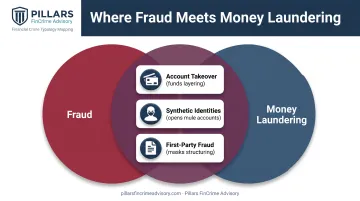
Within that dataset, several typologies consistently overlap:
- Account takeover often funds downstream layering activity
- Synthetic identities built for fraud also open mule accounts
- First-party fraud schemes can mask structuring behavior
When fraud and compliance systems don't communicate, those overlaps stay hidden. An analyst who closes a fraud case as "loss prevented" may never flag it for SAR review. An AML investigator may never learn a related account was already flagged for fraud.
The Business Case for Connecting the Two
Beyond regulatory pressure, integration solves a practical problem: duplicated work. Industry surveys, including Celent's research on U.S. mid-market banks, show collaborative fraud-AML approaches are becoming the norm. Firms report efficiency and cost gains even without a single universal savings figure.
For growth-stage fintechs and payments companies, the stakes run higher. Sponsor banks and regulators expect scaling companies to show program maturity early. A disconnected fraud and compliance function is one of the fastest ways to draw examiner scrutiny.
Best Practices for Building an Integrated Fraud Detection and Compliance Framework
Understanding why integration matters is one thing. Building it is another. Here's a practical roadmap compliance leaders and boards can use to move from disconnected systems to a unified financial crime program.
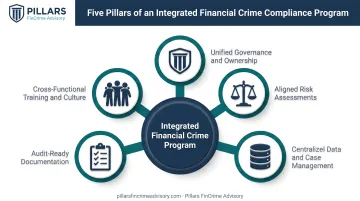
Establish Unified Governance and Ownership
Start with a single financial crime governance structure, or committee, with shared accountability across fraud, AML, and risk teams reporting to one executive sponsor. Without this, ownership gets murky the moment an issue touches both fraud and laundering risk.
Governance should also define clear escalation paths so a fraud alert containing laundering indicators automatically routes to the right investigative team, rather than sitting in a queue while two departments debate whose problem it is.
Align Risk Assessments Across Fraud and Financial Crime
Enterprise-wide risk assessments should evaluate fraud and AML/BSA risks together, not as separate exercises run on different timelines by different teams. This keeps risk appetite consistent and ensures typology coverage doesn't leave gaps between the two programs.
This alignment does double duty:
- Demonstrates program maturity to examiners reviewing your risk assessment
- Supports more defensible, risk-based decision-making across the organization
- Demonstrates program maturity to examiners reviewing your risk assessment
- Supports more defensible, risk-based decision-making across the organization
- Surfaces cross-domain typologies that siloed assessments often miss
Centralize Data, Case Management, and Monitoring
A shared data repository or case management system gives fraud and compliance investigators a single source of truth. From there, teams can:
- Stop duplicating the same alerts across two platforms
- Tune transaction monitoring to catch fraud and money laundering patterns in one pass
- Cut alert fatigue and false positives
Most organizations lack the in-house bandwidth to tune monitoring systems while running day-to-day operations. Pillars FinCrime Advisory supports transaction monitoring optimization within full-lifecycle program build-outs. That work improves alert quality so internal teams aren't left recalibrating rules alone.
Build Audit-Ready Documentation and Reporting Workflows
Integrated SAR and case narratives should reflect both fraud and compliance findings, with a documentation trail examiners can actually follow from alert to resolution. Standardizing escalation, investigation, and reporting templates across teams reduces the inconsistency that often surfaces during an exam.
Why it matters: examiners spend as much time evaluating your documentation as your controls. If a fraud case and a related SAR tell two different stories, that's a finding waiting to happen.
Invest in Cross-Functional Training and Culture
Joint training sessions help fraud analysts recognize AML red flags and help compliance staff understand fraud typologies. Leadership modeling matters here too. When executives treat fraud and compliance as one team with shared goals, staff follow that lead instead of protecting departmental turf.
Common Challenges to Integrating Fraud Detection into Compliance
Integration sounds straightforward on paper. In practice, three obstacles show up repeatedly.
- Resource and budget constraints. Smaller fintechs and neobanks often can't fund dedicated fraud and compliance headcount plus coordinating leadership. Fractional compliance leadership provides senior oversight without a full-time hire.
- Legacy systems and fragmented vendor tools. When fraud and AML monitoring sit on different platforms bought years apart, data sharing becomes a technical project, not a quick fix.
- Organizational resistance. Fraud and compliance teams often run on different KPIs, reporting lines, and incentives. Merging workflows without fixing those gaps tends to stall.
None of these are unusual. They're also not permanent — each one responds to deliberate governance and, where needed, outside expertise to bridge the gap.
The Role of Technology in Sustaining an Integrated Program
AI and machine learning monitoring tools increasingly serve dual purposes. They flag both fraud and AML patterns from the same transaction data, so teams do not need two separate point solutions.
Shared data analytics platforms follow the same path. Fraud and compliance teams get one unified view of customer risk and transaction behavior instead of two competing dashboards.
That said, technology is not a shortcut around a siloed program. A shared monitoring platform layered onto disconnected governance and misaligned processes just produces faster, better-documented silos. The tools have to sit on top of:
- Clear governance and ownership so both teams know who decides and who acts on alerts
- Aligned risk assessments that treat fraud and AML as connected exposure
- Standardized documentation that supports joint investigations and exam readiness
Skip those foundations, and even an advanced AI model won't close the coordination gap.
Signs Your Integrated Program Is Truly Audit-Ready
A few indicators separate a genuinely integrated program from one that just talks about integration:
- Consistent alert quality across fraud and AML monitoring, not two different standards for what counts as a real red flag
- A documented governance structure with clear ownership, escalation paths, and executive sponsorship
- Cross-team case collaboration, where fraud and compliance investigators can point to shared case files, not separate silos of notes
A scalable, well-documented framework signals program maturity to examiners and tends to reduce findings during regulatory exams. Organizations preparing for an exam, or scaling quickly enough that last year's framework no longer fits, often benefit from an independent readiness assessment before regulators arrive.
Pillars FinCrime Advisory, founded by CAMS-certified compliance advisor Joshua Douglas, works with boards and compliance leaders to build governance frameworks and audit-ready documentation. That groundwork helps demonstrate program maturity to regulators and makes exams more predictable.

Frequently Asked Questions
What is the difference between fraud detection and compliance?
Fraud detection identifies and stops financial losses in real time—account takeover, payment fraud, and similar threats. Compliance ensures adherence to regulatory obligations such as AML/BSA. Integrating both gives you one fuller view of financial crime risk.
Why should fraud detection be integrated into a compliance framework instead of managed separately?
Fraud and money laundering typologies frequently overlap, so separate systems create blind spots and duplicated investigative work. This disconnect also draws more scrutiny from examiners looking for one coordinated financial crime program.
What regulations require or encourage integrating fraud and AML compliance?
No single U.S. rule mandates merging fraud and AML into one department. However, FFIEC guidance calls for comprehensive, enterprise-wide BSA/AML programs, and the OCC has emphasized open communication between fraud and compliance functions.
How can small fintechs integrate fraud detection into compliance without a large budget?
Start with unified governance and shared risk assessments before investing in expensive technology. Fractional compliance leadership and outside advisory expertise can also fill gaps without the cost of a full internal buildout.
What technology supports an integrated fraud detection and compliance framework?
Core tools include shared case management, AI-driven transaction monitoring, and centralized data platforms that support both fraud and AML use cases. None of them replace aligned governance and processes.
How often should an integrated fraud and compliance program be reviewed for audit readiness?
At least annually, with additional reviews triggered by regulatory changes, business growth, or emerging fraud typologies. Fast-growing fintechs and payments companies often need more frequent reviews than established institutions.