Introduction
A single missed red flag can turn into a six-figure fine, a failed exam, or worse. For compliance teams at banks, fintechs, and payments companies, AML red flags are the frontline signals that stand between routine business and a criminal laundering scheme slipping through unnoticed.
As cross-border payment volumes and crypto activity grow, regulators expect faster, more precise red flag identification. This isn't academic. FinCEN recorded 4.8 million SAR filings in fiscal year 2025 alone, according to its Year in Review for Fiscal Year 2025 — a number that keeps climbing every year.
This guide breaks down what red flags are, why they matter, the main categories to monitor, and exactly how to respond once one appears.
Key Takeaways
- AML red flags are warning indicators, not proof of a crime on their own
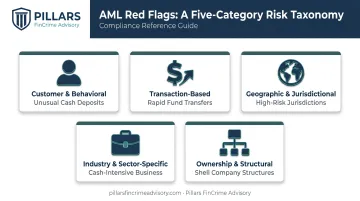
- AML red flags fall into five categories: customer, transaction, geographic, industry, and ownership
- A single red flag rarely justifies a SAR — patterns and missing explanations do
- Respond with documentation, EDD, and escalation—never by tipping off the customer
- A scalable, documented framework separates audit-ready programs from those under scrutiny
What Are AML Red Flags, and Why Do They Matter?
What Are AML Red Flags?
AML red flags are observable indicators, patterns, or inconsistencies that may indicate money laundering or terrorist financing risk in a customer, transaction, or relationship. The FFIEC manual describes these as examples of "potentially suspicious activities" that help institutions and examiners recognize possible laundering schemes. It also notes the list is never exhaustive.
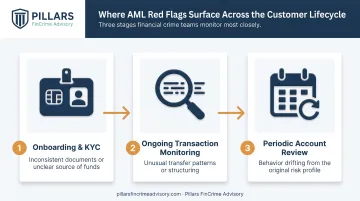
Red flags surface across the entire customer lifecycle:
- Onboarding/KYC — inconsistent identity documents, unclear source of funds
- Ongoing transaction monitoring — unusual transfer patterns, structuring
- Periodic account reviews — behavior drifting from the original risk profile
A red flag is a trigger for further inquiry, not proof of wrongdoing. A legitimate transaction can raise a flag simply because it is inconsistent with a customer's normal activity.
Why Red Flags Matter in AML Compliance
Regulators don't treat red flag identification as optional. FinCEN, FATF, and state or federal examiners expect institutions to build red flag recognition directly into a risk-based BSA/AML program.
Without a structured framework, compliance teams typically run into:
- Missed SARs that surface later during regulatory exams
- Inconsistent escalation across different teams or product lines
- Alert fatigue, where analysts start clearing flags without real review
- Exam findings tied to documentation gaps, not necessarily missed crimes
Nearly 5 million SARs were filed in a single fiscal year. Institutions best positioned to avoid enforcement action rely on clear, repeatable red flag processes—not ad hoc judgment calls.
Types of AML Red Flags Every Compliance Team Should Know
Treating red flags as one long checklist is a mistake. Categorizing them lets teams build targeted monitoring rules, focused training, and clear escalation paths for each risk type.
Customer and Behavioral Red Flags
These show up earliest, often before an account is even opened. Watch for:
- Reluctance or refusal to provide standard KYC information
- Vague or evasive answers about identity, occupation, or business purpose
- Identification documents that appear altered or can't be verified
- Account activity inconsistent with the customer's stated profile
Because these indicators surface at onboarding, they demand strong CDD and KYC controls upfront. Catching a mismatched identity document at intake is far cheaper than unwinding a laundering relationship two years in.
Transaction-Based Red Flags
This is where monitoring systems generate the most noise. Common patterns include:
- Structuring — deposits deliberately kept below reporting thresholds
- Unusually large or suspiciously round-dollar transfers
- Rapid movement of funds across multiple accounts with no clear purpose
- Activity that doesn't match the customer's declared line of business
For fast-scaling fintechs and payments platforms, this category drives the highest alert volumes. Poorly tuned monitoring rules here mean either missed real risk or an avalanche of false positives that burns out an analyst team.
Geographic and Jurisdictional Red Flags
Unexplained transactions tied to high-risk jurisdictions deserve extra scrutiny, but not automatic rejection. FATF's current list of jurisdictions under increased monitoring includes countries such as Haiti, Kenya, Syria, and Venezuela, among others.
FATF does not call for automatic enhanced due diligence against every country on that list. It means the jurisdiction has committed to fixing strategic deficiencies. Compliance teams should feed this geographic data into an overall customer risk score, weighed against transaction purpose and business rationale, not treat it as an instant block.
Industry and Sector-Specific Red Flags
Some business types carry elevated inherent risk regardless of how clean an individual transaction looks:
- Cash-intensive businesses (restaurants, car washes, convenience stores)
- Money service businesses and check cashers
- Virtual asset and crypto-related activity
- Trade finance with mismatched invoice values or shipping documentation
Fintechs and payments companies increasingly serve exactly these higher-risk verticals. A generic red flag list won't cut it. Sector-specific libraries are essential, not a nice-to-have.
Ownership and Structural Red Flags
Obscured ownership shows up in nearly every major laundering case on record. Watch for:
- Shell companies with no operational footprint
- Nominee shareholders masking the real owner
- Ownership layers with no legitimate business reason for the complexity
- Inability to identify the beneficial owner
FinCEN's beneficial ownership framework has shifted: as of the August 2026 final rule, most U.S.-formed companies are now exempt from BOI reporting. The requirement now centers on foreign entities registering to do business in a U.S. state.
Beneficial ownership itself is defined as anyone who exercises substantial control or owns 25% or more of the entity. Compliance teams still need UBO verification as part of CDD; the reporting obligation just narrowed.
How to Respond to AML Red Flags: From Detection to Resolution
Spotting a red flag is step one. Investigation, documentation, and escalation are what determine regulatory defensibility.
- Document the specific red flag observed. Compare it against the customer's expected profile and transaction history to establish real context, not just a gut reaction.
- Apply Enhanced Due Diligence where warranted. This includes verifying source of funds or wealth, and for higher-risk cases, getting senior management or MLRO sign-off before proceeding.
- Escalate internally through a defined chain. Route the case to the compliance officer or MLRO, and record both the decision and the reasoning behind it.
- Determine whether the suspicion threshold is met. If it is, file a Suspicious Activity Report. Under 31 CFR 1020.320(b)(3), banks must file within 30 calendar days of initial detection (or up to 60 calendar days total if no suspect is identified).
- Continue the relationship discreetly. Don't alert the customer that a report may be filed. That crosses into a tipping-off violation, which carries its own legal exposure.
Firms without a mature escalation framework often bring in outside expertise at this stage. Pillars FinCrime Advisory, founded by CAMS-certified compliance professional Joshua Douglas, helps fintechs, payments companies, and financial institutions build scalable, audit-ready red flag identification and SAR decision-making processes that stand up to examiner scrutiny.
Common Mistakes When Handling AML Red Flags
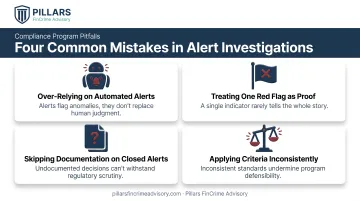
Even well-intentioned teams stumble in predictable ways:
- Over-relying on automated alerts. Systems flag patterns but miss context. Without human judgment, teams both miss real red flags and drown in alert fatigue.
- Treating one red flag as proof. A single indicator is a prompt for inquiry, not a verdict. Genuine suspicion comes from patterns plus a missing legitimate explanation.
- Skipping documentation on closed alerts. Failing to record why an alert was closed or escalated is among the most frequent exam findings—and often more damaging than the underlying risk.
- Applying criteria inconsistently. Different red flag standards across business lines or products create gaps examiners find quickly, undermining an otherwise solid program.
Conclusion
AML red flags are indicators, not verdicts. Recognizing patterns across customer, transaction, geographic, industry, and ownership categories is what separates an effective compliance program from one that only reacts to alerts.
A documented, risk-based response process protects the institution and reduces unnecessary friction for legitimate customers. Firms looking to modernize their red flag frameworks and strengthen exam readiness can work with an experienced partner like Pillars FinCrime Advisory. The goal is a program that scales with the business instead of lagging behind it.
Frequently Asked Questions
What is a red flag for money laundering?
A red flag is any indicator, unusual pattern, or inconsistency in a customer's information or transactions that lacks a clear legitimate explanation and warrants further review. It's a prompt for investigation, not a conclusion.
What are the 5 pillars of anti-money laundering?
The five pillars are:
- A system of internal controls
- Independent testing
- A designated compliance officer
- Ongoing employee training
- Risk-based customer due diligence, including beneficial ownership verification under the CDD rule
What's the difference between a red flag and a Suspicious Activity Report (SAR)?
A red flag is an indicator that prompts a closer look. A SAR is the formal report a financial institution files once review confirms genuine suspicion of illicit activity.
How many red flags does it take to trigger a SAR filing?
There's no fixed number. SAR filing depends on whether the combination of indicators, along with the absence of a credible explanation, creates genuine suspicion of illicit activity.
Do AML red flags vary by industry?
Yes. Cash-intensive businesses, money service businesses, crypto platforms, and real estate firms each carry distinct risk patterns. Monitoring rules should be tailored to each sector's specific exposure.
What does "tipping off" mean in relation to red flags?
Tipping off happens when a firm directly or indirectly alerts a customer that a SAR has been or may be filed. Under federal law, willfully disclosing this information can carry criminal penalties.