Introduction
Most people who search "FinCEN MSB registration cost" assume there's a government filing fee waiting for them. There isn't.
Form 107, the federal registration required under the Bank Secrecy Act, costs $0 to file. The real cost of becoming an operational, compliant money services business comes from state licensing, AML program development, and the ongoing infrastructure needed to keep your program audit-ready.
This guide breaks down what drives cost, a full expense breakdown, whether to build compliance in-house or bring in outside help, and how to budget correctly for 2026. Insights draw on Pillars FinCrime Advisory's hands-on work helping fintechs, payments companies, and financial institutions build scalable, audit-ready compliance programs.
Key Takeaways
- FinCEN Form 107 MSB registration costs $0; state licensing and AML setup drive the real spend
- Total compliance costs run from a few thousand dollars to several hundred thousand for nationwide licensing
- State licensing, surety bonds, and net worth requirements typically drive the bulk of your budget
- Underinvesting early often costs more later through penalties, remediation, or lost banking relationships
How Much Does FinCEN MSB Registration Cost? (Pricing Overview)
FinCEN registration itself is free by statute. The regulation imposes no filing charge, and the BSA E-Filing system doesn't collect one either. What drives your budget is the full cost of becoming a compliant MSB, not the free registration form.
Failing to register still carries a civil penalty of up to $5,000 per violation, and each day the violation continues counts as a separate violation under 31 U.S.C. 5330. Skip the free form, and noncompliance racks up daily exposure fast.
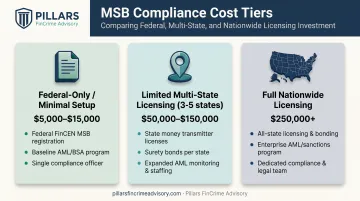
Typical Cost Range to Become an Operational, Compliant MSB
These ranges include filing and licensing fees, bonds, and basic AML program costs. They generally exclude legal fees, ongoing staffing, and technology unless noted.
- Federal-only / minimal setup: roughly $5,000–$15,000
- Limited multi-state licensing (3–5 states): about $50,000–$150,000
- Full nationwide licensing + robust AML infrastructure: $250,000 and up
Price Range 1: Federal Registration Only + Basic AML Program
What's typically included:
- Form 107 filing
- A foundational written AML policy
- Designation of a compliance officer
Best for: Businesses that qualify for state exemptions or operate only in jurisdictions with minimal licensing requirements.
Price Range 2: Federal Registration + Select State Licensing
What's typically included:
- Form 107 filing
- Licensing application fees and bonds for a handful of states
- A tailored AML program plus initial compliance consulting
Best for: Startups launching in a limited number of states before scaling nationally.
Price Range 3: Federal Registration + Nationwide Licensing + Full Compliance Infrastructure
What's typically included:
- Licensing across most states plus DC
- Larger surety bonds, dedicated compliance staff
- Transaction monitoring technology and independent audits
Best for: Established payments companies, fintechs, or crypto exchanges scaling nationwide.
Key Factors That Affect Your Total MSB Compliance Cost
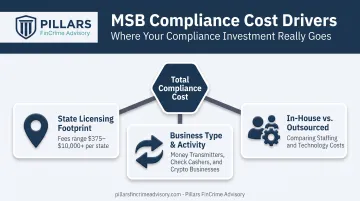
Total cost depends on three variables: your regulatory footprint, how complex your business model is, and how much compliance you build in-house versus outsource.
State Licensing Footprint
Every additional state multiplies your costs. Each one carries its own application fee, bond requirement, and net worth minimum. Application fees alone range from $375 in Florida to $10,000 in Texas, according to state statutes. Required security can run anywhere from $50,000 to $7 million depending on the state and your transaction volume.
Bond amounts and net worth minimums are separate line items, not one figure. A bond is the face amount a surety company backs; net worth is capital you must actually hold. States like California and Texas use asset-based formulas that scale with business size, while smaller states cap requirements lower.
Operating in one or two states might cost tens of thousands. Pursuing licensing across nearly all states plus DC can easily exceed six figures before you've processed a single transaction.
Business Type and Activity
Not all MSB categories face equal licensing burdens:
- Money transmitters generally face the heaviest state licensing requirements
- Check cashers and currency exchangers often carry lighter compliance obligations
- Crypto and virtual currency businesses add costs for blockchain analytics tools and Travel Rule compliance
Crypto adds another layer. FinCEN guidance flags $3,000 or more in convertible virtual currency as a Travel Rule threshold, meaning transmitter and recipient data must be captured and shared. That data infrastructure isn't free.
In-House Build vs. Outsourcing
Hiring a full-time compliance officer means salary, benefits, and ramp-up time. Engaging an outside advisory firm through a fractional CCO/BSA officer model provides senior-level expertise without full-time employment overhead. Pillars FinCrime Advisory uses this approach with fintech and payments clients who need experienced leadership without a full internal hire.
Technology follows the same build-vs-buy logic. Transaction monitoring, sanctions screening, and case management tools scale with your volume and complexity. A low-volume MSB might get by with modest tooling; a high-volume payments company needs higher-capacity monitoring at a much higher monthly cost.
Multi-state licensing applications often require legal counsel familiar with each jurisdiction's quirks. Compliance consultants who design your AML program add another line item, but that investment typically pays for itself by avoiding costly rework later.
Full Cost Breakdown: One-Time vs Recurring Expenses
Total MSB compliance cost spans several categories beyond the $0 federal filing fee. Here's how they break down:
| Cost Category | One-Time or Recurring | Description |
|---|---|---|
| FinCEN Federal Registration (Form 107) | One-time, renewed every 2 years | Filing fee is $0, but renewal is due every two years by December 31. Missing it triggers the same penalties as never registering. |
| State Licensing Application Fees | One-time per state, with periodic renewal | Ranges from roughly $375 to $10,000+ per state depending on jurisdiction. |
| Surety Bonds | Recurring (annual premium) | Premiums are typically a percentage of the total bond face amount, billed annually. |
| AML Program Development and Staffing | Both: initial build plus ongoing | Covers policy drafting, compliance officer designation or hiring, and continued program management. |
| Independent Testing and Audits | Recurring, typically annual | Third-party or qualified internal reviews that test program effectiveness and satisfy examiner expectations. |
| Technology and Transaction Monitoring Tools | Recurring (subscription-based) | Software costs scale with transaction volume and business complexity. |
Two line items trip teams up most often.
Federal renewal deadlines are easy to miss. MSBs must re-register every 24 months by December 31. That cycle is separate from the 180-day re-registration triggered by material ownership or control changes. Miss either deadline, and you're back in civil penalty territory.
Independent testing doesn't legally require a CPA or outside firm. An internal employee independent of the compliance function can conduct it—but scope and frequency should be risk-based, not a rubber stamp.
DIY vs Professional Compliance Support — Which Costs Less Long-Term?
Many businesses try to save money by handling registration and licensing entirely in-house. It's understandable: nobody wants to spend on compliance before they've generated revenue. But this approach can backfire given how much regulatory nuance exists across 50 states plus DC.
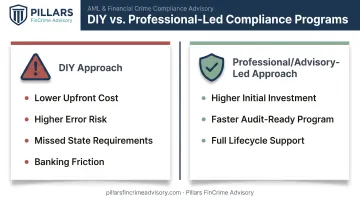
The DIY approach:
- Lower upfront cost
- Higher risk of registration errors, missed state requirements, and processing delays
- Banking friction when sponsor banks scrutinize compliance maturity
The professional/advisory-led approach:
- Higher initial investment
- Faster path to a scalable, audit-ready program
- Full lifecycle support from policy development through exam readiness
Pillars FinCrime Advisory helps fintechs, payments companies, and financial institutions work through this tradeoff. Founder Joshua Douglas, a CAMS-certified compliance professional with 12+ years in financial crime, focuses on turning regulatory expectations into practical business decisions rather than generic checklists.
The long-term math usually favors experienced guidance. Businesses that invest early tend to avoid remediation costs, enforcement penalties, and banking relationship damage that's far more expensive to fix than to prevent.
How to Budget for MSB Compliance in 2026 (And Mistakes to Avoid)
The right budget balances what you need today with where your business is headed, not just the lowest number that gets you through registration.
Factors to Consider When Budgeting
- Growth roadmap: Where do you plan to operate in the next two to three years? Budget for that footprint, not just your launch states.
- Transaction complexity: Crypto activity, cross-border transfers, and high volume all add compliance overhead.
- Build vs. buy: Decide early whether compliance stays in-house or gets outsourced. Retrofitting later costs more than planning ahead.
Common Mistakes That Inflate Costs Later
- Registering with FinCEN, then delaying state licensing research. This leads to rushed, more expensive compliance work once you're already operating.
- Underinvesting in AML program design. Weak programs often surface as examination findings, triggering remediation costs that dwarf the original investment.
- Assuming "free" federal registration means minimal investment overall. The $0 filing fee has nothing to do with the total cost of running a compliant program.
Frequently Asked Questions
Is FinCEN MSB registration free, or does it cost money?
Filing Form 107 with FinCEN is free. There's no government filing fee. The real costs come from state money transmitter licensing, AML program development, and ongoing compliance operations.
How do I update my FinCEN registration?
Material changes—such as certain ownership or control changes, transfers of more than 10% of voting power, or a 50% or greater increase in agents—require re-registration. File Form 107 within 180 days of the triggering event.
How do I find my FinCEN number?
FinCEN doesn't issue a certificate or unique number for MSB registration. You can confirm your registration status anytime using FinCEN's MSB Registrant Search tool.
What is the definition of a money transmitter?
A money transmitter is anyone who accepts currency, funds, or value that substitutes for currency and transmits it to another person or location. There's no minimum transaction threshold that triggers this definition.
How much does state money transmitter licensing typically cost?
Costs vary widely by state, from around $375 in Florida to $10,000 in Texas for application fees alone, before factoring in surety bonds and net worth requirements that can run into the millions.
What happens if I operate as an MSB without registering?
You face civil penalties of up to $5,000 per violation, with each day counted separately. Operating an unlicensed money transmitting business can also carry criminal exposure, including up to five years in prison under federal law.