
Introduction
Every fast-growing fintech and payments company eventually hits the same fork in the road: build an internal AML/BSA compliance function, or bring in outsourced expertise to run it. This isn't just a hiring decision.
It shapes how quickly you're ready for your next exam, how confident your banking partners feel, and whether you can scale without a compliance bottleneck.
The pressure is real. According to ACAMS' Global AFC Threats Report 2026, 47% of nearly 1,400 anti-financial-crime professionals surveyed across more than 200 jurisdictions rated staffing shortages, talent retention, and lack of ongoing training as a high or very high risk.
This post breaks down both staffing models, where each one fits, and a practical framework for choosing between them.
Key Takeaways
- Outsourced officers bring specialized AML expertise on a flexible basis—without fixed overhead
- In-house hires offer daily oversight and institutional knowledge at higher cost and key-person risk
- Choose based on growth stage, regulatory complexity, exam frequency, and budget
- Many fintechs pair an internal owner with outsourced specialists for a hybrid approach
- Picking the wrong model can delay licensing or damage banking relationships
Outsourced Compliance Officer vs. In-House Hire: Quick Comparison
Here's how the two models stack up across the factors that matter most to fintechs, payments companies, and financial institutions:
| Factor | Outsourced Compliance Officer | In-House Hire |
|---|---|---|
| Cost | Retainer or project-based fees, scaled to engagement scope | Salary, benefits, payroll tax, recruiting fees, training, and RegTech tools |
| Time to Deploy | Typically engaged and operational within weeks | Recruiting, vetting, and onboarding often takes several months |
| Scope of Expertise | Cross-industry exposure from working across fintechs, payments companies, and institutions | Deep familiarity with one company's products, narrower external exposure |
| Scalability | Scales with transaction volume, new licenses, or product launches | Fixed capacity; scaling requires new headcount and lead time |
| Regulatory Accountability | Company retains ultimate responsibility; officer role is designated with oversight | Serves as a direct, on-site accountability point examiners often expect |
On that last point: outsourcing doesn't outsource your regulatory obligations. Federal banking agencies have been explicit that using a third party does not diminish an institution's responsibility to comply to the same degree as if the work were done in-house. The board still owns oversight. Day-to-day execution can shift; accountability does not.
What Is an Outsourced Compliance Officer?
An outsourced compliance officer is a specialized advisor or fractional executive who leads or supports your AML/BSA program without joining your payroll. For a fintech scaling fast or navigating a licensing push, this model closes an expertise gap without the twelve-month runway a full department requires.
The operational impact usually shows up in a few specific ways:
- Access to CAMS-certified expertise without a full-time salary commitment
- A faster runway to audit readiness because the person has done this before
- Reduced fixed overhead compared to building a department
- An engagement that can be right-sized as the company grows
Common Engagement Structures
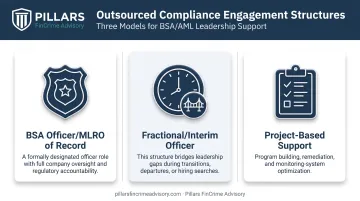
Outsourced compliance support varies by need. Common structures include:
- BSA Officer/MLRO of record: an outside expert formally designated to lead the program, with the company maintaining oversight and documentation
- Fractional or interim officer: bridging a leadership gap during a transition or search for a permanent hire
- Project-based support: building a program, remediating findings, or optimizing transaction monitoring
Pillars FinCrime Advisory is built around this model. Founder Joshua Douglas brings 12+ years of financial crime experience and nearly two decades in financial services.
The firm provides fractional CCO/BSA Officer services and full lifecycle program support, from policy development through transaction monitoring optimization and audit readiness, for fintechs, payments companies, and financial institutions.
Use Cases of an Outsourced Compliance Officer
This model tends to fit companies that are actively growing or changing:
- Fintechs scaling rapidly and outgrowing a lean compliance setup
- Companies pursuing new state money-transmitter licenses
- Businesses entering new sponsor bank partnerships that demand bank-ready compliance
- Organizations working through regulatory remediation after an exam finding
In one engagement, Pillars FinCrime Advisory helped a fintech navigate a complex regulatory review without stalling growth. The program became scalable and audit-ready, giving leadership more confidence ahead of future scrutiny.
What Is an In-House Compliance Hire?
An in-house compliance hire is a full-time employee embedded in daily operations, culture, and decision-making. This person sits in your Slack channels, attends your product meetings, and knows why your risk appetite changed last quarter. That context is something an outside advisor picks up more slowly.
Benefits are strongest for organizations with steady, high-volume compliance workloads:
- Direct, daily oversight of the program
- Institutional knowledge that builds over time
- Immediate availability for internal escalations
- Organic development of a compliance-first culture across teams
How This Scales by Company Size
The title changes as the organization grows:
- Early stage: a dedicated BSA Officer wearing multiple hats
- Growth stage: a Compliance Manager supporting a small team
- Mature stage: a Chief Compliance Officer overseeing a full GRC department
Use Cases of an In-House Compliance Hire
This model fits best where compliance workload is constant, not occasional. That usually means:
- Established banks with steady, high-volume alert and reporting activity
- Larger fintechs with mature programs and dedicated compliance budgets
- Institutions where examiners expect a dedicated on-site accountability figure
When the model fits, budgeting still requires realistic salary expectations. According to Salary.com's 2026 benchmark, the average U.S. BSA Officer earns $89,983 annually, with a 25th-to-75th percentile range of $84,493 to $93,463.
That figure excludes benefits, payroll tax, recruiting costs, and ongoing training. Those extras push the true cost of the hire well above base salary alone.
Which Model Is Right for You? A Decision Framework
There's no universal answer here. The right call depends on weighing a handful of factors together, not picking the trendier option.
Key factors to weigh:
- Company growth stage and funding trajectory
- Regulatory complexity — how many licenses, states, or products you manage
- Budget and headcount plans for the next 12-18 months
- Frequency of exams or audits on your calendar
- Current availability of specialized talent in your market
Situational guidance:
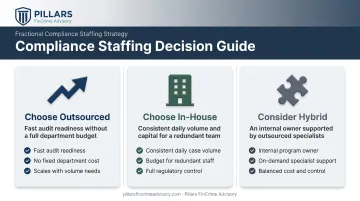
- Choose outsourced if you're a growing fintech that needs to be audit-ready quickly without the budget for a full department
- Choose in-house if you have consistent, high daily compliance volume and the capital to sustain a team with built-in redundancy
- Consider hybrid if you want an internal owner supported by outsourced specialists for program optimization, policy work, or audit prep
Real-World Scenario: Outsourced Support in Action
Picture a payments company whose transaction volume has outgrown its alert review capacity right as a scheduled exam approaches. Alerts are piling up. A new sponsor bank requirement or an internal audit finding pushes leadership to act before the backlog becomes a regulatory problem.
This is where transaction monitoring optimization earns its keep. A VP of Compliance Operations who worked with Pillars FinCrime Advisory on this kind of challenge saw clear gains after monitoring was optimized and KYC processes redesigned: alert quality improved, operational friction dropped, and the team went into exams better prepared.
Outsourced expertise can bridge a capability gap fast, right when growth and examiner scrutiny converge. If you're unsure whether your staffing model can take that pressure, talk with Pillars FinCrime Advisory before your next exam, not during it.
Conclusion
Neither outsourced nor in-house compliance staffing wins by default. The right structure depends on your growth stage, risk profile, and the resources you actually have—not a generic best practice. A seed-stage payments startup and a regional bank with a decade of history simply don't share the same needs.
Match the model to that context and you protect banking relationships, walk into exams prepared, and grow without compliance risk you didn't budget for. Get it wrong, and you rebuild under regulatory pressure instead of ahead of it. Map your stage, risk, and budget against both options before you hire or contract—and if a fractional model fits, bring in experienced support that can stand up the program without a full-time seat.
Frequently Asked Questions
Can you outsource a compliance officer instead of hiring in-house?
Yes. Outsourcing BSA/AML compliance functions is a recognized practice in financial services. However, the company retains ultimate regulatory responsibility even when day-to-day duties are handled externally.
How much does a compliance officer make?
U.S. BSA Officers average $89,983 annually, with a typical range of $84,493 to $93,463, excluding benefits, payroll tax, and training. Outsourced arrangements instead use retainer or project-based fees scaled to the engagement.
What are the three C's of compliance?
There's no single authoritative "three C's" from federal regulators. FinCEN's guidance instead outlines six culture elements, including leadership support, adequate resources, and independent testing of the program.
Is outsourcing compliance cheaper than hiring in-house?
Often, yes, for growing companies. Outsourcing avoids fixed salary, benefits, and recruiting overhead, letting you pay for expertise scaled to your actual workload instead of a full-time headcount.
Can an outsourced compliance officer serve as a company's BSA Officer or MLRO of record?
Yes. This is a common arrangement in many regulatory frameworks, provided the company maintains documented oversight and the board retains ultimate accountability for the program.
When should a growing fintech transition from outsourced to an in-house compliance hire?
Transition when compliance work is daily, you hold licenses across multiple states, or transaction volume sustains a dedicated internal team with built-in redundancy.