
Misclassifying your business isn't a paperwork inconvenience. It can trigger unexpected FinCEN MSB registration, a full anti-money laundering program buildout, and ongoing SAR and CTR filing obligations you never budgeted for.
This guide breaks down the exemption's legal basis, the four conditions you must satisfy simultaneously, real FinCEN rulings showing where the exemption held and where it collapsed, and practical steps to protect your exempt status going forward.
Key Takeaways
- The payment processor exemption requires meeting four conditions at once; missing one voids it entirely.
- FinCEN evaluates your entire funds-flow lifecycle, not just the customer-facing transaction.
- Virtual currency businesses routinely fail the exemption because disbursement happens outside bank-only settlement rails.
- Losing the exemption means MSB registration, an AML program, and SAR/CTR compliance.
- Exemption analysis is fact-specific: another company's ruling doesn't automatically cover you.
What Is the FinCEN Payment Processor Exemption?
Under 31 CFR § 1010.100(ff), a money services business (MSB) includes any person doing business in the U.S. in specific defined capacities — one of which is "money transmitter." A money transmitter is someone who provides money transmission services or otherwise engages in transferring funds.
Money transmission services means accepting currency, funds, or any value that substitutes for currency from one person and transmitting it to another person or location, by any means. That definition is intentionally broad.
Without a qualifying exemption, almost any business that accepts and moves funds on behalf of others gets swept into money transmitter status. That triggers the full weight of Bank Secrecy Act (BSA) compliance:
- Registration with FinCEN
- An AML program
- Recordkeeping
- Suspicious activity monitoring
The payment processor exemption addresses this. Codified at 31 CFR § 1010.100(ff)(5)(ii)(B), it excludes a person who acts only as a payment processor to facilitate the purchase of goods or services, or bill payments, through a clearance and settlement system, under an agreement with the creditor or seller.
FinCEN further clarified this exemption in rulings FIN-2013-R002 and FIN-2014-R009.
The logic is straightforward: the underlying funds already pass through BSA-regulated financial institutions like banks and card networks. Layering a second MSB registration on top of that flow would be redundant. But the exemption only protects businesses that keep the entire flow within that regulated infrastructure.
The Four Conditions for the Payment Processor Exemption
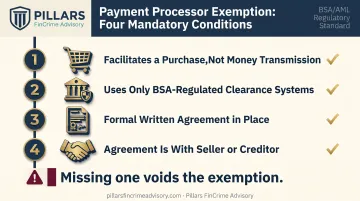
A payment processor must meet all four conditions simultaneously. FinCEN's own rulings show that missing even one , regardless of how solid the other three look, voids the exemption completely.
Condition 1: Facilitating a Purchase, Not Money Transmission Itself
The service must exist to facilitate payment for a good, service, or bill. It cannot be standalone money transmission dressed up as a payment service. In FIN-2014-R011, FinCEN found that exchanging real currency for virtual currency was the service itself, not an incidental step in a purchase. That alone disqualified the exemption.
Condition 2: Operating Only Through BSA-Regulated Clearance and Settlement Systems
Every leg of the transaction , including disbursement to the merchant, must flow through systems that admit only BSA-regulated financial institutions. Think ACH, card networks, or wire systems. This is the condition that trips up the most businesses, especially once non-bank rails or digital wallets enter the picture.
Condition 3: A Formal Agreement Must Govern the Service
The exemption requires a documented, formal agreement. Informal arrangements, verbal understandings, or loosely defined vendor relationships don't qualify, no matter how the funds actually move.
Condition 4: The Agreement Must Be With the Seller or Creditor
At minimum, the formal agreement must be with the seller or creditor that provides the goods or services and ultimately receives the funds. An agreement solely with the customer, or with an unrelated intermediary, isn't enough.
Payment Processor vs. ISO vs. Money Transmitter: Key Distinctions
These three roles get confused constantly, but FinCEN's rulings draw a clear functional line based on who actually touches the funds.
An independent sales organization (ISO) solicits merchants for card processing services but never takes possession or control of merchant funds. Because it neither accepts nor transmits funds, an ISO generally falls outside the money transmitter definition entirely — no exemption analysis even necessary.
A third-party payment processor is different. It presents claims, collects payments, and settles funds with merchants on their behalf under a merchant agreement. Because it does handle funds, it must independently satisfy all four exemption conditions above.
A true money transmitter accepts and transmits funds without qualifying for any exemption, which means full FinCEN registration and AML program requirements apply.
| Role | Touches Funds? | Regulatory Outcome |
|---|---|---|
| ISO | No | Generally outside money transmitter definition |
| Payment Processor | Yes | Must satisfy all four exemption conditions |
| Money Transmitter (non-exempt) | Yes | Full MSB registration and AML obligations |
Case Studies: When the Exemption Applies vs. When It Doesn't
FinCEN's administrative rulings are the clearest window into how this exemption actually plays out.
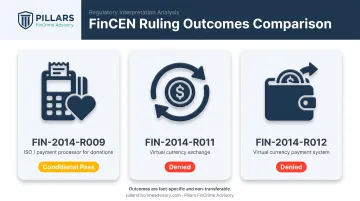
FIN-2014-R009 involved a company acting as both an ISO and a payment processor for nonprofit and religious donation clients. Its ISO activity (soliciting merchants without touching funds) was found not to be money transmission at all.
Its payment processor role met three of the four conditions. FinCEN still couldn't issue an unconditional approval because the ruling hinged entirely on whether merchant disbursements stayed inside a BSA-regulated clearance system.
FIN-2014-R011 involved a virtual currency trading platform. FinCEN denied the exemption because the platform itself wasn't a clearance and settlement system limited to BSA-regulated institutions. Exchanging currency was also the core service, not a facilitation step.
FIN-2014-R012 involved a virtual currency payment system. The real-currency leg from customers satisfied the clearance-system condition. But disbursement of Bitcoin to merchants happened entirely outside a BSA-regulated system, which broke the exemption regardless of how compliant the customer-facing side looked.
The pattern across all three rulings is consistent:
- FinCEN evaluates the entire funds-flow lifecycle, not just the customer-facing leg
- One non-bank rail anywhere in the chain can disqualify the whole exemption
- Outcomes are fact-specific and non-transferable across similar models
A business model that qualifies for one company under one set of facts may not qualify for another with a slightly different disbursement method.
Common Mistakes That Put the Exemption at Risk
FinCEN's rulings keep pointing to the same three mistakes:
- Non-bank disbursement channels. Paying merchants through unregulated wallets, monetary instruments, or non-bank rails instead of BSA-regulated settlement systems, the exact issue that sank FIN-2014-R012.
- Stale or missing formal agreements. Operating without an updated written agreement covering every party in the funds-flow chain, particularly after onboarding new merchants or adding new currencies.
- Unreviewed expansion. Adding new payment rails, cross-border flows, or digital assets without reassessing the original exemption analysis, so a model that qualified at launch can stop qualifying after growth.
Any one of these can convert an exempt payment processor into an unregistered money transmitter, often without anyone noticing until an examiner or bank partner asks.
How to Confirm and Maintain Your Payment Processor Exemption Status
Exemption status isn't a one-time determination. It needs active maintenance as your business evolves.
- Map the complete funds-flow lifecycle. Document acceptance, clearance, and disbursement against all four exemption conditions before relying on exempt status for any product line.
- Get an outside compliance risk assessment. An independent review can catch gaps your internal team may be too close to see, particularly around disbursement rails and agreement coverage.
- Request a formal FinCEN ruling when facts are ambiguous. Under 31 CFR Part 1010, Subpart G, businesses can submit a written request describing their complete factual situation and asking FinCEN to weigh in directly.
Pillars FinCrime Advisory works through this analysis with fintechs, payments companies, and financial institutions. Founder Joshua Douglas—CAMS-certified, with 12+ years in financial crime and nearly 20 years across financial services—helps leadership teams pressure-test money transmitter exposure and build compliance programs that scale without slowing growth.
For companies expanding into new markets, currencies, or payment rails, that outside view often catches exemption gaps before a regulator or sponsor bank does.
Frequently Asked Questions
Who is exempt from the FinCEN CDD rule?
The Customer Due Diligence (CDD) rule applies to covered financial institutions like banks, broker-dealers, and mutual funds, not payment processors specifically. Some regulated entities fall outside CDD beneficial ownership requirements, which is distinct from payment processor exemption status under the BSA.
What is a third-party payment processor?
A third-party payment processor collects payments and settles funds with merchants on their behalf, under a formal merchant agreement. It's distinct from the merchant itself and must independently satisfy the four exemption conditions to avoid money transmitter status.
Does the payment processor exemption apply to cryptocurrency businesses?
Generally, no. FinCEN rulings FIN-2014-R011 and FIN-2014-R012 both show the exemption failing for virtual currency businesses, primarily because disbursement occurs outside BSA-regulated clearance systems.
What happens if a company loses its payment processor exemption?
The company would need to register as an MSB, implement a full AML program, and comply with recordkeeping, SAR, and CTR filing obligations. That is a significant operational and cost shift if it hasn't planned for it.
Is an ISO treated the same as a payment processor under BSA rules?
No. ISOs that never take possession of funds are generally not money transmitters at all. Payment processors, by contrast, do handle funds and must independently satisfy the four-condition exemption test.
Can a company request its own ruling from FinCEN on exemption status?
Yes. Businesses can request an administrative ruling from FinCEN under 31 CFR Part 1010, Subpart G, to get clarity on their specific facts and circumstances rather than relying on another company's ruling.