Many compliance teams still treat OFAC as a domestic U.S. concern that only applies once money physically crosses American borders. That assumption has already cost Swiss banks dearly. Credit Suisse alone paid $536 million in a 2009 global settlement over sanctions violations, and other Swiss institutions have since paid tens of millions more.
This article breaks down why OFAC reaches Swiss banks, walks through the real enforcement cases that prove it, outlines the compliance obligations institutions actually need to meet, and explains how to build a program that can survive regulatory scrutiny.
Key Takeaways
- OFAC jurisdiction reaches Swiss banks once a transaction hits USD clearing or U.S. correspondent banking.
- FINMA's "supervisory guarantee" doctrine pushes Swiss banks to follow U.S. sanctions law without a direct legal mandate.
- Credit Suisse, EFG International, and MBaer show penalties from multimillion-dollar fines to full U.S. market exit.
- Omnibus accounts and one-time screening are the recurring failure points in every major case.
- A scalable, well-governed sanctions program is the strongest defense against regulators and reputational damage.
Why US OFAC Sanctions Reach Swiss Banks: The Extraterritorial Effect
Swiss banks aren't bound by OFAC through Swiss law. They're bound by the plumbing of global finance.
Nearly every USD-denominated transaction, regardless of where it originates, clears through a U.S. correspondent bank at some point. That single fact gives OFAC an effective jurisdictional hook over Swiss institutions even when no U.S. person is directly involved in the deal.
FINMA's Supervisory Guarantee
Switzerland's financial regulator, FINMA, enforces what's known as the "supervisory guarantee of irreproachable business conduct." This doctrine requires Swiss financial institutions to respect foreign supervisory law, including OFAC, despite having no direct statutory obligation to do so under Swiss law.
This isn't theoretical. The Zurich Commercial Court confirmed the principle in a November 2020 ruling, and Switzerland's Federal Supreme Court affirmed it on appeal in August 2021. Together, these rulings formally established that Swiss banks can be required to avoid serious U.S. sanctions exposure as a matter of Swiss supervisory law, not just American law.
The 50% Rule
OFAC's "50% Rule" extends sanctions to any entity owned 50% or more, individually or in aggregate, by blocked persons, even if that specific entity never appears by name on the SDN List. For Swiss banks managing globally dispersed, layered ownership structures, this creates screening complexity banks with simpler ownership books rarely face.
Primary vs. Secondary Exposure
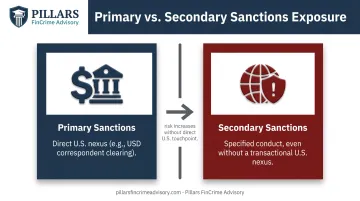
- Primary sanctions apply when a transaction has a direct U.S. nexus, such as clearing through a U.S. correspondent bank.
- Secondary sanctions can target non-U.S. banks for specified conduct even without a transactional U.S. nexus at all.
Clearing a trade in USD is often enough to create primary exposure. Secondary risk turns on the conduct itself, even when no U.S. dollar leg is present.
The FinCEN proposal targeting MBaer shows where this escalates. FinCEN alleges more than $37 million connected to an Iranian oil-smuggling scheme involving IRGC-QF officials, plus tens of millions more tied to Russia and Ukraine-linked activity.
The proposed remedy goes beyond a fine. FinCEN seeks a fifth special measure under Section 311 that would bar U.S. institutions from maintaining any correspondent access for MBaer, directly or indirectly.
Switzerland's Own Sanctions Framework vs. US Requirements
Switzerland runs its own sanctions regime, and it doesn't automatically mirror Washington's.
The Embargo Act (EmbA) of 2002 is the domestic legal basis for Swiss sanctions, enforced by the State Secretariat for Economic Affairs (SECO) through its SESAM database. Federal Council ordinances implement each sanctions program individually.
Here's the structural gap that trips up compliance teams:
- Switzerland has no automatic duty to adopt EU sanctions.
- Switzerland has zero obligation to adopt OFAC sanctions directly.
- Adoption of a foreign sanctions regime requires a specific Federal Council decision under EmbA.
This means a Swiss bank can be fully compliant with every applicable Swiss ordinance and still walk directly into an OFAC enforcement action. Swiss law and U.S. regulatory expectations simply aren't the same checklist.
A client who's clean under SECO's list may still sit on OFAC's SDN List. That gap shows up most often with designations tied to Iran, Russia, and narcotics trafficking.
For any bank with USD exposure, dual-track screening against both Swiss and U.S. frameworks is the baseline—not an enhancement.
Lessons from Major OFAC Enforcement Actions Against Swiss Banks
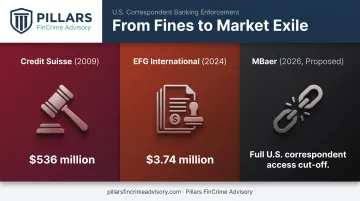
Three cases map the entire spectrum of consequences, from civil fines to total market exile.
Credit Suisse: The $536 Million Warning
Credit Suisse's 2009 global settlement totaled $536 million, split between the U.S. government and the New York County District Attorney's office. OFAC resolved civil liability in the same action. The conduct behind it was deliberate concealment:
- Employees altered SWIFT payment fields to strip sanctioned names and locations.
- Cover payments substituted "Credit Suisse" or "Order of a Customer" language to slip past U.S. correspondent screening.
- Confirmed transaction volumes included 4,775 transfers worth $480 million tied to Iran, plus tens of millions more connected to Sudan and Libya.
EFG International: Omnibus Accounts and Missed Designations
EFG International's 2024 case resulted in a $3,740,442 penalty, reduced from a $10,686,977 base amount. It broke down into three distinct violation categories:
- 727 Cuba-related securities transactions worth roughly $29.9 million, processed through omnibus accounts over several years.
- 141 transactions totaling $468,615 benefiting a Kingpin Act-designated narcotics trafficker.
- Inadvertent dividend payments to a Russian individual shortly after their designation.
OFAC's published enforcement details credited mitigating factors including voluntary self-disclosure, full cooperation, and remedial screening upgrades. Aggravating factors included a multi-year failure to screen and direct benefit flowing to a sanctioned jurisdiction.
MBaer: The Nuclear Option
MBaer shows the ceiling of U.S. enforcement risk. Rather than a monetary penalty, FinCEN's proposed Section 311 action would strip the bank of U.S. correspondent access, direct and indirect. Once that access is gone, remediation rarely restores it.
All three cases share the same underlying weakness: omnibus and nominee account structures that obscure beneficial ownership, combined with a lack of continuous, dynamic rescreening as client risk profiles or sanctions lists change. A client who's clean at onboarding doesn't stay clean forever.
Core OFAC Compliance Obligations Swiss Banks (and Their US Counterparts) Must Meet
Swiss banks operating with any USD exposure face the same practical obligations as U.S. institutions, whether or not Swiss law says so explicitly.
Screening scope must go deeper than the account name. Institutions need to screen every customer, counterparty, and underlying sub-account holder against the OFAC SDN List. That includes applying the 50% Rule to catch indirect ownership hiding behind holding companies or nominee structures.
Onboarding checks aren't enough. OFAC doesn't mandate a fixed rescreening interval, but dynamic, ongoing rescreening is essential. A client with zero risk flags at onboarding can become a designated person, or relocate to a restricted jurisdiction, years later.
Omnibus and nominee accounts need enhanced due diligence. As EFG's case demonstrated, these structures can mask beneficial ownership from both the Swiss institution and any U.S. intermediary bank downstream. Screening only the omnibus account name, without visibility into underlying holders, leaves a blind spot regulators will find.
Parallel reporting duties run both ways. Swiss banks must maintain:
- SECO notification for blocked funds or economic resources under applicable Swiss sanctions ordinances
- U.S. OFAC screening and internal controls under the 2019 OFAC Framework
The Framework expects management commitment, risk assessment, internal controls, testing, and training. Neither obligation replaces the other. Meeting Swiss requirements alone leaves an institution exposed to U.S. enforcement, and vice versa.
Building an OFAC-Ready Compliance Program for Cross-Border Banking Relationships
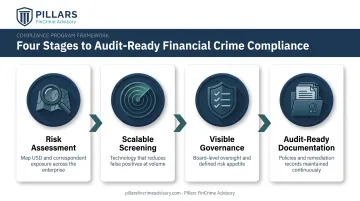
A defensible program starts with mapping exposure, not buying software.
Start With a Real Risk Assessment
Map and document every touchpoint connecting an institution's transactions, correspondent relationships, and USD clearing activity to the U.S. financial system. That includes indirect exposure through foreign correspondents that themselves maintain U.S. accounts.
Invest in Screening That Scales
Technology-driven screening and monitoring tools need to handle complex ownership structures and high transaction volumes without drowning compliance teams in false positives. A system that flags everything is functionally the same as a system that flags nothing.
Build Governance That Examiners Can See
Board- and C-suite-level governance frameworks translate OFAC's regulatory expectations into concrete decisions about risk appetite, program investment, and strategic positioning. Examiners and correspondent banks evaluate this governance maturity when deciding whether to continue a banking relationship at all.
Make the Program Audit-Ready Before You Need It
Documented policies, training records, and remediation plans matter. OFAC's own enforcement guidelines reward self-disclosure and demonstrated remedial action with materially reduced penalties, exactly what happened in the EFG case.
Pillars FinCrime Advisory, founded by CAMS-certified financial crime specialist Joshua Douglas, helps fintechs, payments companies, and financial institutions build full-lifecycle sanctions programs. That work spans:
- Risk assessments calibrated to actual transaction exposure
- Sanctions and OFAC list management with screening calibration
- Transaction monitoring optimization to improve alert quality without adding operational friction
- Exam-ready governance documentation
The goal is straightforward: keep compliance capacity ahead of growth, not scrambling to catch up after an examiner or correspondent bank raises a flag.
Frequently Asked Questions
Who needs to comply with OFAC sanctions?
OFAC regulations apply to all U.S. persons and entities, plus any foreign institution whose transactions touch the U.S. financial system, such as USD clearing. For internationally active banks, that makes OFAC compliance a practical global requirement.
Are Americans allowed to have Swiss bank accounts?
Yes. Americans can legally hold Swiss accounts but must meet U.S. reporting obligations like FBAR and FATCA. Swiss banks screen and report on account holders, and sanctioned individuals remain prohibited regardless of nationality.
What bank transactions are subject to OFAC regulations?
Any transaction involving a blocked person, a sanctioned jurisdiction, or clearing through U.S. correspondent banks or USD infrastructure falls under OFAC. This includes wire transfers, securities trades, and dividend or interest payments.
What happens if a Swiss bank is found violating OFAC sanctions?
Consequences range from civil monetary penalties, as seen with Credit Suisse and EFG, to loss of U.S. market access. FinCEN can also impose Section 311 special measures that sever a bank from the U.S. financial system, as proposed against MBaer.
What is OFAC's 50% Rule and why does it matter for Swiss banks?
The rule blocks any entity owned 50% or more, individually or in aggregate, by sanctioned persons, even if that entity isn't named on the SDN List. This creates significant screening complexity for Swiss banks with globally dispersed, layered client ownership structures.
How can financial institutions reduce OFAC compliance risk when dealing with foreign banks?
Use continuous sanctions screening, enhanced due diligence on omnibus and nested accounts, and clear escalation paths for hits. Pair that with sanctions program design and independent review so gaps surface in testing—not in an exam or enforcement action.