This guide is written for BSA officers, compliance managers, and board members building or refining a risk-based BSA/AML program under NCUA and FFIEC expectations. Risk scoring shows up constantly in exam findings and vendor sales pitches, yet it's frequently misunderstood at the operational level. Many credit unions treat it as a static checkbox — set it up once, forget about it.
That approach doesn't hold up under exam scrutiny. Below, we'll cover how risk scoring actually works, what factors shape it, where it applies across the member lifecycle, and when it needs a rebuild.
Key Takeaways
- AML risk scoring assigns each member a composite risk level from weighted factors: products, geography, and transaction behavior
- NCUA and the FFIEC BSA/AML Examination Manual expect a documented, risk-based methodology, not a generic vendor default
- Accurate scoring drives EDD triggers and monitoring frequency; poor scoring causes alert fatigue or missed high-risk activity
- Recalibrate scores periodically using real transaction and SAR data, not initial assumptions
- A high risk score should never automatically trigger account closure; that conflicts with regulatory guidance
What Is AML Risk Scoring & Why It Matters for Credit Unions
What Is AML Risk Scoring?
AML risk scoring is a quantitative and qualitative methodology that assigns a numeric or tiered rating (typically low, medium, or high) to a member relationship based on weighted risk factors. The goal is proportionate due diligence: apply more scrutiny where the risk is real, and less where it isn't.
Risk scoring is often mixed up with two related but distinct concepts:
- Customer due diligence (CDD): The actual process of gathering and analyzing information to understand a relationship's nature and purpose
- Enterprise-wide BSA/AML risk assessment: An aggregate view of institution-wide risk across products, services, and geographies
Risk scoring sits between these two. It rates the individual relationship using inputs the CDD process produces, and it feeds into the broader enterprise risk picture without being the same thing as either.
Why AML Risk Scoring Is Used in Credit Unions
The FFIEC BSA/AML Examination Manual makes clear that customer risk-factor assessment is institution-specific, considering all pertinent information rather than a fixed checklist. NCUA Rule 748 reinforces this by requiring every federally insured credit union to maintain a board-approved BSA compliance program with documented internal controls and independent testing.
Scoring isn't optional. It's how that risk-based expectation gets operationalized.
Credit unions face specific pressures here:
- Smaller compliance teams and shared back-office resources make prioritization essential
- Member-owned structures carry a broad mix of consumer and small-business risk profiles, often in a single branch footprint
- Limited staff can't manually review every account with equal depth
Without proper scoring, generic monitoring rules generate excessive false positives, high-risk members slip through undetected, and examiners cite the absence of a documented methodology as a program deficiency.

NCUA's own 2024 OIG audit found BSA violations noted in nearly a third of examinations reviewed between 2018 and 2021. Examination scrutiny on this area isn't theoretical.
How AML Risk Scoring Works: The Complete Process
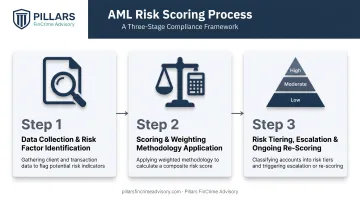
Scoring begins at onboarding with data collection. The credit union applies a weighted model to calculate a composite score, tiers the member into a risk category, and continues through ongoing monitoring and periodic re-scoring. The inputs feeding that model typically include:
- Member or entity type (individual vs. business)
- Products and services used
- Delivery channel (in-branch vs. digital-only)
- Geography and jurisdiction exposure
- Historical transaction behavior
The model weights individual risk factors and aggregates them into a single score or tier. A cash-intensive business, for instance, rates higher than a payroll-deposit member. Governance sets the weighting methodology, score thresholds, and escalation triggers, usually documented in board-approved policy.
Step 1: Data Collection & Risk Factor Identification
This step gathers member information at onboarding: occupation, expected activity, geography, and ownership structure for business accounts. It also pulls ongoing transaction and account data to identify which risk factors actually apply to that relationship, not just which ones are theoretically possible.
Step 2: Scoring & Weighting Methodology Application
The credit union's documented model applies weights to each factor and calculates a composite score. This can happen through a vendor's AML platform, a spreadsheet-based model, or a hybrid of automated data pulls with manual review. The mechanism matters less than the documentation behind it. Examiners want to see why each weight was chosen, not just what the final score is.
Step 3: Risk Tiering, Escalation & Ongoing Re-Scoring
Credit unions tier members into low, moderate, or high categories. High-risk tiers trigger enhanced due diligence (EDD) and more frequent reviews. Teams refresh scores periodically or when triggering events occur, such as:
- An address or occupation change
- Adoption of a new product (wires, RDC, cross-border ACH)
- Unusual transaction activity that doesn't match the original profile
Where Risk Scoring Applies in the Member Lifecycle
Risk scoring applies at account opening and KYC, during periodic risk reviews, and at event-driven triggers such as large cash deposits, new business accounts, or adverse media hits. The score should evolve with the member relationship and the credit union's changing risk profile, not sit unused after onboarding.
Key Factors That Affect AML Risk Scoring Accuracy in Credit Unions
Several variables determine whether a scoring model reflects reality or only looks good on paper:
- Member/entity inputs: Individual vs. business members, cash-intensive businesses, MSBs, and non-resident aliens usually carry higher weight due to identity and source-of-funds complexity
- Operating conditions: Higher-risk geographies, digital-only account opening, and products such as wires, remote deposit capture, or cross-border ACH
- System dependencies: Core and third-party AML/monitoring integrations that keep scores current instead of stale
- Scale and frequency: Asset size, membership growth, and transaction volume drive how often models need recalibration—and when manual scoring stops working
- Regulatory constraints: NCUA Rule 748 and the FFIEC manual require documented, defensible models tailored to the credit union’s real risk profile, not a generic template
That last point is where many credit unions get stuck. A model built for a 5,000-member shop does not automatically scale to 50,000 members with a growing commercial deposit base.
When internal teams need a second look at whether the weighting still matches the membership, credit unions often bring in outside help. Firms like Pillars FinCrime Advisory are engaged to validate or rebuild scoring methodologies during exam prep or remediation.
Common Mistakes, Misconceptions & When Risk Scoring Falls Short
Misconceptions That Undermine Risk Scoring Programs
A few assumptions consistently trip up otherwise solid compliance programs:
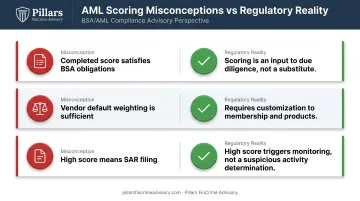
- "A completed score satisfies our BSA obligations." It doesn't. Scoring is an input to due diligence, not a substitute for it.
- "The vendor's default weighting is good enough." Examiners commonly flag out-of-the-box models that aren't customized to your membership and product mix.
- "A high score means we file a SAR." A risk score and a SAR/CTR filing decision are different things entirely. A high score signals closer monitoring, not a suspicious activity determination.
When Risk Scoring May Fall Short
The 2022 interagency joint statement makes clear that no customer type carries one uniform risk level automatically.
Treating an entire category — money service businesses, for example — as a blanket exclusion or automatic high score misapplies the guidance and can draw examiner criticism rather than avoid it.
Static models also fail against emerging typologies. A weighting scheme built three years ago won't reflect current fraud patterns or the credit union's own SAR history unless it's been recalibrated using that data.
The clearest sign a program is running on autopilot: the scoring model hasn't been updated, tested, or validated since it was first implemented. This is a common examiner finding, and it's an easy one to avoid with a scheduled validation cycle.
Conclusion
AML risk scoring is the mechanism that translates member and transaction data into a risk-based, examiner-defensible compliance program. Getting it right shapes exam outcomes, alert quality, and how efficiently a small compliance team can actually operate day to day.
Owning a scoring tool isn't the same as running a mature program. What separates the two is disciplined, regularly recalibrated scoring built around the credit union's real membership and product mix.
When that recalibration needs an outside perspective, advisors like Pillars FinCrime Advisory can help validate or rebuild a model so it's ready for the next exam cycle—not just the last one.
Frequently Asked Questions
What is the biggest risk to credit unions?
BSA/AML compliance is the risk examiners most consistently prioritize for credit unions, with fraud and cybersecurity close behind. That focus reflects member-facing cash and wire activity plus growing digital account opening.
Does BSA apply to credit unions?
Yes. Credit unions are treated as "banks" under the Bank Secrecy Act's definitions and are subject to the same AML/CFT program, reporting, and recordkeeping requirements as other insured financial institutions.
What is the $3,000 bank rule?
Under the BSA's recordkeeping rule, financial institutions must retain records for funds transfers and monetary instrument sales of $3,000 or more. This differs from the $10,000 threshold that triggers a Currency Transaction Report (CTR).
How often should a credit union update its AML risk scores?
Regulatory guidance doesn't mandate a fixed schedule, but most credit unions review low-risk members annually and high-risk members more frequently. Event-driven updates should also occur whenever a triggering activity, like a large cash deposit, happens.
What's the difference between AML risk scoring and an enterprise-wide risk assessment?
Risk scoring rates individual member relationships based on their specific factors. The enterprise-wide assessment evaluates institution-wide inherent and residual risk across all products, services, and business lines.
Can a small credit union manage AML risk scoring manually?
Manual scoring can work for very small, low-complexity memberships. As membership and transaction volume grow, manual processes become error-prone and harder to defend to examiners. Automated tools or outside advisory support then become the practical next step.