This scenario plays out constantly at fast-growing fintechs, payments companies, and financial institutions. AML/BSA obligations, sanctions lists, and data-security requirements shift faster than quarterly or annual audit cycles can track. A control that passed review in January can fail silently by March, and nobody finds out until the next scheduled check.
This article breaks down what continuous compliance monitoring actually is, how it differs from traditional point-in-time audits, the core components of a working program, the tools available, and the challenges (and fixes) most compliance teams run into along the way.
Key Takeaways
- Continuous monitoring tracks controls and evidence in near real time, closing the gap left by scheduled, point-in-time audits.
- Regulators have levied billion-dollar penalties tied directly to delayed detection of monitoring failures.
- Automated evidence collection, real-time testing, and risk-based alerting form the backbone of a working program.
- Technology alone can't tune thresholds or interpret alerts. That still requires financial crime expertise.
What Is Continuous Compliance Monitoring (and Why It Matters)?
Defining Continuous Compliance Monitoring
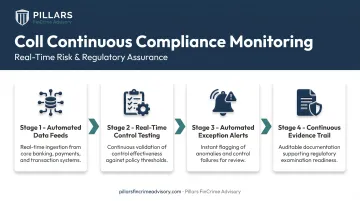
Continuous compliance monitoring is the ongoing, near real-time tracking of controls, evidence, and exceptions, rather than a scheduled, point-in-time review. Instead of compliance staff pulling samples once a quarter, the system pulls data continuously and flags problems as they happen.
In practice, it works like this:
- Automated data feeds pull activity from source systems (core banking, KYC platforms, sanctions screening tools) as it's generated.
- Control tests run against live data, not a static snapshot from last quarter.
- Exception alerts route automatically to the person responsible for fixing them.
- An evidence trail builds itself continuously, so there's no scramble before an exam.
As Deloitte notes, this approach moves testing from judgmental samples toward full-population monitoring, while giving second- and third-line teams ongoing visibility into first-line activity.
Why This Matters for Fintechs and Financial Institutions
Financial crime risk doesn't wait for your review calendar. Transaction typologies shift, sanctions lists update, and fraud patterns evolve on a weekly (sometimes daily) basis. A quarterly review cycle simply can't keep pace with that speed.
The cost of falling behind is not hypothetical. In 2024, FinCEN assessed a record $1.3 billion penalty against TD Bank, citing persistent backlogs of suspicious activity and trillions of dollars in transactions left unmonitored, according to FinCEN's own announcement. The OCC separately fined the bank $450 million for systemic transaction-monitoring breakdowns.
Smaller institutions face the same exposure at smaller scale. New York's DFS penalized National Bank of Pakistan $35 million in 2022 for deteriorating transaction-monitoring controls.
A continuously monitored program signals maturity to examiners and boards. But there's a real tension here: fintechs that over-engineer controls to look "safe" often slow their own growth without actually reducing risk.
Balancing innovation with regulatory confidence, rather than layering on controls for their own sake, is one of the harder calls scaling companies have to make.
Continuous Monitoring vs. Traditional Periodic Compliance Audits
Traditional audits give you a snapshot. By the time the review wraps up and the report gets written, the control environment being described has already moved on. That creates a blind spot between review cycles — exactly where problems like the TD Bank case took root.
Continuous monitoring closes that gap. Controls get tested as activity occurs, and documentation builds year-round instead of getting assembled in a pre-audit scramble. Thomson Reuters describes this shift as moving from historical, point-in-time risk assessment toward ongoing analysis of current and historical data together.
| Dimension | Periodic Audits | Continuous Monitoring |
|---|---|---|
| Timing | Fixed review cycle (quarterly, annual) | Ongoing, near real-time |
| Evidence collection | Requested manually before fieldwork | Captured automatically as activity happens |
| Coverage | Judgmental samples | Full-population testing |
| Risk visibility | Limited to the review window | Continuous, updates as risk changes |
| Audit readiness | Scramble before fieldwork | Documentation maintained year-round |
The Institute of Internal Auditors frames continuous auditing as technology-enabled assurance delivered to boards and senior management on an ongoing basis. Continuous monitoring supplements, rather than replaces, independent validation. The FFIEC still expects periodic review of a monitoring system's methodology and effectiveness.
Key Components of a Continuous Compliance Monitoring Program
A working program isn't just software bolted onto old processes. It needs five things functioning together.
- Automated evidence collection — connecting core banking, KYC/CDD, sanctions screening, and case management systems so evidence is captured continuously, not pulled manually before each audit.
- Real-time control testing — evaluating controls like transaction monitoring rules, access approvals, or CDD refresh cycles against defined thresholds the moment new data arrives.
- Risk-based exception alerting — routing flagged issues to named control owners with severity ratings, due dates, and clear escalation paths, so nothing sits unmanaged.
- Audit-ready reporting — dashboards that trace every conclusion back to underlying evidence, control status, and remediation history for examiners and leadership.
- Governance and ownership — defined accountability across compliance, risk, technology, and business units, so monitoring output turns into action instead of a pile of unread reports.
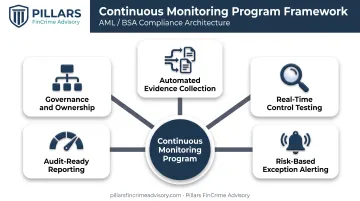
That last point trips up more programs than people expect. OFAC's compliance framework identifies management commitment, risk assessment, internal controls, testing, and training as the five essential components of a sanctions program. The same logic applies broadly: technology without ownership just produces noise.
Weaknesses need root-cause analysis and remediation, not just a flag in a dashboard.
Tools and Technologies for Continuous Compliance Monitoring
Most organizations building a continuous monitoring stack pull from four categories:
- GRC/compliance management platforms: the control layer that runs continuous process monitoring and maintains the audit trail.
- AML/transaction monitoring systems: rule-based scenarios that generate alerts, built on an underlying risk assessment covering products, customers, geography, and channels.
- Case management systems: where generated alerts get investigated and, when warranted, escalated toward a SAR filing.
- Reporting and dashboard tools: the layer examiners and the board actually look at, tracing conclusions back to evidence.
What to Evaluate Before You Buy
Not all platforms deliver the same value. Before committing, check:
- Integration depth: can it actually connect to your core banking, KYC, and case management systems, or does it require manual exports?
- Real-time alerting vs. batch reporting: a tool that refreshes overnight isn't continuous monitoring; it's a faster periodic review.
- Audit trail quality: can you trace a flagged exception all the way back to source data?
- Regulatory framework coverage: does it map to BSA/AML, OFAC, and any state-specific requirements your business faces?
Here's the part that gets missed: technology alone can't interpret an alert, tune a threshold, or judge whether a control design still fits your current risk. That's where hands-on financial crime expertise comes in.
Pillars FinCrime Advisory's work optimizing transaction monitoring, and translating regulatory expectations into practical program decisions, complements these platforms rather than replacing them. The firm also independently evaluates AML, transaction monitoring, KYC, and compliance software vendors against a client's actual risk profile, transaction volume, and budget. A mismatched tool creates as much risk as no tool at all.
Common Challenges in Implementing Continuous Compliance Monitoring
Even strong programs stall when data, alerts, and talent can't keep up with continuous monitoring demands.
Data Standardization and Legacy System Integration
Core banking, KYC, and case management systems rarely speak the same language. Inconsistent formats across those systems make it hard to compare control results reliably. Legacy infrastructure at established institutions makes this worse, not better.
Alert Fatigue and Data Overload
Continuous monitoring can flood a lean team with exceptions. Thomson Reuters reports that false-positive alerts consume staff time and slow clearing rates. Some banks generate thousands of business-as-usual alerts daily.
Without proper threshold calibration, staff-to-alert imbalances create backlogs that overwhelm compliance teams instead of protecting them.
Resource and Skill Gaps
Fast-growing fintechs often lack the in-house bandwidth or specialized financial crime expertise to build, tune, and maintain a monitoring program. Daily regulatory change compounds the strain.
Thomson Reuters' Cost of Compliance research found scarcity of technical sanctions skills and heavy competition for qualified staff among institutions, fintechs, vendors, and consultancies alike.
Best Practices for Effective Continuous Compliance Monitoring
Building a program that actually holds up under examination takes more than buying software. Follow this sequence:
- Start with a risk assessment and control inventory mapped to BSA/AML, OFAC sanctions, and state money transmitter requirements, so monitoring priorities reflect real exposure, not generic checklists.
- Automate evidence collection and set risk-based alert thresholds calibrated to your actual risk profile, not a one-size-fits-all rule set borrowed from another institution.
- Establish clear ownership, response SLAs, and escalation paths for every exception, so findings turn into documented remediation instead of an unmanaged backlog.
- Maintain audit-ready documentation continuously and validate the monitoring program on a risk-based cadence. The FFIEC notes no fixed regulatory requirement for independent testing frequency; 12 to 18 months is only an example.
- Pair technology with experienced oversight across policy development, risk assessments, transaction monitoring optimization, and exam readiness. Pillars FinCrime Advisory, founded by Joshua Douglas, provides fractional CCO/BSA Officer support and hands-on program guidance so growing companies get senior expertise without a full-time hire.
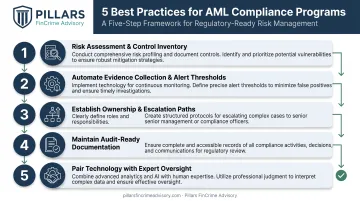
Programs that skip step 4 tend to drift. A monitoring system tuned two years ago for a smaller transaction volume won't reflect today's risk, no matter how automated it looks on paper.
Frequently Asked Questions
What is continuous compliance monitoring?
Continuous compliance monitoring is the ongoing, automated tracking of controls and evidence to detect and fix compliance gaps in near real time—not only during scheduled audits. It supplements periodic risk assessment; it does not replace it.
What are the 7 pillars of compliance?
The seven commonly cited pillars are written policies, compliance leadership and oversight, training, communication channels, standards enforcement, risk assessment and monitoring, and corrective action. They support continuous monitoring programs well beyond their original healthcare context.
What are the 5 C's of audit findings?
The 5 C's framework covers Condition (current state), Criteria (expected standard), Cause (underlying reason), Consequence (impact), and Corrective Action (the fix). It's used to document findings clearly for examiners, boards, and other stakeholders.
How is continuous compliance monitoring different for financial institutions than for other industries?
Financial institutions and fintechs must continuously track financial crime risks like transaction typologies and sanctions exposure, not just cybersecurity or privacy controls common elsewhere. The stakes involve BSA/AML obligations with direct regulatory enforcement consequences.
What happens if a fintech or financial institution doesn't adopt continuous compliance monitoring?
Gaps in AML/BSA controls can go undetected for months, leading to examiner findings, regulatory penalties, and reputational damage. The TD Bank enforcement actions show how costly delayed detection can become at scale.
How often should compliance controls be tested under a continuous monitoring program?
Match testing cadence to each control's risk level and data availability: real-time checks for high-risk controls like sanctions screening, and daily or weekly reviews for lower-risk ones. No universal rule applies—frequency should follow your risk profile.