That's a mistake. The wallets that stall before launch, or draw regulator attention after it, rarely fail because of bad UX. They fail because licensing gaps, thin AML controls, or missed consumer protection obligations catch up with them.
This guide covers the regulatory landscape digital wallets operate in, how to build a real AML/KYC program, the security and privacy rules that apply, and a practical checklist for building compliance into the product from day one — not bolting it on after the fact.
Key Takeaways
- Digital wallets become regulated financial products the moment funds move
- Design KYC/AML programs, state money transmitter licensing, and PCI DSS into the build from day one
- Federal oversight of large payment apps has shifted since 2025; teams need current guidance
- Building compliance alongside development is what separates wallets that scale from ones that stall
What Is a Digital Wallet App & Why Compliance Is Non-Negotiable
A digital wallet stores payment credentials, balances, or value on a user's behalf and lets them pay, transfer, or withdraw funds. That's different from a mobile banking app, which is simply a digital front end to an existing deposit account at a chartered bank.
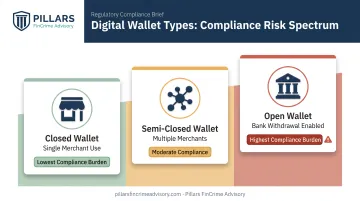
Industry analysts, including Juniper Research, generally group wallets into three models:
- Closed wallets — usable only within one merchant's ecosystem (think store credit)
- Semi-closed wallets — usable across a defined network of participating merchants
- Open wallets — broadly interoperable, often supporting withdrawal to a linked bank account
Here's the part teams miss: open wallets carry the heaviest compliance burden. The moment a wallet lets users cash out to a bank account, it starts to look like money transmission in the eyes of regulators, regardless of what the product team calls it internally.
This is why "development" and "compliance" can't run on separate tracks. A wallet sits at the intersection of money transmission law, consumer protection rules, and financial crime statutes.
Decisions made in a sprint planning meeting—how onboarding works, whether balances can be withdrawn, how transaction limits are set—are compliance decisions whether anyone labels them that way or not.
The US Regulatory Framework for Digital Wallets
There's no single "digital wallet law" in the United States. Instead, several overlapping frameworks apply depending on what the wallet actually does with customer funds.
BSA/AML and MSB Registration
Under federal law, "money transmission" means accepting funds from one person and transmitting them to another person or location. If a wallet does this, it likely qualifies as a Money Services Business (MSB) and must register with FinCEN, generally within 180 days of establishment, with renewal every two years.
One detail teams overlook: operating through a bank sponsor or Banking-as-a-Service partner doesn't automatically remove these obligations. The partner's contract can still push AML and compliance responsibilities onto the wallet company, even without a direct FinCEN registration requirement.
State Money Transmitter Licensing
Forty-nine states regulate money transmitters (Montana is the exception), and most require a license before a company can hold or transmit customer funds. Licensing runs through the Nationwide Multistate Licensing System, but:
- Each state sets its own checklist, documentation, and fee requirements
- New York, for example, won't consider an application complete until every required document and fee is submitted
- Processing timelines vary widely by state and by how quickly applicants respond to follow-up requests
Teams that assume a license takes a few weeks are usually the ones that miss their launch date.
CFPB Oversight of Digital Wallets
In late 2024, the CFPB finalized a rule extending bank-like supervision to nonbank providers processing at least 50 million covered consumer payment transactions annually. It took effect in January 2025.
Congress then disapproved that rule under the Congressional Review Act, and the repeal was signed into law in 2025. The CFPB can't reissue a substantially similar rule without new statutory authority.
The 50-million-transaction threshold is now a repealed historical marker, not a current trigger. The CFPB retains other supervisory tools, so this area is still worth monitoring as it evolves.
PCI DSS, Tokenization, and Cardholder Data
Any wallet that stores, processes, or transmits cardholder data falls under PCI DSS, regardless of company size. Tokenization (replacing card numbers with non-sensitive tokens) can reduce compliance scope, but it doesn't eliminate PCI obligations. How much scope you shed depends on how tokenization is implemented.
Regulation E and Consumer Protection
Person-to-person payments generally qualify as electronic fund transfers under Regulation E, which sets firm rules teams need to design around:
- Consumers who report unauthorized transactions within two business days cap their liability at the lesser of $50 or pre-notice transfers
- Later reporting can raise that cap to $500
- Error investigations generally must resolve within 10 business days, extendable to 45 days with provisional credit
Cross-border ambitions add complexity fast. The EU's proposed PSD3 framework, for instance, would layer new requirements on top of PSD2. Map jurisdiction-specific rules before any international launch; don't assume US compliance transfers.
Building a Risk-Based AML/KYC Compliance Program
Getting the regulatory framework right on paper is one thing. Building a program that actually functions day-to-day is another.
Customer Identification at Onboarding
Wallet providers acting as MSBs generally need to verify identity before granting full functionality. That typically means collecting name, date of birth, address, and an identification number, then retaining those records for five years after last use.
Bank-specific CIP rules don't automatically transfer to nonbank wallets unchanged, so the program needs to match the wallet's actual regulatory status.
Tiered Verification Models
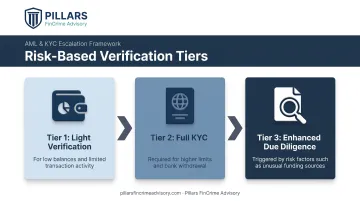
Not every user needs the same friction level on day one. A workable model looks like:
- Light verification for small balances and limited transaction volume
- Full KYC required before unlocking higher limits or bank withdrawal
- Enhanced due diligence triggered by risk factors like unusual funding sources
This balances user experience against risk. The thresholds still have to be documented and defensible, not arbitrary.
Documented AML Program and SAR Filing
MSBs need a written, risk-commensurate AML program covering internal controls, a designated compliance officer, staff training, and independent testing. SAR obligations are specific: transactions of $2,000 or more tied to suspected illegal activity generally require a filing within 30 calendar days of detection. Supporting records must be kept for five years.
Ongoing Monitoring, Not a One-Time Checkbox
Risk doesn't stay static after onboarding. Usage patterns shift, typologies evolve, and periodic re-verification catches what point-in-time checks miss. Examiners look for more than a policy binder that hasn't been touched since launch:
- Board and executive oversight
- Independent program testing
- A clearly designated BSA/AML officer
Regulators expect programs tailored to a wallet's actual risk profile, not a generic template. Many fintechs bring in outside, CAMS-certified financial crime expertise—firms like Pillars FinCrime Advisory—to design and pressure-test these programs before launch, rather than after an exam surfaces the gaps.
Security & Data Privacy Best Practices
A wallet's security posture and its regulatory obligations are the same conversation.
Baseline technical controls should include:
- TLS encryption for data in transit
- Encryption at rest for stored credentials
- Tokenization to minimize exposure of raw payment data
Beyond encryption, wallets handling consumer financial data need to account for the Gramm-Leach-Bliley Act (GLBA) Safeguards Rule. Core requirements include:
- A written information security program
- A designated qualified individual
- Ongoing risk assessments
- FTC breach notification within 30 days when 500 or more consumers are affected (in effect since May 2024)
State privacy laws add another layer. Under CCPA/CPRA, the GLBA exemption only covers information actually subject to GLBA, not every dataset a financial institution holds. Consumers can still opt out of the sale or sharing of non-exempt personal information, and once they do, a business can't resume without fresh authorization.
None of this matters without a plan for when things go wrong. A documented incident response and breach notification process is what keeps a security failure from becoming a compounded regulatory failure. Skipping this step is one of the more common, and most expensive, oversights in wallet development.
Compliance Best Practices Checklist for Wallet App Development Teams
Most compliance failures in wallet development trace back to timing, not intent. Here's how to avoid the common traps:
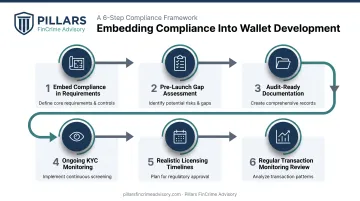
- Embed compliance into product requirements from day one. Retrofitting AML controls, licensing status, and data protection into a built product is slower and more expensive than designing them in.
- Run a pre-launch regulatory gap assessment covering licensing status, AML program completeness, and data protection controls before submitting to app stores or bank partners.
- Build audit-ready documentation as you go: policies, risk assessments, monitoring records, and training logs, so an examination doesn't trigger a scramble.
- Treat KYC as ongoing, not a one-time gate. Static onboarding checks miss evolving risk.
- Budget realistically for state licensing timelines. They vary widely and rarely move as fast as a product roadmap wants them to.
- Revisit transaction monitoring rules regularly as volume grows and typologies shift. A rule set tuned for launch volume won't hold at scale.
Two pitfalls still catch teams even when the checklist above is in place:
- Multi-state money transmitter licensing often runs far longer than the product roadmap assumes
- A bank sponsor relationship does not remove the need for independent AML oversight
Treat compliance as an ongoing program, not a single pre-launch task, and the controls stay scalable as wallet volume grows. Pillars FinCrime Advisory supports that full lifecycle—from policy development and risk assessments through transaction monitoring optimization and audit readiness.
Frequently Asked Questions
What are some examples of digital payment apps?
PayPal, Venmo, Cash App, Apple Pay, and Google Pay/Wallet are widely used examples. They differ in how funds move — some allow withdrawal to a linked bank account, which shifts them toward open-wallet functionality with heavier compliance obligations.
Is KYC/AML compliance mandatory for all digital wallet apps?
Most wallets that move real money must implement KYC/AML controls under the Bank Secrecy Act. Narrow exceptions exist for closed-loop, non-monetary wallets, but they're limited and shouldn't be assumed without a specific legal review.
Do digital wallet companies need a money transmitter license?
Most open and semi-closed wallets need state money transmitter licenses unless they operate entirely under a licensed bank or BaaS partner's charter. Even then, contractual compliance obligations often still apply.
What is the CFPB's digital wallet rule and who does it apply to?
The CFPB finalized a rule in 2024 extending oversight to large payment app providers, but Congress repealed it in 2025 under the Congressional Review Act. The specific transaction-volume threshold from that rule no longer applies as a current trigger.
How does PCI DSS apply to digital wallet app development?
PCI DSS applies whenever an app stores, processes, or transmits cardholder data. Tokenization can reduce how much of the system falls into scope, but it doesn't remove PCI obligations entirely.
When should compliance be built into the wallet app development process?
Compliance planning should start at the requirements and discovery stage, before core features are built. Adding controls after development is underway almost always causes rework and pushes back launch timelines.