That's the gap threat intelligence (TI) is supposed to close. In 2024 alone, researchers tracked 269 million card records posted across dark and clear web marketplaces, a jump attributed largely to new breach activity rather than recycled data (Recorded Future, 2025). For fintechs, payments companies, and financial institutions, picking the wrong TI provider doesn't just waste budget. It means missed early warnings, alert fatigue that burns out fraud analysts, and findings during your next regulatory exam.
This guide gives compliance and fraud leaders a practical framework for evaluating TI providers built specifically for payment fraud, not repurposed generic cyber feeds.
Key Takeaways
- Payment fraud threat intelligence turns compromised cards and credentials into warnings you can act on before losses hit
- Top providers pair payment-specific underground coverage with fast alerts and clean integrations
- Score vendors on data depth, actionability, and compliance fit—not feature lists or sticker price
- Vague sourcing claims and unclear SLAs are the biggest vendor-selection red flags
- Independent advisory help turns vendor pitches into a program that meets fraud and BSA/AML needs
What Is Threat Intelligence for Payment Fraud?
Threat intelligence for payment fraud is the practice of collecting and analyzing external signals to spot payment-related threats before they turn into losses on your books. Those signals come from dark web forums, phishing infrastructure, malware logs, and underground marketplaces.
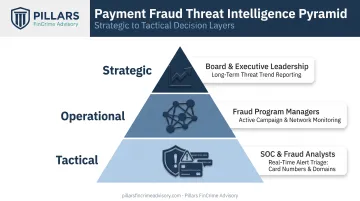
Not all intelligence serves the same audience. It typically breaks into three tiers:
- Strategic – long-term trends and industry-level risk patterns for board and executive decisions
- Operational – specific active campaigns, like a card shop or mule recruitment ring, relevant to fraud program managers
- Tactical – immediate, actionable detail (compromised card numbers, malicious domains, timestamps) that SOC and fraud analysts act on directly
Core Signal Types That Matter for Payment Fraud
Generic threat feeds cover malware and network intrusions. Payment fraud requires narrower, deeper signals:
- Compromised cards and BIN-level data – Early visibility into cards exposed on underground shops reduces chargebacks and unnecessary reissuance costs
- Compromised credentials and account-takeover indicators – Infostealer logs and credential marketplaces close the gap between a third-party breach and an ATO on your platform
- Merchant and website compromise signals – Digital skimming or phishing on one compromised merchant can expose thousands of cards at once
Scale matters here. SpyCloud alone recaptured 548 million malware-exfiltrated credentials in 2024 (SpyCloud, 2025). Newly detected e-skimmer infections nearly tripled in 2024, hitting close to 11,000 unique e-commerce domains.
Why Payments Companies and Financial Institutions Rely on It
Done well, payment fraud threat intelligence delivers concrete operational wins:
- Earlier fraud interruption, before a compromised card or account gets used
- Reduced chargeback and loss rates over time
- Faster fraud investigations, since analysts start with context instead of a blank slate
- Stronger, documented evidence for regulatory examiners reviewing your fraud controls
What to Consider When Choosing a Threat Intelligence Provider for Payment Fraud
These factors connect a vendor's technical capabilities to outcomes you can actually measure, not just checkboxes on a features sheet.
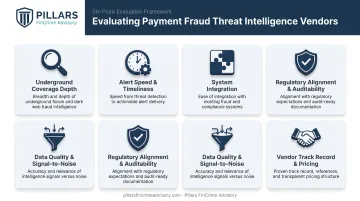
Depth of Payment-Specific Underground Coverage
Generic cyber feeds miss the carding shops, BIN-level data dumps, and mule-account chatter that matter most here. Press vendors on:
- Percentage of compromised cards detected before fraud occurs
- Specific underground marketplaces they monitor (not just claim to cover)
Speed and Timeliness of Alerts
A delayed signal is nearly as useless as no signal. Stolen payment data gets monetized fast, and lead time from exposure to alert varies widely by provider. Demand hard numbers on:
- Time-from-exposure-to-alert
- Reduction in Mean Time to Detect (MTTD)
Integration With Existing Fraud and Compliance Systems
Intelligence that can't feed your transaction monitoring, case management, or SIEM/SOAR tools stays trapped in PDF reports instead of driving action. Track KPIs such as:
- Percentage of alerts auto-actioned
- Analyst hours saved through automation
Regulatory Alignment and Auditability
Examiners increasingly expect documented, risk-based use of external threat data within BSA/AML and fraud programs. FinCEN encourages sharing relevant cyber information across fraud, BSA/AML, and cybersecurity teams, though it stops short of mandating any specific commercial feed (FinCEN, 2016).
Confirm the provider can produce clean audit trails mapped to frameworks like PCI-DSS.
Data Quality and Signal-to-Noise Ratio
Raw feeds without context or validation create alert fatigue fast and erode analyst trust. Recorded Future noted that likely reposted or recycled card data jumped from 19% in 2023 to 36% in 2024—a strong reason to ask how any vendor deduplicates. Also push for:
- False-positive rate
- Percentage of alerts tied to a confirmed, actionable threat
Vendor Track Record, Expertise, and Pricing Transparency
Human analyst expertise and reference-checkable case studies matter more than raw data volume alone. Require:
- Named references, not aggregate marketing claims
- Pricing that scales with transaction volume, not flat fees that punish growth
Red Flags to Watch For When Evaluating Providers
A few warning signs should stop a vendor conversation cold:
- Vague sourcing claims – If a provider can't clearly explain where and how they collect payment-specific underground data, treat that as a dealbreaker, not a minor gap.
- No compliance context in reporting – Leaving your compliance team to manually translate raw intelligence into examiner-ready evidence defeats much of the purpose of buying the service.
- Unclear service levels – No defined SLA for alert delivery, escalation paths, or analyst support in an active incident means you're on your own when it matters most.
How Pillars FinCrime Advisory Can Help
Selecting a threat intelligence provider only pays off if it's woven into a broader, examiner-ready financial crime program. That's the piece vendors themselves rarely help you with, since their incentive is closing a sale, not building your governance structure.
Joshua Douglas, founder of Pillars FinCrime Advisory, brings 12+ years of financial crime experience and CAMS certification to every engagement. He helps leadership teams turn vendor capabilities into sound governance decisions. Pillars supports this process by:
- Developing vendor evaluation criteria and RFP frameworks tailored to your specific payment fraud risk
- Mapping threat intelligence outputs to BSA/AML and fraud program requirements for audit readiness
- Advising on integration priorities so intelligence strengthens transaction monitoring instead of adding more noise
- Providing unbiased guidance so decisions rest on business and regulatory fit, not a sales pitch
If your team is choosing between providers and needs someone in the room who isn't selling a platform, Pillars FinCrime Advisory can help you evaluate fit, structure the decision, and keep the program examiner-ready.
Conclusion
Choose the threat intelligence provider whose coverage, speed, and integrations match your payment fraud risk profile—card-present fraud, account takeover, or merchant-side skimming. Brand recognition matters far less than fit.
Fraud tactics and regulatory expectations both keep shifting, so provider selection shouldn't be a one-and-done decision. Revisit it periodically. Pair strong intelligence tools with sound program governance, and those early external signals turn into real, measurable loss prevention instead of another report nobody reads.
Frequently Asked Questions
What are the 5 stages of threat intelligence?
The commonly referenced lifecycle actually has six stages: direction/planning, collection, processing, analysis, dissemination, and feedback. In payment fraud, feedback is what refines which underground sources actually produce actionable card and credential alerts.
What's the difference between cyber threat intelligence and fraud-specific threat intelligence?
Cyber threat intelligence covers broad risks like malware and network intrusions. Fraud-specific intelligence narrows in on carding shop monitoring, mule-account tracking, and skimming detection—signals that map directly to payment losses.
How much should a payments company or fintech expect to invest in threat intelligence?
Pricing varies significantly by data scope and integration complexity, and most providers keep list prices off their public sites. Budget for integration work and analyst time on top of license fees, not just the subscription cost.
Can threat intelligence replace transaction monitoring systems?
No. Threat intelligence complements transaction monitoring by supplying earlier external signals, like a compromised card or credential, that inform and help prioritize which monitoring rules and alerts deserve attention first.
What compliance frameworks should a threat intelligence provider support for payment fraud programs?
Look for alignment with PCI-DSS requirements around payment page security, plus documentation practices that support BSA/AML expectations and FFIEC guidance for regulated payment entities.
How long does it typically take to see measurable value from a new threat intelligence provider?
Early operational indicators, like alert volume and false-positive rate, usually show up within a few months of go-live. Loss-avoidance ROI takes longer to substantiate and needs consistent tracking against your baseline fraud rates.