This guide is written for compliance officers, founders, and executive teams at growth-stage fintechs and financial institutions building or maturing a compliance program. Many organizations use "compliance policy" loosely, often conflating policies with procedures. That confusion creates gaps that surface during audits or regulatory exams, usually at the worst possible time.
Here's what we'll cover: what compliance policy development actually means, why it matters for regulated fintechs, the step-by-step process, the core policy types every program needs, and the mistakes that trip up even well-intentioned teams.
Key Takeaways
- Compliance policy development turns legal and regulatory obligations into documented operating standards
- Strong policies underpin BSA/AML programs, regulatory exams, and sponsor bank due diligence
- Build policies through risk assessment, clear objectives, drafting, approval, and scheduled review
- Effective policies hold regulatory rigor without slowing day-to-day operations
- Version control and ongoing review matter as much as the initial draft
What Is Compliance Policy Development?
Compliance policy development is the process of creating, documenting, and maintaining the rules an organization follows to meet legal, regulatory, and internal requirements.
The outcome is a documented, approved framework employees can use for decisions—and that regulators, auditors, and banking partners can review to gauge program maturity.
Policy vs. Procedure
These two terms get conflated constantly, and the distinction matters.
- Policy defines the what and why: the institutional standard or rule
- Procedure defines the how: the specific steps for carrying it out
A common banking-industry framing is direct: policies are guidelines that state institutional standards, while procedures are the narrower action plans specifying implementation.
For example, a BSA/AML policy might state that the company will monitor transactions for suspicious activity and file SARs when warranted. The matching procedure names who reviews which alert queue, what escalation timelines apply, and how the SAR narrative is drafted and approved.
Where Policy Fits in the Documentation Hierarchy
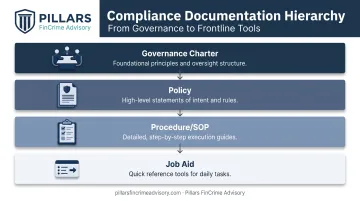
Policy development is one pillar of a broader compliance program, not the whole thing. Documentation typically flows in this order:
- Governance charter: establishes board and committee oversight
- Policy: sets the rule and rationale
- Procedure/SOP: operationalizes the rule step by step
- Job aid: gives frontline staff quick reference tools
Skipping levels, or treating a procedure as if it were a policy, is exactly the kind of gap that surfaces during an exam.
Why Compliance Policy Development Matters for Fintechs, Payments Companies & Financial Institutions
Regulators expect documented, board-approved policies as a baseline. But written documents alone don't satisfy examiners. The FFIEC is explicit on this point: a review of written policies and procedures is only the first step in judging program adequacy, and actual practices must correspond to what's written.
Enforcement history backs this up. In 2025, FinCEN's consent order against Brink's Global Services found the company had no written AML program at all and no monitoring, escalation, or SAR procedures in place, resulting in a $37 million penalty.
What Fast Growth Demands From Policies
Fintechs and payments companies scale faster than traditional banks, and generic templates simply can't keep pace. Growing transaction volume and new product launches demand:
- Scalability that doesn't require a full rewrite every time a new product ships
- Adaptability across jurisdictions and customer types
- Clear escalation paths so frontline staff know who decides what
Without these, teams end up making inconsistent decisions, failing exams, or worse, losing a sponsor bank relationship entirely.
Policy Maturity Is a Business Enabler, Not Just a Legal One
Sponsor banks and payment networks increasingly review a fintech's written policies during onboarding due diligence. The 2021 interagency fintech guide specifically lists policies, procedures, training, and internal controls as information a partner bank may review when assessing a fintech's AML program.
Policy maturity isn't only about satisfying examiners. It's often the difference between landing a banking partner and getting turned away.
Pillars FinCrime Advisory helps leadership teams close that gap. Founded by Joshua Douglas, a CAMS-certified compliance professional with 12+ years in financial crime, the firm builds scalable, audit-ready frameworks for fintechs, payments companies, and financial institutions. Programs are sized to fit: not over-built for a startup, and not so thin that a growing company outgrows them in a year.

How to Develop a Compliance Policy: Step-by-Step Framework
Policy development moves from identifying risk and regulatory obligations, through drafting and stakeholder validation, to approval, rollout, and continuous review. Along the way, it draws on regulatory research, prior exam findings, risk assessment outputs, and input from legal, compliance, and business unit leaders.
During drafting, teams translate that raw input into clear, actionable rules with defined ownership so every control has a named owner. Governance structures keep the process honest: board or compliance committee sign-off, version control, and set review cadences stop the policy from drifting out of date.
The finished policy becomes a documented reference for employees and an auditable trail that shows program maturity.
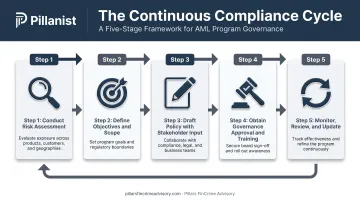
Step 1: Conduct a Compliance Risk Assessment
Identify the laws, regulations, and risks specific to your products, customers, and geographies. Ground the assessment in evidence, not a generic industry checklist:
- Applicable BSA/AML, sanctions, and consumer rules for your charter or partner-bank model
- Prior exam or audit findings (they often show exactly where policies fall short)
- Products, channels, customer types, and geographies you actually serve
The output should reflect the company's actual risk profile and drive what the policy must cover.
Step 2: Define Policy Objectives and Scope
State what the policy must achieve and name exactly which departments, products, channels, and roles it covers. If a team, product, or customer segment is in scope, say so explicitly. A vague scope produces inconsistent application and gaps examiners will find later.
Step 3: Draft the Policy with Stakeholder Input
Legal, compliance, and business unit leaders should co-draft language that is regulator-ready and operationally realistic. Strip legal jargon frontline staff cannot act on. If employees cannot tell what to do from the page, the policy will not get followed.
Step 4: Obtain Governance Approval and Roll Out Training
Policies require formal sign-off before publication. Under 31 CFR 1020.210(b)(3), banks without a federal functional regulator must have their AML program approved by the board or an equivalent body. Once approved, deliver training and attestations to every affected employee.
Step 5: Monitor, Review, and Update on a Defined Cycle
Review policies at least annually, and off-cycle when something material changes:
- Regulatory updates or new guidance
- New products, markets, or delivery channels
- Exam findings, audit issues, or serious incidents
Track every update in version history. Auditors will ask for it, and a clean trail is part of proving the program works.
Types of Compliance Policies Every Financial Crime Program Needs
Every financial crime program rests on a core set of policies. Missing one usually shows up fast during an exam or partner review.
| Policy Type | What It Covers |
|---|---|
| BSA/AML & Sanctions (OFAC) | Internal controls, independent testing, responsible officer, sanctions screening |
| Customer Identification/KYC | Risk-based identity verification, records, watchlist checks |
| Transaction Monitoring & SAR Filing | Unusual activity detection, escalation, SAR timelines, five-year retention |
| Vendor/Third-Party Risk | Due diligence on third-party controls and ongoing oversight |
Related policies such as data privacy, code of conduct, and complaint handling should live in the same inventory. Contradictions between separate documents are a common audit finding.
Scope should scale with company size. An early-stage fintech needs leaner documentation than a chartered bank. Regardless of stage, keep these core elements in place:
- Written program
- Defined ownership
- Clear escalation paths
Common Mistakes & Key Factors to Get Right
Even well-resourced teams stumble on the same handful of issues.
- Copy-paste templates. Borrowing another company's policy without tailoring it to your risk profile, products, and regulatory footprint is a fast path to exam findings.
- Assuming a document equals compliance. Examiners test whether the policy is followed. A binder of unused policies is often worse than none: it signals the program isn't taken seriously.
- Treating policy as a one-time project. Products change, markets expand, and rules shift. Without a scheduled review, the policy is outdated as soon as any of those move.
A written program alone doesn't satisfy regulators. It has to match what's actually happening day-to-day.
What to get right from the start:
- Map policy language to your real products, customers, and geographies
- Assign an owner, control, and evidence trail for every requirement
- Trigger formal review when products, markets, or regulations change
When internal teams lack bandwidth or depth to keep policies regulator-ready and workable day to day, outside advisors can close the gap. That is often where Pillars FinCrime Advisory supports in-house teams: full-lifecycle help from drafting and risk assessments through transaction monitoring optimization and audit readiness, so the program stays practical to run—not only compliant on paper.
Frequently Asked Questions
Can you give me an example of a compliance policy?
A BSA/AML policy is a common example. It typically covers customer due diligence, transaction monitoring, SAR filing procedures, and designation of a compliance officer responsible for program oversight.
What are the 7 pillars of compliance?
A common framework covers written policies, oversight, training, monitoring and auditing, reporting lines, enforcement, and corrective action. It comes from healthcare guidance, not BSA/AML rules, but the principles translate well.
What are the three C's of compliance?
There's no single standardized regulatory definition for this term. Different sources often frame it as culture, compliance, and consequences—a helpful mental model, not an official standard.
What does "compliance policy" mean?
A compliance policy is a formal, documented guideline outlining the rules and expectations an organization follows to meet legal and regulatory obligations. It establishes the what and why behind employee behavior.
How often should compliance policies be reviewed and updated?
At minimum, review policies annually. Beyond that, update them immediately when regulations change, exam findings surface, or the business launches new products or enters new markets.
What's the difference between a compliance policy and a compliance procedure?
A policy defines what the organization must do and why. A procedure defines the specific how-to steps employees follow to carry that policy out day to day.