The stakes are real. Pick the wrong provider, and you risk missed Suspicious Activity Reports, regulatory findings, and the kind of reputational hit that follows a bank discovering it processed ransomware payments. Pick the right one, and you close the gap between raw threat data and the split-second decision to approve or block a payment.
Nasdaq Verafin estimated $3.1 trillion in illicit funds moved through the global financial system in 2023, with projected fraud and bank-fraud losses reaching $485.6 billion worldwide, according to its 2024 Global Financial Crime Report. This guide breaks down what payment fraud intelligence actually is, the provider categories on the market, the factors that separate strong vendors from weak ones, and the mistakes that leave programs exposed.
Key Takeaways
- Payment fraud intelligence connects criminal payment infrastructure data to real-time fraud, AML, and compliance decisions
- Providers span threat-intelligence platforms, fraud APIs, B2B payment security tools, and account validation services
- Score vendors on coverage, integration depth, typology breadth, detection accuracy, regulatory fit, and scale
- Single-stage point solutions leave exploitable gaps; cross-system cyber-fraud fusion closes them
- Independent advisory support turns vendor claims into an exam-ready program
What Is Payment Fraud Intelligence?
Payment fraud intelligence is actionable data on criminal payment infrastructure: compromised bank accounts, cryptocurrency wallets, behavioral and device signals, and threat actor attribution. Fraud, AML, and compliance teams use it to stop fraudulent or criminally linked payments, either before funds move or immediately after.
Providers in this space generally fall into four categories:
| Category | What it decides | Example use case |
|---|---|---|
| Threat-intelligence platform with payment module | Whether an external account, merchant, or wallet is criminally exposed | Flagging a stolen card record found on a dark web forum |
| Fraud detection API | Whether a transaction or account event should be approved or declined | Real-time scoring at checkout or onboarding |
| B2B payment security platform | Whether a payment instruction or payee change is trustworthy | Catching a business email compromise (BEC) wire redirect |
| Vendor/bank account validation tool | Whether supplied bank details are open and valid | Confirming ACH acceptance before a payroll run |
Core Components That Separate Real Intelligence From Noise
Mature providers build intelligence from three layers—not just internal transaction logs dressed up as external insight:
- Collection methodology – Dark web forums, malware C2 infrastructure, scam pages, and underground marketplaces
- Risk scoring and attribution – Threat actor or malware context, plus first-seen and last-seen timestamps—not a bare red flag
- Delivery mechanism – Real-time API feeds into fraud engines, SIEM/SOAR tools, and case management systems
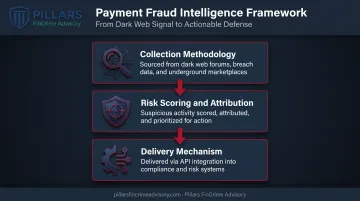
Scale of collection matters. Recorded Future tracked more than 142 million card records on monitored dark web marketplaces in 2025, along with active Magecart e-skimming infrastructure, in its Annual Payment Fraud Intelligence Report.
Why Institutions, Fintechs, and Payments Companies Rely On It
Fraud teams that operate blind to external criminal infrastructure discover losses after the money is gone. Payment fraud intelligence changes that timeline.
It also bridges the historic silo between cybersecurity/threat intel teams and fraud, AML, and compliance teams—an approach often called "cyber-fraud fusion."
Beyond loss prevention, strong intelligence supports:
- Timely SAR filing backed by defensible evidence
- Reduced reputational exposure from unknowingly processing criminal payments
- Documentation examiners can actually follow during exam season
What to Consider When Choosing a Payment Fraud Intelligence Provider
Vendor marketing pages tend to sound identical. Every provider claims broad coverage and low false positives. The factors below move evaluation past the sales deck and toward measurable outcomes. Requirements shift depending on whether you're a community bank, a growth-stage fintech, or a high-volume payments processor.
Data Source Coverage and Collection Methodology
A provider limited to card data will miss crypto wallets, mule account networks, and ransomware payment infrastructure entirely. That gap matters: the FBI's IC3 recorded 149,686 cryptocurrency-related complaints in 2024, representing $9.3 billion in losses, a 66% jump from the prior year. Broader source coverage directly reduces false negatives and undetected mule activity. Ask vendors to break out coverage by asset type, not just report an aggregate number.
Real-Time Delivery, API Access, and Integration Ecosystem
Intelligence that arrives an hour after a wire clears is a post-mortem, not a defense. It needs to reach fraud engines and compliance workflows without manual lag. When piloting a vendor, test:
- API latency under production-level load (p50/p95/p99, not just averages)
- Native integrations with your existing SIEM, SOAR, or case management stack
- Time-to-alert from data collection to actionable flag
Fraud Typology Coverage
A provider tuned for one attack type leaves the rest of the payment lifecycle exposed. Coverage should span BEC, mule networks, ransomware payments, synthetic identity, e-skimming, and check fraud.
This isn't a minor category. Check fraud SARs exceeded 680,000 in 2022, nearly double the prior year. The Nacha/AFP survey found 79% of surveyed organizations experienced attempted or actual payments fraud in 2024, with 63% reporting check fraud specifically.
Track fraud loss reduction across every channel, not just the one your last incident exposed.
Detection Accuracy and False Positive Management
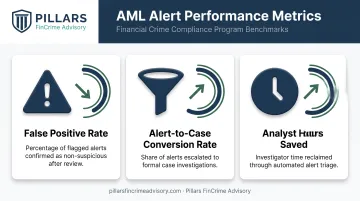
Opaque, "black box" scoring erodes analyst trust fast. If your team can't explain why a score triggered a review, they'll start overriding it, and the tool becomes shelfware. Key performance indicators to request from any vendor:
- False positive rate at a fixed review capacity, not a cherry-picked pilot
- Alert-to-case conversion rate showing how many flags turn into real investigations
- Analyst hours saved compared to your current baseline
Regulatory and Compliance Alignment
Detection alone doesn't satisfy an examiner. Intelligence needs to support audit trails, examiner documentation, and defensible SAR-filing timelines.
Federal regulation generally requires a SAR within 30 calendar days of initial detection, extendable to 60 days when no suspect has been identified, with records retained for five years. A provider that can't export clean, timestamped evidence for that window creates extra work for your team.
Look for reduced time between detection and reporting, plus improved outcomes on exam findings.
Scalability, Cross-System Fusion, and Total Cost of Ownership
Your provider today needs to work at triple the transaction volume and in new geographies tomorrow. Ask how the platform connects fraud, AML, and SOC functions, and price out the full stack, not just the license fee:
- Data module and API usage costs
- Integration and implementation effort
- Ongoing tuning, analyst review time, and support SLAs
Cost per protected transaction, tracked over time, tells you more than any single quote.
Red Flags That Signal a Provider Won't Scale With Your Program
Some warning signs show up before you've even signed a contract:
- Generic threat intelligence with no payment context — feeds full of IP addresses and malware hashes are useless to a fraud or AML analyst who needs a bank account or wallet identifier.
- If scoring models are undocumented, your team can't defend risk decisions to an examiner or auditor. Walk away when the vendor can't explain how a score was calculated.
- Single-stage lifecycle coverage leaves gaps attackers exploit. A tool limited to onboarding or wire verification leaves the rest of the payment journey exposed.
- Rigid architecture that resists integration with your compliance and case management stack forces manual workarounds and reintroduces the human error the tool was meant to eliminate.
Any one of these should slow a purchase decision. Two or more, and bring in an outside perspective before you sign.
How Pillars FinCrime Advisory Can Help
Pillars FinCrime Advisory doesn't sell fraud intelligence software. That's intentional. The guidance you get on which provider fits your program isn't shaped by a referral fee or a partnership deal.
Founder Joshua Douglas brings 12+ years of specialized financial crime experience and nearly 20 years across financial services, backed by CAMS certification. He helps leadership teams translate vendor technical claims (data coverage, API specs, scoring models) into board-level risk and investment decisions.
Pillars frames fraud risk work around the five components of the GAO Fraud Risk Management framework: governance, risk assessment, control activities, investigation and corrective action, and monitoring.
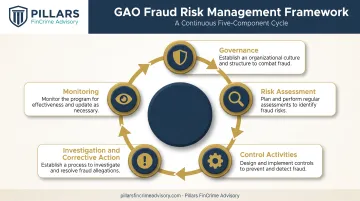
What that looks like in practice:
- Full lifecycle support from policy development and risk assessments through transaction monitoring optimization and audit readiness
- Independent evaluation of AML, KYC, transaction monitoring, and fraud intelligence tools against your risk profile, volume, and budget
- Practical guidance that balances innovation with regulatory confidence
- Hands-on help making programs scalable and exam-ready after vendor selection
If your team needs a second set of eyes before committing budget to a fraud intelligence platform, have that conversation early—before the contract is signed.
Conclusion
Pick the payment fraud intelligence provider whose data coverage, integrations, and regulatory alignment match your risk profile, transaction volume, and growth plans—not the one with the biggest brand name.
Evaluation is ongoing. Coverage gaps open, integration performance drifts, and regulatory expectations shift. Revisit fit on a set cadence, not only after something breaks.
When internal teams need help validating vendor claims before signing, an independent advisor such as Pillars FinCrime Advisory can pressure-test coverage and controls so gaps surface in diligence—not in an examiner finding.
Frequently Asked Questions
What is payment fraud intelligence?
It's data on criminal payment infrastructure (compromised accounts, wallets, and identifiers) used to detect and stop fraudulent transactions in real time. It combines external threat data with internal transaction context.
How is a payment fraud score calculated?
Scores typically combine behavioral signals, device and geolocation data, transaction history, and threat intelligence attribution into a weighted numeric estimate. Methodologies vary significantly by vendor, so ask for the underlying logic before relying on it.
What are the 7 elements of fraud?
There's no single universally accepted list of seven; elements vary by jurisdiction and offense type. Commonly cited factors include false representation, knowledge of falsity, intent to deceive, victim reliance, and resulting damages.
What is the 10/80/10 rule for payment fraud?
It's an informal heuristic suggesting roughly 10% of users are inherently trustworthy, 80% are situational, and 10% are predisposed to fraud. Use it as a mental model for tiered controls—not as a validated statistical finding.
How much do payment fraud intelligence providers typically cost?
Most providers use custom, enterprise pricing based on transaction volume, data modules, and integration scope. Weigh quoted costs against reduced fraud losses and lower compliance risk rather than comparing sticker price alone.
How long does it take to implement a payment fraud intelligence solution?
API-based integrations can go live in weeks. Full integration with case management, SIEM, and monitoring workflows typically takes longer, depending on internal data readiness and staffing.