Introduction
Crypto adoption keeps climbing, and so do the losses criminals extract from it. In 2024, the FBI's Internet Crime Complaint Center logged 149,686 cryptocurrency-related complaints totaling $9.3 billion in reported losses. That is a 66% jump from the year before, according to the 2024 IC3 Annual Report.
That growth isn't limited to individual victims. Fraud tactics have evolved to target the fintech and payments platforms that move crypto at scale, not just the retail investor scrolling social media. For compliance teams, that means the stakes now include regulatory exposure, not just customer losses.
This guide covers the fraud types you need to recognize, the red flags that separate scammers from legitimate opportunities, how institutions build formal risk management programs, and what to do when your customers—or your institution—get hit.
Key Takeaways
- Spot crypto fraud patterns early: phishing, investment scams, rug pulls, romance scams, and exchange hacks
- Treat every blockchain transfer as final; recovery after funds leave is rare
- Stand up formal AML/KYC programs and transaction monitoring if you handle digital assets
- Pair personal vigilance with organizational controls for the strongest fraud defense
Common Types of Cryptocurrency Fraud
Fraud tactics have diversified right alongside adoption. Among 2024 cryptocurrency-related IC3 complaints, extortion ranked as the most reported category at 47,054 complaints, while investment fraud came in second at 41,557 complaints but caused the greatest financial damage at $5.8 billion in losses.
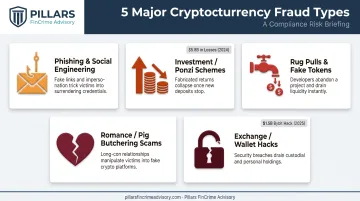
Phishing and Social Engineering Scams
Fake exchange emails, fraudulent giveaways, and brand impersonation trick users into revealing private keys or sending funds. The Commodity Futures Trading Commission describes the pattern clearly: scammers use links or QR codes that redirect people to look-alike sites built to steal money or credentials.
Investment and Ponzi/Pyramid Schemes
These schemes promise guaranteed high returns, funded not by real profits but by new investor deposits. BitConnect remains the textbook example.
The SEC alleges its Lending Program ran from early 2017 through January 2018 and defrauded retail investors of roughly $2 billion. The Department of Justice has described the structure as a classic Ponzi: earlier investors were paid with later investors' money.
Rug Pulls and Fake Token/ICO Scams
Developers hype a new token, collect funds, then abandon the project or drain the liquidity pool. Tokens can go to zero overnight. The tactic has become one of the fastest-growing crypto fraud categories, especially around new token launches and thinly traded pools.
Romance and "Pig Butchering" Scams
A fraudster builds trust over weeks or months through a fake romantic or friendly relationship, then steers the victim toward a fraudulent trading platform. The FBI defines this as crypto investment fraud involving an online relationship that precedes the fraudulent pitch. In Operation Level Up, agents notified 4,323 potential victims (76% did not know they were being scammed) and estimated $285.6 million in losses avoided through early intervention.
Exchange and Wallet Hacks
High-profile breaches show why a platform's security posture matters as much as end-user habits. In February 2025, North Korean state actors stole approximately $1.5 billion in ether from the Bybit exchange, according to the FBI. Attackers compromised a developer's computer and inserted malicious code that made a fraudulent transaction look legitimate.
This distinction matters for both customers and the institutions that serve them:
- Custodial risk : funds held by an exchange are only as safe as that platform's controls, governance, and incident response
- Non-custodial risk : self-hosted wallets shift key management to the user, while institutions still face exposure through on-ramps, support channels, and fraud losses tied to compromised accounts
How to Spot a Crypto Scammer: Warning Signs to Watch For
Most crypto scams share recognizable patterns, whether they're targeting a retiree on social media or an institutional account.
Behavioral red flags:
- Unsolicited contact from someone claiming investment expertise
- High-pressure tactics urging immediate action ("this opportunity closes tonight")
- Promises of guaranteed or unusually high returns
Payment-related red flags:
- Requests to move the conversation off-platform (Telegram, WhatsApp, or other encrypted apps)
- Demands for upfront "fees" or "taxes" before releasing your own funds
- Insistence that payment must happen exclusively in crypto
Technical red flags:
- Cloned or slightly misspelled exchange URLs
- Team members who can't be verified or found anywhere else online
- Anonymous, vague, or plagiarized whitepapers
Social proof red flags:
- Fake testimonials and fabricated review campaigns
- Deepfake videos impersonating celebrities or executives
- Coordinated bot activity that creates false legitimacy on social media
The Wallet Address Trap
A public wallet address alone cannot withdraw your funds. Scammers still exploit address handling in other ways:
- Address poisoning: attackers send a tiny transaction from a look-alike address so it appears in your history, hoping you'll copy the wrong one later
- Fake QR codes: scanning an unfamiliar code can route payment to an attacker's wallet or trigger malware
- Clipboard-hijacking malware: malware swaps a copied wallet address with an attacker-controlled one before you paste it
Verify the full destination address character by character, and send a small test transaction before moving significant funds. Fintechs and financial institutions should fold these same signals into customer education and fraud monitoring playbooks.
Building an Institutional Fraud Prevention & Risk Management Program
Fintechs, payments companies, and financial institutions handling digital assets operate under real regulatory teeth. FinCEN guidance treats most crypto exchangers and administrators as money transmitters under the Bank Secrecy Act, requiring registration, written AML policies, a designated compliance officer, staff training, and independent program review.
The enforcement risk isn't theoretical. FinCEN assessed Binance a $3.4 billion civil money penalty for willful BSA violations, along with a five-year supervised monitorship — the largest settlement in U.S. Treasury Department history, according to FinCEN's own announcement.
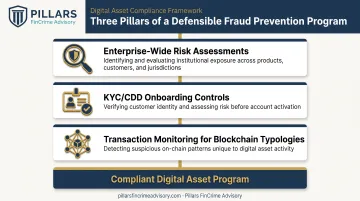
A defensible program typically includes:
- Enterprise-wide risk assessments that reflect the organization's actual product mix and customer base
- KYC/CDD onboarding controls built for the specific risk profile of digital asset customers
- Transaction monitoring tuned to blockchain-specific typologies such as mixers, DeFi layering, and structuring patterns that don't show up in traditional monitoring rules
The hard part is balance. Overly rigid controls create customer friction that drives users to less compliant competitors. Weak controls invite regulatory action and reputational damage. Neither extreme works.
Pillars FinCrime Advisory helps leadership teams strike that balance. Founder Joshua Douglas brings 12+ years of financial crime experience and CAMS certification to building full-lifecycle programs, from policy development and risk assessments through transaction monitoring optimization and exam readiness.
Programs built piecemeal under deadline pressure—after an incident or exam finding—tend to cost far more than programs built proactively with room to mature.
Practical Prevention Best Practices for Individuals and Businesses
Prevention responsibility sits on both sides of a transaction.
For individuals:
- Use hardware wallets for significant holdings so keys stay offline and harder to compromise than in hot wallets
- Enable two-factor authentication on every crypto-related account
- Verify URLs and wallet addresses before every transaction
- Never share your seed phrase, not with "support staff" or anyone else
For businesses and platforms:
- Layer security with cold storage and multi-signature wallets that require multiple key-holders to approve each transaction
- Train employees regularly on social engineering tactics
- Commission third-party security audits on a recurring schedule
Fraud tactics don't stand still, so neither should your defenses. Build a habit of tracking emerging scam typologies, from a personal Google alert to an institutional threat intelligence feed. That ongoing vigilance pays off far more than a one-time policy update.
Can You Recover Stolen Cryptocurrency? What to Do After Being Scammed
Blockchain transactions are largely irreversible. There's no bank to call and reverse the charge. That said, recovery isn't always a dead end. Cooperative exchanges and law enforcement have recovered funds in specific cases, especially when blockchain forensic tracing can follow the path of the assets.
One example: in June 2025, the DOJ filed a civil forfeiture complaint against more than $225.3 million in cryptocurrency traced through blockchain analysis to confidence-scam theft and laundering, reported as the largest crypto seizure in U.S. Secret Service history.
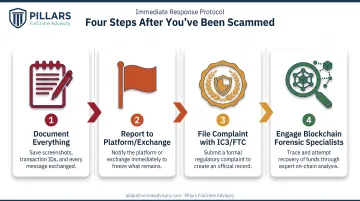
If you've been scammed, act fast:
- Document everything: transaction hashes, wallet addresses, dates, amounts, and all scammer communications
- Report to the platform or exchange involved immediately
- File a complaint with IC3.gov or the FTC, with every identifying detail you have
- Engage blockchain forensic specialists if the loss amount justifies the cost
Watch for recovery scams. The FBI warns that fraudulent "recovery" firms target prior victims, promise to retrieve funds for an upfront fee, then disappear or demand more money. Never pay an advance fee for recovery services. Report any such approach to IC3.
Frequently Asked Questions
Can you get your money back if you get scammed on crypto?
Recovery is rare because blockchain transactions are irreversible. Report to the exchange involved, file with IC3 or law enforcement, and engage blockchain forensic specialists when the loss justifies the cost.
How can you tell if someone is a crypto scammer?
Watch for unsolicited contact, pressure to act quickly, promises of guaranteed returns, and requests to move communication off-platform. Cloned websites and unverifiable team members are additional warning signs.
What is the biggest risk in crypto?
For individuals, it's irreversible transactions with no centralized recourse if something goes wrong. For institutions, it's the compliance and regulatory risk of unknowingly facilitating illicit activity on their platform.
Can someone steal your money if they have your crypto wallet address?
No. A public wallet address alone can't be used to withdraw funds. The real risk comes from related tactics like address poisoning and phishing that trick you into sending funds to the wrong address.
What's the difference between a crypto scam targeting individuals and fraud risk at the institutional level?
Consumer scams target one victim through deception or social engineering. Institutional fraud risk involves platform-level AML and compliance failures that can enable illicit activity at scale, requiring formal regulatory programs to manage.
How often should a fintech or payments company update its fraud risk assessment?
Most institutions review risk assessments annually, or sooner after a major product launch, regulatory change, or growth event. Outside advisory support is most useful when internal teams lack bandwidth or specialized digital-asset expertise.