

An executive board holds binding authority. An advisory board does not. Confusing the two isn't just a semantic slip. It can create real compliance gaps, especially around who actually approved the AML program regulators expect to see documented in board minutes.
That distinction matters more than most leadership teams realize. A company's written BSA/AML program must be board-approved and reflected in official minutes, according to FFIEC guidance on assessing BSA/AML compliance programs. Advisory input, however valuable, doesn't satisfy that requirement.
This article breaks down what each structure actually is, compares them side by side, and helps you figure out which one (or both) your organization needs.
Key Takeaways
- Executive boards hold binding, fiduciary authority; advisory boards offer non-binding guidance only
- Regulators require board-approved AML/BSA programs, not advisory sign-off
- Advisory boards fill specialized financial crime expertise gaps fast, without adding headcount
- Many fintechs run both structures together for layered governance
- The right setup depends on your regulatory exposure, growth stage, and internal skill gaps
Executive Board vs Advisory Board: Quick Comparison
Here's how the two structures stack up across the areas that matter most for compliance-driven organizations:
| Dimension | Executive Board | Advisory Board |
|---|---|---|
| Authority & decision-making | Binding votes; approves budgets, policies, and program elements | Recommends; has no legal decision-making authority |
| Legal & fiduciary accountability | Directors owe duties of care and loyalty; ultimately accountable for BSA/AML oversight | No fiduciary duties; cannot be held liable the way directors can |
| Composition & selection | Elected or appointed directors, often with governance or industry ties | Handpicked subject-matter experts, chosen for specific expertise gaps |
| Meeting structure & frequency | Formal, minuted meetings on a set schedule (quarterly or monthly) | Flexible, often informal, meeting as-needed or project-based |
An executive board governs. An advisory board informs. One carries legal weight. The other carries expertise. Neither is a substitute for the other, which is exactly why so many regulated companies use both.
What is an Executive Board?
An executive board is a formally elected or appointed governing body with binding legal and fiduciary authority over an organization's direction, risk appetite, and compliance obligations. Depending on the company, this might refer to the full board of directors, or to an executive committee that handles decisions between full board meetings.
For regulated fintechs and financial institutions, this structure isn't optional. The board must designate a qualified BSA officer, ensure that person has real authority and resources, and receive regular compliance reporting, per FFIEC standards on BSA compliance officer requirements.
Credit unions face the same expectation: NCUA examiners specifically confirm that board approval is documented in the minutes.
Why this structure matters:
- Creates centralized accountability that examiners can point to during a review
- Speeds up approval of compliance budgets and policy changes
- Establishes a clear chain of command regulators recognize and expect
Core Responsibilities of Executive Boards
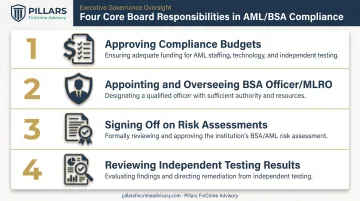
Executive boards are the ones actually on the hook when things go wrong. Their responsibilities typically include:
- Approving compliance budgets and signing off on major remediation plans
- Appointing and overseeing the BSA Officer or MLRO, including reviewing their authority and independence
- Signing off on risk assessments before they're finalized or submitted to regulators
- Reviewing independent testing results, which should flow directly to the board per FFIEC guidance
This isn't theoretical. In 2024, the OCC issued a cease-and-desist order and a $450 million civil money penalty against TD Bank for BSA/AML program deficiencies, including growth restrictions tied to unresolved compliance gaps. Bank of America faced a similar cease-and-desist order that same year.
These cases don't prove a direct causal link between board strength and outcomes, but they underline the stakes: when board-level oversight is passive or under-resourced, regulators notice.
Chartered banks, credit unions, and licensed money transmitters all operate under this expectation. If your business fits one of those categories, a functioning executive board isn't a nice-to-have. It's table stakes.
What is an Advisory Board?
An advisory board is a group of external subject-matter experts convened to give non-binding strategic or technical guidance. According to NACD's overview of advisory boards, these groups have no legal decision-making authority, and their recommendations are exactly that: recommendations.
For fintechs and payments companies navigating fast-moving financial crime regulations without deep in-house expertise, that's often precisely what's needed.
Core benefits include:
- Access to specialized knowledge without fiduciary liability attached
- Faster access to niche expertise than hiring a full-time compliance executive
- Added credibility with investors and, in some cases, regulators evaluating program maturity
Advisory boards come in a few flavors. Some fintechs build compliance or financial crime advisory boards. Others lean on technical advisory boards or customer advisory boards. Specialized financial crime advisory support, in particular, has become common among growth-stage fintechs trying to bridge expertise gaps before they're ready to build a full compliance team.
Use Cases of Advisory Boards
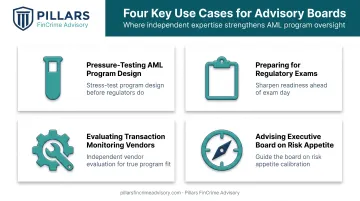
Advisory boards tend to show up at specific pressure points:
- Pressure-testing AML program design before it goes live
- Preparing for regulatory exams by identifying weak spots before an examiner does
- Evaluating transaction monitoring vendor decisions, matching tools to actual risk profile and volume
- Advising the executive board and C-suite on risk appetite and program investment priorities
Fast-scaling fintechs and payments companies often bring in CAMS-certified financial crime advisors to guide executive boards through program build-out, remediation, and audit readiness. Firms like Pillars FinCrime Advisory fill that gap so leadership gets senior-level input on work such as transaction monitoring optimization, KYC redesign, and exam prep—without the overhead of a full-time hire.
Executive Board vs Advisory Board: Which Structure Is Right for You?
There's no single right answer here. The correct setup depends on where your company sits regulatorily and operationally.
Factors to Consider
- Regulatory exposure and company stage. An early-stage fintech operating under a sponsor bank faces different obligations than a chartered financial institution examined directly by the OCC or FDIC.
- Internal expertise gaps. Smaller fintechs often lack a fully developed compliance function, meaning AML and KYC responsibilities fall on a lean team stretched across other priorities.
- Governance overhead vs. flexibility. Executive boards create binding accountability; advisory boards deliver specialized input without a permanent fiduciary structure.
Situational Recommendations
- Formalize an executive board when binding governance, fiduciary accountability, and formal regulatory sign-off are non-negotiable for your charter or license type.
- Bring in a financial crime advisory board when you need targeted, flexible expertise to inform executive decisions without adding permanent governance overhead. Many organizations run both at once. That mix is increasingly common as regulatory scrutiny on fintechs intensifies.
Real-World Example: Strengthening Governance with Financial Crime Advisory Support
Picture a mid-sized payments company whose executive board approved a transaction monitoring system years ago, before volume tripled. Alerts piled up. Investigators triaged cases without a clear risk-based method, and the board's own visibility into program maturity started slipping ahead of a scheduled regulatory review.
Rather than scrambling to hire a full compliance team under deadline pressure, the executive board brought in outside financial crime expertise. Support from Pillars FinCrime Advisory helped rework monitoring rules, redesign KYC workflows, and prepare documentation for the upcoming exam.
The result: alert quality improved, operational friction dropped, and the team walked into their regulatory exam better prepared than before.

The takeaway: Pairing executive board authority with specialized advisory expertise turns reactive compliance into a scalable, audit-ready program. If your executive board is facing something similar, contact Pillars FinCrime Advisory for a program assessment.
Conclusion
Executive boards and advisory boards aren't competing options—they solve different problems. One holds legal authority and fiduciary accountability. The other brings specialized expertise without that liability. Which one your organization needs, or whether you need both, comes down to regulatory maturity, growth stage, and where internal knowledge falls short.
For most fintechs and payments companies operating under real regulatory scrutiny, the strongest setup pairs the two: an executive board that governs with confidence, backed by advisory expertise that keeps the program sharp between exams. That combination supports faster, more confident scaling and a stronger standing with regulators.
Frequently Asked Questions
What is the difference between a board and an executive board?
"Board" is a general term that can refer to many types of governing or advisory groups. An executive board typically refers specifically to the governing body, or a subset of it, that holds binding, fiduciary decision-making authority.
Is an advisory board the same as a board of directors?
No. An advisory board offers non-binding guidance and recommendations, while a board of directors holds legal and fiduciary authority over the organization's decisions.
Is it worth being on an advisory board?
Yes, for many professionals. It offers influence, credibility, and networking opportunities without the fiduciary liability that comes with a formal director role, making it a lower-risk way to contribute expertise.
What are the four main types of boards?
Common categories include fiduciary or statutory boards, advisory boards or councils, executive committees (a subset of the main board), and operating boards. Definitions vary by organization and industry.
Can a company have both an executive board and an advisory board?
Yes. Many fintechs and financial institutions run both together, with the executive board handling formal governance and the advisory board informing those decisions with specialized expertise.
Do advisory board members have voting rights or fiduciary duties?
Typically, no. Advisory board members generally lack the voting rights and fiduciary duties that elected directors carry, which is a key distinction between the two roles.