This scenario plays out constantly in fintech. Regulators no longer accept a program that looks good on paper — they expect it to be risk-based, documented, and provable under scrutiny.
Most compliance failures aren't caused by bad intentions. They come from poor design: missing ownership, generic policies borrowed from a template, and no way to demonstrate the program actually functions. This guide walks through a step-by-step framework for designing a program that holds up, the core elements regulators expect, common mistakes to avoid, and when outside expertise makes sense.
Key Takeaways
- Effective compliance programs are risk-based, documented, tested, and owned—not static policy binders.
- Design follows a repeatable cycle: risk assessment, governance, policies, training, monitoring, and remediation.
- Exam-ready programs match the organization's real risk profile and growth stage, not a generic template.
- Weak executive buy-in, thin compliance staffing, and no remediation path are the top failure points.
How to Design an Effective Compliance Program: A Step-by-Step Framework
A durable compliance program is built in sequence. Skip a step or reverse the order, and gaps show up later in exams, audits, or enforcement actions.
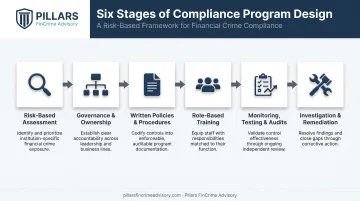
Step 1: Conduct a Risk-Based Assessment
Program design starts with mapping applicable regulations, products, customer types, and geographies to pinpoint where actual compliance exposure lives. Regulators expect this assessment in writing, distributed to the board, management, and relevant staff, not kept as institutional knowledge in someone's head.
For fintechs and payments companies, this typically means evaluating three areas before drafting a single policy:
- AML/BSA obligations tied to the specific products and customer base
- Sanctions exposure, including OFAC screening needs across transaction types and geographies
- Third-party and sponsor bank relationships, since outsourcing payment activity never transfers regulatory accountability away from the underlying bank
Step 2: Establish Governance, Ownership & Board Accountability
A named compliance officer only satisfies regulatory expectations if that person has real authority, independence, resources, and direct access to the board. Appointment alone isn't enough. The officer needs a reporting line where compliance status, risk exposure, and open issues get communicated regularly.
Pair that with a RACI-style breakdown that names who is Responsible, Accountable, Consulted, and Informed for each compliance function. Without it, compliance becomes "everyone's job," which in practice means it's no one's job.
Step 3: Translate Requirements into Written Policies and Procedures
Policies should use plain, actionable language tied to specific regulatory obligations, not generic boilerplate lifted from a competitor's manual. Written policies alone don't establish an adequate program if actual practices don't match them.
Two things matter most here:
- Cross-reference frameworks to avoid duplicating the same control language across five different policy documents.
- Build procedures around how the business actually runs, not an idealized workflow that looks clean in a slide deck but breaks down the moment underwriting or engineering touches it.
Step 4: Build Role-Based Training and Communication Channels
One generic training module for the entire company misses the point. Frontline staff face different risks than underwriting, and engineering faces different risks than either. Training should reflect the specific exposure each role actually creates.
Equally important: a trusted, confidential reporting channel. Employees need a documented, retaliation-free path for raising concerns, and the organization needs a clear process for how those concerns get escalated and resolved.
Step 5: Implement Monitoring, Testing, and Independent Audits
Ongoing monitoring plus periodic independent testing is what separates a real program from a paper one. Testing should be risk-based, performed by qualified independent staff, and cover both control effectiveness and reporting quality. Findings should flow back into policy updates.
The FFIEC BSA/AML Examination Manual points to a 12-18 month testing cycle as a common benchmark, though more frequent testing is warranted after major changes in risk profile, systems, or staffing.
The cost of skipping this step is well documented. FinCEN found that TD Bank's AML program was neither properly designed nor adequately resourced — monitoring gaps let suspicious activity accumulate in backlogs for years. The result was a record $1.3 billion penalty and a four-year independent monitorship.
Step 6: Create Investigation, Reporting, and Remediation Protocols
Detecting an issue means nothing without a documented path to resolving it. This step needs:
- Define timelines from detection to resolution
- Set clear escalation triggers for when an issue moves up the chain
- Track corrective actions through to documented closure
Examiners consistently ask to see this trail. If a program can't produce evidence of how a past issue got fixed, it raises doubts about whether it's designed to catch the next one.
Key Elements That Determine Whether a Compliance Program Actually Works
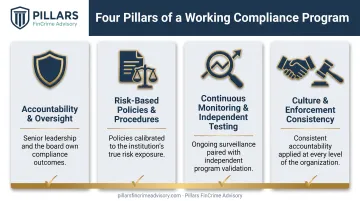
Regulators and examiners evaluate programs against a common set of foundational elements, most rooted in the federal Sentencing Guidelines' seven-element framework. Four of these consistently separate credible programs from fragile ones.
Accountability and Oversight
Without a named, empowered owner, compliance responsibilities get diffused across departments and nothing gets prioritized. Named ownership is typically one of the first things examiners and prosecutors check when assessing program credibility. It's a quick signal of whether the organization takes compliance seriously.
Risk-Based Policies and Procedures
Policies copied from templates or a competitor's playbook rarely reflect an organization's actual risk profile. Risk-calibrated policies reduce regulatory exposure and cut unnecessary operational friction — two outcomes that don't usually go together with generic documents.
Continuous Monitoring and Independent Testing
Annual reviews leave long windows where controls can silently drift out of compliance. Ongoing testing catches gaps early and builds the evidence trail examiners expect to see during an exam.
Culture and Enforcement Consistency
Inconsistent discipline, such as letting management off more easily than frontline staff for the same violation, signals to regulators that the program isn't taken seriously. Consistent, well-publicized enforcement is repeatedly cited as a top factor in whether examiners judge a program credible.
When You Need to Build or Redesign Your Compliance Program
A full redesign is typically triggered by one of a handful of events:
- Rapid growth that outpaces the original compliance framework
- Launching a new product or entering a new market
- M&A activity that changes the risk profile overnight
- Adverse findings from a regulatory exam
Scaling fintechs and payments companies often outgrow their original compliance framework long before anyone notices. The gap stays hidden until an exam or a partner bank's review exposes it.
The Federal Reserve's 2024 enforcement action against Evolve Bank is a clear example. Examiners found the bank lacked an effective risk-management framework for its fintech partnerships and insufficient AML controls, prompting required remediation.
For organizations without in-house resources, or facing a looming exam with no time to spare, partnering with an experienced financial crime compliance advisory firm can close the gap fast. Pillars FinCrime Advisory works with fintechs and payments companies to translate regulatory expectations into a scalable, audit-ready framework without slowing growth. That includes sponsor bank representation for companies that need to rebuild trust with a banking partner.
Common Mistakes to Avoid When Designing a Compliance Program
Even solid programs stumble for predictable reasons. Avoid these traps:
- Treating it as a one-time project. A compliance program isn't a binder you finish and file away. It's a living system that needs regular review as the business grows and regulations shift.
- Writing policies that don't match operations. A program that looks compliant on paper but breaks down in daily practice is worse than having no program. It creates false confidence.
- Skipping genuine executive and board buy-in. Without real leadership commitment, training becomes a box-check, enforcement turns selective, and the program loses credibility with staff and examiners.
Conclusion
An effective compliance program has to be designed for your risks and your business. It takes a deliberate process: risk assessment, governance, policy design, training, and testing working as one system, not six disconnected checklists.
Most failures trace back to design choices made early, not bad luck. That's why getting the framework right from the start matters more than fixing it after an exam finding.
If you're not sure your current program would hold up under scrutiny, an outside assessment can answer that question before a regulator does. Pillars FinCrime Advisory, founded by CAMS-certified compliance professional Joshua Douglas, helps fintechs, payments companies, and financial institutions design programs that scale with growth and stand up to exam scrutiny.
Frequently Asked Questions
What are the 7 elements of a compliance program?
The federal Sentencing Guidelines outline seven core elements:
- Written standards and procedures
- Designated oversight authority
- Screening for high-risk personnel
- Periodic training
- Monitoring and confidential reporting channels
- Consistent enforcement and discipline
- Prompt corrective action after issues are found
What are the three C's of compliance?
The phrase commonly refers to Culture, Communication, and Controls. All three need to reinforce each other — strong controls mean little if the culture doesn't back them up.
What makes a good compliance program?
A good program is risk-based, has clear ownership, gets actively tested rather than sitting static, and can produce evidence of effectiveness the moment regulators ask for it.
How long does it take to design an effective compliance program?
Timelines vary by size and complexity. Most organizations can build an initial framework in a few months, with full program maturity — consistent testing, refined controls, proven track record — developing over a year or more.
Who should be responsible for designing a compliance program?
A designated compliance officer typically leads the effort, but effective design requires input from executive leadership, legal, and operations — plus outside advisory expertise when in-house resources are limited.
How often should a compliance program be reviewed or updated?
At minimum, annually. But reviews should also happen immediately after regulatory changes, new product launches, M&A activity, or findings from a regulatory exam.