This guide is written for BSA/AML officers, compliance leaders, and executives at fintechs, payment companies, and financial institutions. Get the risk assessment wrong, and every downstream decision — CDD calibration, EDD triggers, monitoring thresholds, staffing levels — inherits that flaw.
Too many institutions treat this as a static annual document, or worse, a generic spreadsheet template pulled from a Google search. This guide covers the actual methodology: the step-by-step process, the risk categories examiners expect to see, and the pitfalls that turn a routine exam into a finding.
Key Takeaways
- An AML risk assessment identifies, measures, and documents ML/TF exposure—not a rewritten policy narrative
- Inherent risk (before controls) and residual risk (after tested controls) are distinct calculations
- The FFIEC's two-step approach (identify categories, then analyze and quantify) drives US regulatory expectations
- Documented control mapping and board approval separate defensible assessments from vulnerable ones
- Update risk assessments annually, and immediately after any material trigger event
What Is an AML Risk Assessment (and Why It's Essential)?
An AML risk assessment identifies where money laundering or terrorist financing risk lives inside your institution. It measures how severe that exposure is and documents the conclusion so examiners can trace and test it.
Definition & Purpose
A well-built risk assessment is the analytical backbone that tells you where controls, monitoring intensity, and risk appetite need to be concentrated. It converts a regulatory obligation into an operational decision tool.
It's also frequently confused with AML risk management. They're related but distinct:
- Risk assessment identifies and measures exposure
- Risk management deploys the controls, monitoring, and governance that respond to that exposure
You can't manage what you haven't accurately measured first.
Who Is Required to Conduct One
There's no single line in the Bank Secrecy Act that says "you must complete a risk assessment." But supervisory expectations leave little room for interpretation. According to the FFIEC BSA/AML manual, a well-developed risk assessment "assists the bank in identifying ML/TF and other illicit financial activity risks," and examiners treat its absence as a program gap.
This expectation extends to:
- Banks, credit unions, and thrifts
- Money services businesses (MSBs) under 31 CFR 1022.210
- Fintechs and payment processors operating under sponsor-bank relationships
Regulators don't prescribe exact risk categories. The number and depth should scale with your size, complexity, and business model. A five-person MSB doesn't need the same granularity as a multi-state payments platform.
Inherent Risk vs. Residual Risk Explained
This is the distinction that separates a defensible assessment from a guessing exercise.
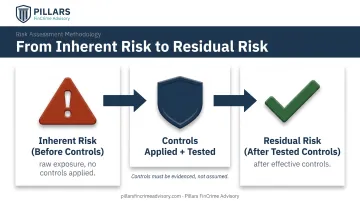
- Inherent risk is your exposure before any controls are applied
- Residual risk is what remains after controls are applied and tested
That second word matters. A documented control doesn't reduce risk just because it exists on paper. It reduces risk only when effectiveness is evidenced. Teams typically rate controls strong, adequate, or weak based on actual performance data—not an assumption that the control works as designed.
Why Getting This Right Matters for Growing Institutions
For fast-scaling fintechs and payment companies, a weak initial risk assessment doesn't stay small. It compounds with every new customer, product, and jurisdiction added to the business.
The OCC's 2026 consent order against Community Federal Savings Bank illustrates this pattern directly. The enforcement action found that rapid payment-processing growth, cross-border activity, and higher-risk products outpaced the bank's controls and risk processes. It required a written, board-approved, institution-wide assessment covering products, customer types, geographies, third parties, and residual risk.
Engaging an experienced financial crime advisory partner early, such as Pillars FinCrime Advisory (founded by CAMS-certified compliance professional Joshua Douglas), helps growing institutions build a scalable, audit-ready framework from the start. Retrofitting one after an exam finding is far more expensive and disruptive.
How to Conduct an AML Risk Assessment: A Step-by-Step Process
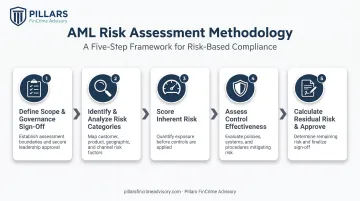
The FFIEC's approach breaks down into two conceptual moves: first, identify your specific risk categories: products, services, customers, and geographic locations. Second, analyze and quantify the data within each one.
Documentation matters at every stage, whether you're working in a spreadsheet or dedicated software. Examiners want to see the work papers that show how you reached your conclusions, not just the final scores.
Risk scoring should follow a defined scale (commonly 1-3 or 1-5) so you can systematically reduce inherent risk scores based on control strength, rather than adjusting them case by case.
Step 1: Define Scope and Secure Governance Sign-Off
Before any analysis begins, get senior management or board approval for scope, risk categories, and scoring methodology. Skipping this step is one of the fastest ways to end up with an assessment that different departments interpret differently.
Step 2: Identify and Analyze Risk Categories
Pull the underlying data for each category:
- Segment customers and track onboarding volumes
- Inventory products and services
- Map geographic exposure by customer domicile and transaction routing
- Analyze transaction volume and value trends over time
Step 3: Score Inherent Risk
Rate exposure before controls are applied, using consistent criteria across every business line. Inconsistent scoring between departments is exactly the kind of thing examiners flag as a governance failure rather than a minor technical gap.
Step 4: Assess and Rate Control Effectiveness
Map each control (CDD, EDD, transaction monitoring, sanctions screening) to the risk it's meant to mitigate. Rate it strong, adequate, or weak based on tested performance data, such as detection rates or alert accuracy, not on whether the policy document reads well.
Step 5: Calculate Residual Risk, Document, and Obtain Approval
Document the rationale for final risk classifications and obtain formal sign-off from the board or senior management so the results carry regulatory weight. Review the assessment annually, or immediately when a material trigger hits:
- New products or services
- New jurisdictions
- M&A activity
- Exam findings
Key Risk Categories Evaluated in an AML Risk Assessment
Customer or Member Base Risk
This category covers several higher-risk customer types:
- Politically exposed persons (PEPs)
- Non-resident customers
- Cash-intensive businesses
- Money services businesses (MSBs)
- Complex beneficial ownership structures
PEP status alone is not automatically high risk. Authority level, access to government assets, and transaction geography matter more than the label itself.
Customer risk should be evaluated dynamically, not frozen at onboarding. A customer's profile — and their risk score — can change significantly over the life of the relationship.
Products and Services Risk
Wire transfers, correspondent banking, prepaid instruments, trade finance, and crypto-related products all carry distinct risk profiles. What matters more than a high-level product label is:
- Transaction limits and functionality
- Whether the product allows cross-border movement
- How easily the product can be used anonymously
Geographic Risk
Geographic risk covers exposure to jurisdictions with elevated corruption, sanctions, or weak AML frameworks.
It is not one-dimensional. Assess customer domicile, transaction routing, and beneficial ownership location separately: a customer can be low-risk on one dimension and high-risk on another.
Delivery Channel Risk
Non-face-to-face onboarding, agent networks, and API-driven channels all introduce distinct verification challenges.
Beyond channel design, institutions should map overall exposure against FinCEN's National AML/CFT Priorities, which include:
- Corruption
- Cybercrime
- Fraud
- Human and drug trafficking
- Proliferation financing
Cross-referencing your delivery channels against these priorities gives examiners confidence that your risk assessment reflects current national typologies, not just internal assumptions.
AML Risk Assessment Best Practices and Common Mistakes to Avoid
Best practices
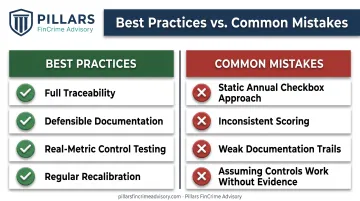
- Build full traceability from risk identification through control mapping to governance approval
- Defend every residual risk conclusion line-by-line with exam-ready documentation
- Test controls with real metrics (detection rates, escalation timelines, false-positive ratios), not assumptions on paper
- Recalibrate scores when you launch products, enter new markets, or hit material trigger events
Common mistakes to avoid
- Treating the assessment as a static annual checkbox instead of a living framework
- Applying inconsistent risk scoring across business lines
- Leaving weak documentation trails that examiners read as governance failures
- Assuming a documented control works as designed without performance evidence
Institutions that pass exams cleanly rarely have the fanciest template. They can walk an examiner through why each score exists.
Conclusion
An AML risk assessment is the operational backbone of a risk-based compliance program. Methodology, inherent versus residual risk, honest control mapping, and documented governance matter far more than which template you use.
Pillars FinCrime Advisory, led by CAMS-certified founder Joshua Douglas, helps fintechs, payments companies, and financial institutions build or remediate risk assessments designed to hold up under regulatory exam scrutiny.
Frequently Asked Questions
What is an AML risk assessment report?
An AML risk assessment report is the documented output of the assessment process. It shows risk categories, inherent risk scores, control mapping, residual risk conclusions, and governance approval so examiners can trace how your institution reached its conclusions.
What red flags should trigger an AML risk assessment update?
Typical red flags include structuring, transactions tied to high-risk jurisdictions, and PEP involvement. Those same factors should trigger a reassessment of your institution's AML risk assessment, not only a transaction alert.
How often should an AML risk assessment be updated?
Plan on at least an annual review. Update immediately after new products, new jurisdictions, mergers, acquisitions, or exam findings; waiting for the annual cycle isn't enough.
What is the difference between AML risk assessment and AML risk management?
Assessment identifies and measures your exposure to money laundering and terrorist financing risk. Management deploys the controls, monitoring, and governance structure that respond to what the assessment found.
Who is required to conduct an AML risk assessment?
All regulated financial institutions (banks, credit unions, MSBs, fintechs, and payment processors) are expected to perform one under a risk-based approach. Emerging sectors like NIL platforms face the same expectation as their compliance obligations mature.
What happens if an AML risk assessment is inadequate?
An inadequate assessment typically surfaces as an escalated examiner finding, which can lead to a consent order or other enforcement action. Beyond the regulatory penalty, remediation projects are almost always more costly and disruptive than building it right the first time.