Many sponsor banks and fintech partners now face a harder question than "what tools do we buy?" It's "which tools actually satisfy an examiner, and which just make us feel covered?" Those are not the same thing.
This guide breaks down the core compliance tool categories sponsor bank programs need, the best practices for selecting them, the pitfalls that sink otherwise well-funded programs, and where advisory expertise fills the gaps technology alone can't close.
Key Takeaways
- Build a layered stack: onboarding/KYC, transaction monitoring, fraud detection, and audit-ready reporting
- Prioritize control, visibility, and a single source of truth over convenience or lower cost
- Weak reconciliation and unclear oversight ownership cause most program failures
- Tools alone don't create maturity; governance and policy calibration matter equally
Understanding Sponsor Bank Compliance: Why the Stakes Are So High
A sponsor bank lends its charter, regulatory infrastructure, and oversight framework so a fintech can offer banking products without becoming a bank itself. The fintech builds the app and customer experience. The bank remains legally accountable for how that product complies with federal law, regardless of who built the technology behind it.
That accountability doesn't transfer just because a task gets outsourced. Federal Reserve guidance is explicit: contracting out compliance functions does not shift the bank's legal responsibility for BSA/AML compliance, monitoring, and oversight.
For sponsor banks, the exposure is concrete:
- Full legal accountability for BSA/AML stays with the bank, even when work is outsourced
- Rising share of federal enforcement tied to fintech partner-bank arrangements
- Board-level ownership when examiners stress-test the compliance stack
Enforcement data backs that up. Fintech partner-bank actions represented 35% of publicized federal enforcement measures through Q1 2024, up from 26% in Q4 2023 and just 10% a year earlier, according to Klaros Group data reported by American Banker.
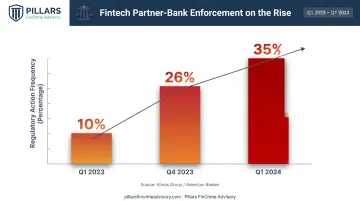
That trajectory is why compliance tooling has moved from an IT line item to a board-level agenda item. When a sponsor bank's charter and fintech partnerships are on the line, examiners will test the tool stack first.
Core Compliance Tool Categories Every Sponsor Bank Program Needs
No single platform covers everything a sponsor bank needs. A defensible program layers several tool categories, each addressing a distinct regulatory expectation.
| Tool Category | What It Does | Regulatory Expectation |
|---|---|---|
| KYC/KYB & CDD | Identity verification, UBO collection, sanctions/PEP screening | FinCEN's CDD rule requires identifying beneficial owners with 25% or more ownership, plus one control person |
| Transaction monitoring & AML | Rule engines, SAR/UAR case management, escalation workflows | Reasonable filtering criteria, timely alert investigation, independent validation |
| Fraud detection | Real-time authorization controls, velocity limits, identity checks | Risk-based processes reviewed at least annually under Nacha's fraud monitoring rule |
| Perpetual monitoring | Automated due diligence refresh, risk re-scoring | Ongoing monitoring to update customer information on a risk basis |
| Audit trail & reporting | Centralized documentation, exam-ready dashboards | Board reporting, independent validation, transaction testing |
| Dispute management | Structured card/ACH dispute workflows | Regulation E timelines: error determination within 10 business days |
Why the Stack Needs Depth, Not Just Breadth
Buying six point solutions doesn't automatically create a compliant program. Each category needs to feed a unified view of the customer and the transaction, not sit in isolation. A KYC tool that can't pass risk scores downstream to transaction monitoring creates blind spots examiners are trained to find.
Dispute Management Deserves More Attention Than It Gets
Among the six categories above, teams often treat dispute workflows as a customer service function rather than a compliance one. That's a mistake.
Regulation E timelines are strict:
- Provisional credit within 10 business days when an investigation extends to 45 days
- Full correction within one business day of confirming an error
A dispute tool without built-in timeline enforcement creates compliance exposure quietly, one missed deadline at a time.
Best Practices for Selecting & Implementing Compliance Technology
Choosing compliance technology hinges on control, not feature checklists. Before signing any vendor contract, sponsor banks need clarity on who owns what.
Follow this sequence when evaluating tools:
- Define control ownership first. Document exactly what the bank owns versus what the fintech or vendor owns, function by function, before you shop for tools.
- Favor single-source-of-truth architectures. Fragmented "side core" models—fintech ledgers run apart from the bank's system of record—complicate reconciliation and slow exams.
- Vet vendors like regulators vet you. Ask about SLAs, escalation paths, and reconciliation processes with the same rigor examiners apply to the sponsor bank itself.
- Require real-time shared dashboards. Oversight shouldn't depend on a vendor emailing a monthly PDF report.
- Stress-test integrations before go-live. Confirm data flows cleanly between BaaS platforms, subledgers, and fraud/AML systems under real transaction volume.
- Build in scalability from day one. A stack that can't absorb new products or volume without a full re-platform costs far more later than it saves now.
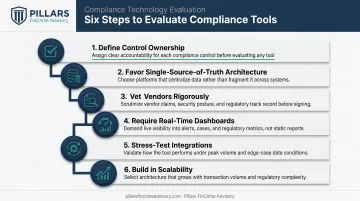
Interagency guidance backs steps one and three directly. The third-party risk lifecycle runs through planning, due diligence, contract negotiation, ongoing monitoring, and termination. Contracts should guarantee the bank access to its own data, plus audit rights and remediation authority.
Skip that groundwork, and you're building on sand.
Common Pitfalls That Undermine Sponsor Bank Compliance Programs
Even well-resourced programs fail for surprisingly consistent reasons. Three stand out.
Weak ledger reconciliation and FBO account mismanagement. When a fintech maintains its own deposit ledger and the bank's core only holds an omnibus "for benefit of" account, discrepancies can grow undetected for months.
The Synapse-Evolve collapse shows the scale of the risk. The bankruptcy trustee found an estimated $65 million to $95 million gap between what Synapse's records showed end users were owed and what partner banks believed they owed. Thousands of customers lost access to their own funds.
Mismatched oversight expectations. Sponsor banks and fintech partners often sign contracts without agreeing, in specific terms, on reporting cadence, escalation triggers, or audit rights. Those gaps surface later, usually during an exam, and by then they're much harder to fix quietly.
Over-reliance on third-party tools without internal governance. A vendor platform can flag suspicious activity, but it can't take ownership of your compliance program. Regulators expect the bank itself, not its vendors, to maintain sufficient staffing, independent validation, and board reporting.
The Sutton Bank consent order from February 2024 required exactly that: stronger board supervision, independent testing, and a relationship inventory covering every third party with compliance responsibilities.
None of these failures started as one catastrophic event. They built up from small, unreconciled gaps that nobody owned.
Beyond the Tech Stack: Why Advisory Support Matters for Audit-Ready Programs
Even the best compliance software fails to satisfy examiners if the policies, risk assessments, and governance behind it aren't calibrated to the program's actual risk profile. A rule engine only performs as well as the risk-based logic feeding it, and that logic has to be designed, tested, and updated by people who understand both the regulation and the business.
This is where Pillars FinCrime Advisory comes in. Founded by Joshua Douglas, a CAMS-certified compliance executive with 12+ years of financial crime experience, the Houston-based firm helps sponsor banks and fintechs translate regulatory expectations into board-ready compliance frameworks.
That work spans the full lifecycle:
- Policy development and risk-based program design
- Independent risk assessments and governance structures
- Transaction monitoring optimization
- Sponsor bank representation and regulatory alignment
- Audit readiness support
One VP of Compliance Operations who worked with the firm on transaction monitoring optimization and KYC redesign summed up the result plainly: alert quality improved, operational friction dropped, and the team walked into its next exam prepared instead of scrambling.
Advisory support doesn't replace your tool stack. It makes sure the tools are pointed at the right risks, calibrated to your actual customer base, and backed by documentation an examiner will accept without a follow-up request.
Frequently Asked Questions
How does a sponsor bank work?
A sponsor bank provides its charter, regulatory infrastructure, and oversight so a fintech can offer banking products under that bank's authority. The bank stays accountable to regulators for the fintech's compliance, even though the fintech builds the customer-facing product.
What compliance tools does a sponsor bank need?
At minimum, a sponsor bank needs KYC/KYB and customer due diligence tools, transaction monitoring and AML systems, fraud detection controls, and audit-ready reporting dashboards. Perpetual monitoring and dispute management tools round out a defensible stack.
What's the difference between a sponsor bank and a BaaS provider?
The sponsor bank holds the charter and carries full regulatory responsibility for the products offered. A BaaS provider is typically a technology intermediary connecting fintechs to the bank, supplying middleware and operations but not regulatory accountability.
How much oversight should a sponsor bank have over fintech partners?
Oversight should scale with the fintech's maturity and risk profile. Newer or higher-risk partners often need near-daily reporting, while established, lower-risk partners may only need monthly reviews.
What happens if a sponsor bank fails an audit?
Consequences can include consent orders, mandated remediation plans, higher capital requirements, and restrictions on onboarding new fintech partners until corrective actions are verified. The OCC's 2024 action against Blue Ridge Bank included several of these measures.
How can fintechs prepare for sponsor bank due diligence?
Fintechs should have documented AML/BSA policies, clean and reconciled financials, and audit-ready records covering KYC procedures and prior compliance testing before approaching a sponsor bank. Gaps here typically slow down or derail partnership negotiations.