
"KYC operations" describes the full lifecycle — identifying customers, verifying who they are, rating their risk, and watching that risk over time. Not just the software that pulls a document at onboarding.
This guide breaks down the stages of KYC operations, how the process actually works, how long it takes, and what separates a program that merely has tools from one that's genuinely audit-ready.
Key Takeaways
- KYC operations rest on three pillars: identification, due diligence/risk assessment, and ongoing monitoring
- Processing time ranges from seconds for automated checks to weeks for enhanced due diligence
- Risk-based segmentation lets low-risk customers move fast while high-risk relationships get real scrutiny
- Most regulatory fines trace back to weak operations and staffing, not weak technology
What Is KYC and Why KYC Operations Matter
KYC Meaning and Purpose
KYC, or Know Your Customer, is the process of identifying a customer, verifying that identity, and assessing the risk they present, both before onboarding and throughout the relationship. Regulators treat it as a foundational anti-money laundering control, not an optional courtesy.
The reason is scale. The UNODC estimates that money laundered globally in a single year equals 2% to 5% of global GDP, or roughly $800 billion to $2 trillion in current US dollars. That volume is exactly why regulators expect financial platforms to keep bad actors out at the door and monitor them if they get in.
KYC exists to prevent criminals from using legitimate financial rails to:
- Launder proceeds of crime
- Finance terrorism
- Commit identity fraud or account takeover
- Move funds through shell structures undetected
Why KYC Operations Matter for Fintechs, Payments Companies, and Financial Institutions
For regulated entities, KYC is a legal obligation under the Bank Secrecy Act. Weak execution creates direct regulatory and reputational exposure.
Growth-stage fintechs feel this acutely. A KYC process built for 10,000 customers rarely holds up at 500,000. Operations that aren't designed to scale tend to break down during rapid growth, producing exactly the kind of backlogs and inconsistent decisioning that examiners flag.
But strong KYC operations aren't just a defensive requirement:
- Sponsor banks scrutinize a fintech's KYC maturity before signing a partnership agreement
- Investors treat compliance readiness as part of diligence
- Regulatory exams go smoother when a program can demonstrate consistent execution, not just a policy document
The Stages of KYC Operations
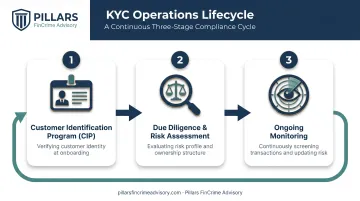
KYC operations unfold across three connected stages, regardless of industry or jurisdiction. Each stage feeds the next.
Customer Identification (CIP)
Customer Identification Program (CIP) rules require written procedures that create a reasonable belief the institution knows each customer's true identity. For banks, that standard is set in 31 CFR 1020.220. At minimum, institutions collect:
- Legal name
- Date of birth (for individuals)
- Address
- Government-issued identification number
Verification happens two ways:
- Documentary verification — an unexpired government photo ID, such as a driver's license or passport; for entities, articles of incorporation or a business license
- Non-documentary verification — checking a consumer-reporting agency, comparing data against a public database, or contacting the customer directly
Document-based methods work best for in-person or higher-risk onboarding. Non-documentary methods often support digital, low-friction signups where speed matters and risk is lower.
Customer Due Diligence and Enhanced Due Diligence
CDD goes beyond identity. It assesses the purpose of the relationship, expected activity, and source of funds or wealth, then assigns a risk rating. For legal entity customers, it also requires identifying beneficial owners—anyone owning 25% or more—plus one control person. FinCEN's 2016 CDD Final Rule treats this as one of four core pillars of an AML program.
Enhanced Due Diligence (EDD) kicks in when risk factors escalate, including:
- Politically exposed persons (PEPs) — though PEP status alone doesn't automatically mean higher risk
- Customers from high-risk jurisdictions
- Unusual or opaque ownership structures
- Products or channels associated with elevated money laundering exposure
EDD typically involves deeper source-of-wealth documentation, senior management sign-off, and more frequent transaction review.
Ongoing Monitoring and Periodic Reviews
KYC doesn't end when an account opens. Ongoing monitoring includes transaction surveillance, sanctions and PEP rescreening, and periodic file reviews to keep risk profiles current.
Review frequency should scale with risk rating:
- High-risk customers — frequent reviews, often annually or upon any material change
- Medium-risk customers — periodic reviews on a defined cycle, commonly every two to three years
- Low-risk customers — lighter-touch or event-driven reviews, often every three to five years
Regulators don't mandate a fixed refresh schedule. FFIEC guidance confirms that ongoing monitoring should be risk-based and responsive to material changes, not tied to an arbitrary calendar.
How the KYC Process Works and How Long It Takes
Step-by-Step KYC Onboarding Workflow
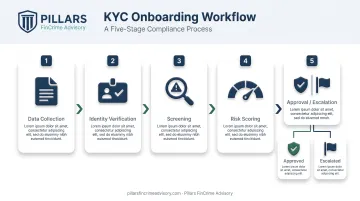
A typical KYC workflow moves through five operational steps:
- Data collection — customer submits identifying information and documentation
- Identity verification — documentary or non-documentary checks confirm the person is who they claim to be
- Screening — sanctions, PEP, and adverse media checks run against the customer's identity
- Risk scoring — the system or analyst assigns a risk tier based on customer, product, geography, and channel factors
- Approval or escalation — low-risk cases auto-approve; anything flagged routes to manual review
Automated case routing is what separates a scalable operation from a manual one. It lets straightforward, low-risk applications clear instantly while directing analyst time to cases that actually need judgment.
Documentation and audit trails at every step matter just as much as the decision itself — they're what let a business demonstrate program effectiveness when an examiner asks "show me."
Factors That Affect KYC Processing Time
There's no single answer to how long KYC takes. It depends on the case.
Automated, low-risk digital verification can clear in seconds. Manual review, EDD, or complex ownership structures can stretch to days or even weeks.
A 2016 Thomson Reuters survey of over 1,500 financial-institution and corporate respondents found onboarding time had already risen 22% year-over-year, with nearly a third of corporate customers waiting more than two months. That trajectory has only continued as regulatory complexity has grown.
The main variables driving timing:
- Verification method — automated vs. manual review
- Customer risk tier — standard vs. high-risk or EDD
- Document quality — incomplete or unclear submissions cause rework
- Jurisdiction — cross-border customers often require additional checks
- Backlog and staffing capacity — the real bottleneck in most programs
Here's the part teams often miss: the technology usually isn't the delay. It's workflow design and staffing. A well-calibrated screening tool still creates a backlog if there aren't enough trained analysts to clear the queue.
Building a Scalable, Risk-Based, Audit-Ready KYC Operations Program
Applying a Risk-Based Approach
A risk-based approach segments customers by tier so operational effort concentrates where it matters, instead of applying identical friction to every applicant. That means:
- Low-risk customers move through streamlined, mostly automated checks
- Medium-risk customers get standard CDD
- High-risk customers receive EDD and closer ongoing review
The backbone of a defensible program is a documented risk assessment methodology covering customer, product, geographic, and channel risk factors. Without that documentation, a risk-based approach is just a claim. Examiners want to see the logic, not only the outcome.
Governance, Staffing, and Quality Assurance
Tools don't make a program audit-ready. Clear policies, defined escalation paths, and quality assurance sampling do. Those controls are what separate a compliance function that looks polished in a vendor demo from one that holds up in an exam.
Many fintechs and payments companies scale their customer base faster than their compliance operations. The result: alert backlogs, inconsistent risk decisions, and the kind of findings examiners specifically call out.
This is where Pillars FinCrime Advisory works with fintechs, payments companies, and financial institutions to turn KYC policy into an operating model that works day to day. That work spans:
- Risk assessments tailored to the organization's actual customer, product, and geographic footprint
- Policy and procedure design built around a documented risk-based approach
- Transaction monitoring optimization to improve alert quality and reduce operational friction
- KYC program redesign to modernize identification and verification workflows
- Fractional CCO/BSA Officer support for ongoing governance and regulatory oversight
Done well, that work shows up as clearer alert quality, less operational friction, and stronger exam preparedness. A scalable KYC program is a process that holds up under growth and scrutiny, not a policy binder on a shelf.

US KYC Regulations and Common Operational Challenges
Key US Regulatory Requirements
Three regulatory pillars anchor US KYC obligations:
- Bank Secrecy Act (BSA): the foundational AML recordkeeping and reporting framework
- FinCEN Customer Identification Program rule: requires risk-based identity verification before or shortly after account opening
- CDD Final Rule: adds beneficial ownership identification, relationship risk-profiling, and ongoing monitoring requirements
FinCEN issued exceptive relief effective February 13, 2026. Covered institutions no longer need to re-verify beneficial owners every time an existing legal-entity customer opens another account. Identification is still required at the first account, or when facts call prior information into question.
The FFIEC BSA/AML Examination Manual doesn't create legal requirements on its own, but it sets the practical standard examiners use to judge whether a program is adequate.
Common Operational Challenges and How to Address Them
The same pain points show up across fintechs and financial institutions:
- High false-positive screening rates: poorly calibrated sanctions and PEP lists bury analysts in irrelevant alerts
- Manual bottlenecks: insufficient automation forces analysts to review cases that should auto-clear
- Inconsistent risk scoring: undocumented or subjective scoring produces uneven decisions across similar customers
- Outdated customer information: files that don't reflect current ownership or activity create blind spots
Periodic program reviews, calibrated screening rules, and clear documentation practices address these directly.
The OCC's December 2024 cease-and-desist order against Bank of America shows the cost of leaving them unresolved. Examiners cited SAR filing delays, an uncorrected CDD deficiency, and weak internal controls, and required an independent consultant plus a lookback review.
Frequently Asked Questions
What are the stages of KYC operations?
KYC operations span three stages: customer identification (verifying who someone is), due diligence and risk assessment (understanding relationship purpose and assigning risk), and ongoing monitoring (keeping profiles current over time).
How long does the KYC process take?
Timing ranges from seconds for automated, low-risk digital checks to days or weeks for manual review or enhanced due diligence. Complex ownership structures and cross-border customers typically take longest.
What is the difference between KYC and CDD?
KYC is the overall customer verification process. CDD is the risk-assessment component within it, covering relationship purpose, expected activity, source of funds, and beneficial ownership.
What documents are required for KYC?
Common requirements include a government-issued photo ID (driver's license or passport) and proof of address. For businesses, articles of incorporation and beneficial ownership documentation apply. Exact requirements vary by customer type and risk level.
Is KYC required for fintechs and payment companies?
Yes. Most fintechs and payment companies are subject to BSA/AML obligations, either through a sponsor bank partnership or direct registration as a money services business.
What triggers KYC reverification or an updated review?
Common triggers include unusual transaction activity, expired identification documents, changes in beneficial ownership, or a new sanctions or PEP match. Reviews should also be risk-based rather than fixed to a calendar.