
Each term has a distinct scope, a different regulatory anchor, and a specific role inside your risk program. Confuse them, and you risk onboarding friction in the wrong places, blind spots examiners will find, and a compliance program that looks fragmented under scrutiny.
Getting this right isn't academic. It affects how fast you onboard customers, how examiners score your program maturity, and how exposed you are when regulators come knocking. This article breaks down what KYC, KYB, and AML actually mean, how they connect, and what your leadership team needs to know to build a program that scales instead of breaking.
Key Takeaways
- KYC verifies individual identity; KYB verifies business identity and ownership; AML is the umbrella both feed into
- Most fintechs and payments companies need all three working as one connected system
- Examiners assess KYC and KYB as one connected risk system, not separate checkboxes
- Disconnected KYC/KYB processes are a frequent root cause of AML program deficiencies
- A scalable program requires operational integration, not just legal compliance on paper
KYC vs KYB vs AML: Quick Comparison
Here's the fastest way to see how these three pieces differ and where they overlap.
| Dimension | KYC | KYB | AML |
|---|---|---|---|
| Target/Scope | Individual customers | Business entities and their beneficial owners | The full framework governing both, plus transaction monitoring |
| Core Documents/Data | Government ID, proof of address, biometric verification | Incorporation records, beneficial owner (UBO) identification, licensing documents | Program policies, risk assessments, SAR filings, audit trails |
| Primary Objective | Confirm identity and assess individual risk | Confirm legal legitimacy and ownership structure | Prevent, detect, and report money laundering and terrorist financing |
| Regulatory Anchor | USA PATRIOT Act Section 326 CIP requirements | FinCEN CDD Rule and beneficial ownership requirements | BSA, FinCEN regulations, and FATF recommendations |
Notice that AML isn't a fourth item competing for space on this list. It's the container the other two sit inside.
What is KYC, KYB, and AML?
Know Your Customer (KYC)
KYC is the identity verification and risk assessment process applied to individual customers, both at onboarding and throughout the relationship. It breaks down into three components:
- Customer Identification Program (CIP): collecting and verifying name, date of birth, address, and an identification number before or shortly after opening an account
- Customer Due Diligence (CDD): understanding the nature and purpose of the relationship to build a risk profile
- Enhanced Due Diligence (EDD): additional scrutiny (source of funds, occupation, expected transaction volume) applied to higher-risk individuals
For fintechs and payments companies, KYC carries a specific tension: users expect account creation in minutes, but fraud prevention demands real verification. Federal guidance actually allows some flexibility here. Identifying information must be gathered before account opening, but verification can be completed within a reasonable time afterward using risk-based procedures.
One point gets missed constantly: KYC is not a one-time gate. It requires ongoing monitoring to catch behavioral changes that signal emerging risk, not just a snapshot taken at signup.
Know Your Business (KYB)
KYB verifies a business's legal existence, ownership structure, and legitimacy before onboarding it as a customer or platform partner. It's inherently more complex than KYC because it doesn't replace individual verification; it adds to it.
Under FinCEN's beneficial ownership requirements, financial institutions must identify and verify:
- Every natural person who directly or indirectly owns 25% or more of the entity's equity
- At least one individual with significant control (CEO, CFO, COO, or similar)
That means KYB requires KYC-level identity checks on every qualifying owner, plus entity-level documentation:
- Incorporation and registration records
- Ownership registries or certified beneficial ownership forms
- Business licensing documentation
- Proof of physical operations
For payments companies specifically, merchant onboarding and B2B platform access live or die on rigorous KYB. A weak entity verification process is often where sponsor banks push back hardest during program reviews.
Anti-Money Laundering (AML)
AML is the broader regulatory framework and set of controls designed to detect, prevent, and report money laundering and terrorist financing. KYC and KYB aren't separate requirements competing with AML — they're tools that feed it.
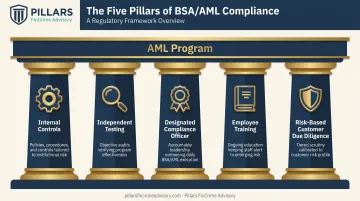
Every BSA/AML program rests on five pillars:
- A system of internal controls to assure ongoing compliance
- Independent testing of the program
- A designated compliance officer
- Training for relevant personnel
- Risk-based, ongoing customer due diligence
The stakes for getting this wrong are not abstract. In 2024, FinCEN assessed a record $1.3 billion penalty against TD Bank, the largest ever levied against a depository institution, alongside a four-year independent monitorship and a full SAR lookback. That's what happens when the underlying due diligence feeding an AML program breaks down.
How KYC, KYB, and AML Work Together in a Compliance Program
The hierarchy is straightforward once you see it: AML is the objective and framework. KYC and KYB are the due diligence mechanisms that support it. Neither works as a standalone checkbox exercise.
What you actually need depends on who you serve:
- Consumer fintech app — primarily KYC, with individual risk profiling driving monitoring
- B2B payments platform — primarily KYB, with UBO verification driving merchant onboarding decisions
- Marketplace serving both — full KYC and KYB running in parallel, feeding one shared risk engine
Risk-based AML programs calibrate the depth of these checks (basic, standard, or enhanced) based on the customer or business risk profile. FinCEN's CDD Rule established this as a core requirement back in 2018, and it remains the operational backbone of modern programs: identity and ownership data has to translate into an actual risk decision, not just a filed document.
Here's the part leadership teams underestimate: regulators don't evaluate KYC and KYB separately. FinCEN, the FCA, and EU authorities assess them as one connected control environment during exams. A gap in beneficial ownership verification shows up as an AML program deficiency, not a standalone KYB problem.
This is exactly where a lot of fintech and payments leadership teams go wrong. They treat KYC, KYB, and AML as three separate technology purchases (a verification vendor here, a monitoring tool there) instead of one integrated system with shared risk logic.
Pillars FinCrime Advisory works directly with boards and CEOs to design governance frameworks that connect all three into a scalable, examiner-ready program—not three disconnected point solutions.
Real-World Scenario: When Fragmented Compliance Creates Risk
Picture a growing payments company scaling both customer and merchant onboarding fast. Individual KYC runs through one vendor. Business KYB runs through another. Neither feeds a unified risk score into the AML monitoring system.
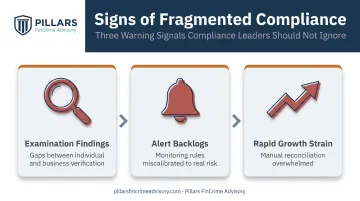
For a while, this works fine. Then something forces the issue:
- Examination findings expose gaps between individual verification, business verification, and transaction monitoring
- Alert backlogs build because monitoring rules were never calibrated to real customer and merchant risk profiles
- Rapid growth (new product, market, or sponsor bank) overwhelms manual reconciliation between systems
This is typically when dedicated financial crime expertise gets brought in. The work redesigns the program so KYC, KYB, and transaction monitoring run on one risk-based framework instead of three disconnected processes.
Results match what Pillars FinCrime Advisory has seen across engagements: alert quality improves, operational friction drops, and the program is better prepared for regulatory exams.
One client, a VP of Compliance Operations, credited combining transaction monitoring optimization with KYC redesign for these gains. A Chief Compliance Officer described navigating a complex regulatory review with a program that had become scalable and audit-ready.
If KYC, KYB, and AML feel like three separate headaches instead of one connected system, that's the signal. Not a future problem to plan for — a present one worth assessing now.
Ready for a compliance program evaluation? Contact Pillars FinCrime Advisory at 281-825-1603 or pillarsfincrimeadvisory@gmail.com to talk through where your KYC, KYB, and AML functions stand.
Conclusion
KYC, KYB, and AML work as complementary layers of one compliance system. The right mix depends on whether your business serves individuals, businesses, or both, and how much risk each customer type carries.
For fintech and payments leadership, that distinction drives practical outcomes: faster onboarding, lower regulatory exposure, and an audit-ready program that scales with growth.
Frequently Asked Questions
What are the 5 stages of KYC?
Most programs follow five stages: collect identifying data, verify identity under CIP, build a CDD risk profile, apply EDD for higher-risk customers, then monitor on an ongoing basis. Update the file when material changes arise.
How is KYB different from KYC?
KYC verifies individuals; KYB verifies business entities and their beneficial owners. KYB is inherently more document-intensive because it requires entity-level records plus KYC-level checks on every qualifying owner.
Are KYC and AML the same thing?
No. KYC is one component within the broader AML framework, not a synonym for it. AML also includes governance, independent testing, training, and institution-wide monitoring.
What are the 5 pillars of anti-money laundering?
The five pillars are internal controls, independent testing, a designated compliance officer, employee training, and risk-based ongoing customer due diligence.
Does a fintech need both KYC and KYB?
Yes, if it serves both individual users and business or merchant accounts. Both processes need to run under one connected AML program, not as separate systems.
What happens if a company fails to meet KYC, KYB, or AML requirements?
Consequences can include regulatory fines, cease-and-desist orders, growth restrictions, and reputational damage. Fixing gaps before an exam almost always costs less than remediating after one.