
That's not an accident. BaaS pricing is negotiated deal by deal, shaped by compliance scope, transaction volume, and how many products you're bundling. Meanwhile, embedded finance revenue is projected to more than double to $51 billion by 2026, according to Bain & Company's Embedded Finance Report — meaning more companies are entering these negotiations blind, without a benchmark to compare against.
This guide breaks down every fee line, typical cost ranges by program stage, the compliance costs most vendor pages never mention, and the exact questions to ask before you sign a contract.
Key Takeaways
- BaaS pricing stacks setup, platform, and usage or revenue-share fees—almost never one published number.
- Compliance scope usually drives real cost more than the feature list, and buyers underestimate it most.
- Fixed pricing rewards scale; usage-based pricing is the default for pilots still proving product-market fit.
- Post-launch compliance remediation, not the signed quote, is where most programs actually lose money.
How Much Does Banking as a Service Cost in 2026? (Pricing Overview)
BaaS pricing is negotiated per program. There's no rate card because your compliance scope, sponsor bank relationship, and transaction volume all shift the number, sometimes by a factor of ten.
Companies get this wrong in three predictable ways:
- Budgeting only for the platform fee and forgetting per-transaction, pass-through, and reserve costs entirely
- Confusing "cost to build a BaaS platform" with "cost to buy access to one" . These are two different budgets with different capital requirements
- Underestimating compliance pass-through costs, which compound as your account and transaction volume climbs
Pilot, Growth, and Enterprise Programs
Vendors don't publish a formal pilot/growth/enterprise pricing ladder, but buyers still evaluate deals along a consistent shape:
- Pilot programs with narrow feature sets (basic accounts, limited payments) generally negotiate a smaller implementation fee and a lower monthly minimum, since there's less compliance surface area to underwrite.
- Growth programs add cards or lending and typically shift toward a platform fee layered with per-transaction pricing, since usage starts driving real cost.
- Enterprise programs move almost entirely to negotiated, revenue-share, or custom pricing, which is why "contact us" dominates at this tier.
At high volume, providers structure deals around your actual economics rather than quoting a public number that fits no one.
Buy vs. Build: The Budget You're Actually Comparing
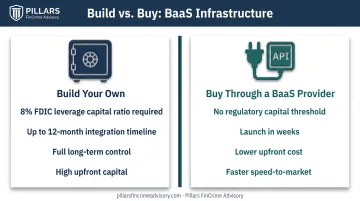
Licensing a BaaS provider and building proprietary regulated infrastructure are not variations of the same budget . They're different financial commitments entirely.
Building your own bank-grade infrastructure means clearing regulatory capital thresholds. The FDIC requires de novo institutions to maintain a leverage capital-to-assets ratio of at least 8% throughout their first three years of operation, according to the FDIC's Handbook for Organizers of De Novo Institutions. That's before you've built a single API.
Buying access through a BaaS provider skips that capital burden and typically launches in weeks rather than the up to a year timeline direct bank integration can require. You trade long-term control for speed and a lower upfront capital ask . For most companies still validating a product, that is the right trade.
The Complete BaaS Fee Line Breakdown
A BaaS bill is built from a defined set of fee lines. Providers disclose them inconsistently, so here's what to ask for by name.
Setup / Implementation Fee
One-time. Covers technical integration, sandbox testing, and sponsor bank onboarding: the work that happens before you can process a single transaction.
Platform / Monthly Fee
Recurring access fee for APIs, uptime, and core maintenance. It's frequently tied to a minimum monthly commitment whether or not you hit it.
Per-Account and Per-Transaction Fees
Recurring, and they scale directly with usage. Rates vary by payment rail (ACH, wire, and real-time payments each carry different costs) and by direction (inbound is typically priced differently than outbound).
Reserve Requirements
Not technically a fee, but capital the provider holds against risk exposure such as disputes or negative balances. Unit's own documentation frames reserve accounts as a cushion against losses. It's rarely disclosed publicly, but it directly reduces your available working capital.
Revenue Share / Interchange Split
The provider's cut of interchange or fee income from your card or account program. Interchange itself typically runs from under 1% to nearly 3% of a transaction, per Synctera's documentation. Treasury Prime notes that customers often retain 50% to 90% of interchange revenue depending on volume. Where you land in that range is entirely negotiated.
Pass-Through Costs
Variable and easy to miss. This bucket includes:
- KYC/KYB verification checks
- Card production and shipping
- FX spread on international transactions
- Fraud tooling and monitoring
These are typically billed separately from the headline quote, and they're the line items that grow fastest once you scale.
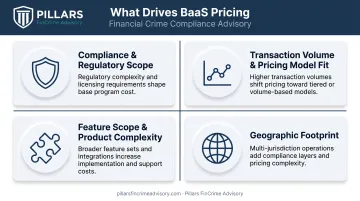
Key Factors That Affect BaaS Pricing
Your price depends on compliance depth, architecture complexity, and business model — not the feature list on a sales page.
Compliance and Regulatory Scope
Basic onboarding checks cost far less than full KYC, AML transaction monitoring, sanctions screening, and regulatory reporting.
Sponsor bank oversight adds cost as scrutiny rises. Through Q1 2024, actions against fintech partner banks represented 35% of publicized enforcement measures, according to American Banker's coverage of supervisory scrutiny. Sponsor banks pass that oversight burden downstream.
Transaction Volume and Pricing Model Fit
High-volume, established programs typically qualify for fixed or negotiated pricing that improves margins as they scale. Early-stage or pilot programs usually pay more per unit under variable, usage-based pricing while they're still testing product-market fit.
Feature Scope and Product Complexity
A payments-only program costs far less than a multi-product stack spanning accounts, card issuing, and lending. Working with multiple sponsor banks adds flexibility but increases integration and certification costs compared to a single-bank relationship.
Geographic Footprint
Multi-currency or cross-border programs add FX markup, additional licensing, and jurisdiction-specific compliance layers. Solaris, for example, notes that cards issued under passporting arrangements can expose customers to higher fees or payment refusal depending on the country. That remains a real cost even without a published markup number.
Hidden Costs, Compliance Risk & Regulatory Scrutiny in BaaS Pricing
The most expensive line items in a BaaS relationship are rarely the ones quoted upfront. They surface after launch: compliance gaps, examiner findings, or a program remediation nobody budgeted for.
That 35% enforcement share against fintech partner banks isn't a legal footnote. It's a financial risk. When a sponsor bank faces scrutiny, the fintechs on that charter absorb the fallout too: frozen onboarding, added monitoring requirements, or a forced overhaul of controls mid-program.
Programs launched with thin KYC/AML controls tend to pay for it twice. The first cost is whatever was saved by skipping a real risk assessment at launch. The second, larger cost shows up later as monitoring overhauls, look-back reviews, and outside consulting fees. Those expenses routinely exceed whatever the original provider quote saved.
This is where independent compliance advisory earns its keep. Pillars FinCrime Advisory works with fintechs, payments companies, and financial institutions to build the compliance layer that BaaS pricing conversations tend to skip over, including:
- Policy development and AML/BSA program design aligned to actual risk exposure
- Risk assessments that size KYC/KYB and transaction monitoring to real transaction volume, not guesswork
- Transaction monitoring optimization to improve alert quality and reduce operational friction
- Independent evaluation of compliance software vendors, matched to your risk profile, volume, and budget
- Exam readiness support that strengthens policies, documentation, and reporting before regulators ask
Pillars helps organizations prepare for audits and exams; it doesn't perform the audits themselves. Founder Joshua Douglas brings 12+ years of financial crime experience and nearly 20 years across financial services as a CAMS-certified compliance professional. He helps leadership teams budget for the compliance layer of a program before a regulator forces the issue.
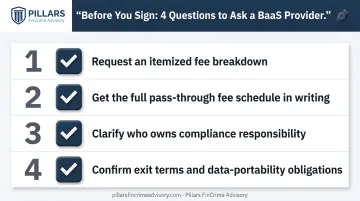
Questions to Ask a BaaS Provider Before You Sign
A "contact us for pricing" page isn't a reason to accept a vague verbal quote. Push for specifics before you commit.
- Request a written, itemized fee breakdown covering setup, platform, per-account, per-transaction, reserve requirements, minimum commitment, and revenue split. A generic quote isn't a contract you can budget against.
- Get the full pass-through fee schedule in writing: KYC/KYB per-check costs, card production, and FX markup. These compound fastest as volume grows and are the easiest costs to underestimate.
- Clarify who owns compliance responsibility, including which audit and reporting support is bundled versus billed separately.
- Confirm exit terms and data-portability obligations before you sign anything. Switching costs and trapped data can erase years of fee savings.
The right BaaS price accounts for full lifecycle cost: build-versus-buy tradeoffs, every fee line, and the compliance risk underneath. Pair provider evaluation with independent compliance guidance so you protect margins long after launch, not only at signing.
Frequently Asked Questions
What is an example of a BaaS?
Providers such as Unit, Solaris, and Treasury Prime let non-bank companies embed branded accounts, cards, or payment capabilities into their own products through a licensed sponsor bank relationship. The bank holds the license; the provider supplies the technology layer.
What is SaaS in banking?
SaaS refers to software a bank or company licenses to run its own operations, hosted on the provider's cloud infrastructure. BaaS is different: it lets non-banks embed actual licensed banking capabilities, like deposit accounts or card issuing, directly into their own product.
How much does banking as a service cost?
There's no public rate card. Costs combine a one-time setup fee, recurring platform fees, and usage-based transaction or revenue-share charges. Total cost depends heavily on compliance scope and transaction volume.
Is it cheaper to build or buy a BaaS platform?
Buying is typically faster and far less capital-intensive upfront. Building proprietary regulated infrastructure means meeting capital thresholds like the FDIC's 8% leverage ratio for de novo banks, so it offers more long-term control but demands more capital and time.
What are the most commonly hidden costs in BaaS pricing?
Reserve requirements, revenue splits, KYC/KYB pass-through fees, and post-launch compliance remediation are the least disclosed and most consequential costs. Most of these surface after a program is already live.
Who is responsible for compliance costs in a BaaS partnership?
Baseline compliance functions are usually bundled into provider fees. Deeper program-level obligations—independent audits, ongoing monitoring, and remediation—typically fall on the fintech or program manager, which is where costs most often surprise teams post-launch.