It also built a target on their backs.
Regulators have taken notice. In January 2025, California's DFPI joined 47 other state regulators in an $80 million enforcement action against Block, Inc.'s Cash App for BSA/AML violations tied to weak customer due diligence, identity verification, and suspicious activity reporting. It's a clear signal: fast growth doesn't buy fintechs a pass on compliance.
This guide covers what challenger banks need to know: the US regulatory landscape, where the biggest risks hide, how to build monitoring that scales, and what examiners expect from your compliance department.
Key Takeaways
- Challenger banks face the same BSA, PATRIOT Act, and AMLA duties as national banks—size and app ratings don’t matter
- Fast onboarding and instant payments require continuous AML monitoring, not a one-time background check
- Exams keep flagging weak risk assessments, inconsistent EDD, and poor alert management at digital-first banks
- Scalable programs pair calibrated technology with documented governance and trained staff
- Outside financial crime advisory support helps compliance keep pace without slowing product launches
What Is AML Compliance Monitoring for Challenger Banks?
AML compliance monitoring is the ongoing work of screening customers, watching their transactions, and investigating anything that looks suspicious. It continues for the entire life of the account—not only at sign-up.
That distinction matters. A lot of digital banks treat compliance as a gate at onboarding: verify identity, run a sanctions check, approve the account, move on. Real monitoring never stops. It includes:
- Continuous transaction surveillance that flags unusual patterns as they happen
- Periodic customer risk reassessment as spending habits, income, or account activity shift
- Timely SAR filing when something crosses the line from odd to suspicious
Labels that matter for AML scope:
- Challenger bank: Holds its own banking charter and carries full bank-level BSA obligations directly
- Neobank: A fintech partnered with a chartered bank; legal responsibility is split with the sponsor
- Digital bank: Informal catch-all for both—not a formal regulatory category
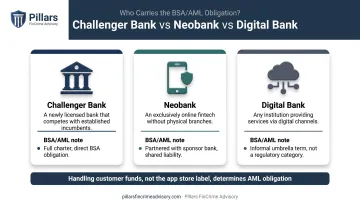
What determines your AML obligation isn't the label on your app store listing. It's whether you're handling customer funds.
Why Challenger Banks Face Heightened Regulatory Scrutiny
The UK's Financial Conduct Authority studied this exact issue in a 2022 review and found that criminals are specifically attracted to the fast onboarding processes challenger banks advertise, particularly for setting up money mule networks. Speed that delights legitimate customers also lowers the friction for bad actors.
There's a second factor examiners watch closely: staffing. Many challenger banks run compliance teams that are lean relative to their transaction volume, especially compared to legacy banks with decades-old compliance infrastructure. That resourcing gap doesn't go unnoticed during exams.
Examiners test whether headcount, technology, and processes scaled with the customer base—or whether growth simply outran the controls meant to manage it.
AML Regulatory Requirements for Challenger Banks in the US
There's no innovation carve-out here. Whether you're a chartered challenger bank or a fintech operating through a bank partnership, you're fully subject to US AML and BSA law. Being a startup changes nothing about your legal obligations.
Bank Secrecy Act (BSA) & USA PATRIOT Act Obligations
The FFIEC's BSA/AML manual lays out the core program pillars every institution must have in place:
- A written AML program approved by the board, appropriate to the bank's size and risk profile
- A designated BSA/compliance officer who coordinates day-to-day compliance
- Ongoing employee training for staff whose roles touch BSA compliance
- Independent testing of the program's effectiveness, conducted by internal audit, outside consultants, or qualified staff free of conflicts
The USA PATRIOT Act adds Customer Identification Program (CIP) requirements on top of these pillars. Banks must collect a customer's name, date of birth, address, and identification number, then verify that identity through documentary or non-documentary means.
For fully digital onboarding flows, this is where a lot of the risk lives. It's easy to move fast through a CIP check when there's no human on the other side of the screen pausing to ask questions.
Anti-Money Laundering Act (AMLA) & FinCEN/OFAC Oversight
AMLA, enacted in 2021, raised the stakes considerably. It allows enhanced civil penalties for repeat violations, up to three times the profit gained or twice the maximum penalty otherwise available.
It also expanded whistleblower protections, which matters for fast-scaling fintechs where internal reporting channels sometimes lag behind hiring.
Beneficial ownership reporting has also been a moving target. FinCEN's 2026 rule removed direct BOI reporting requirements for most US companies and persons, though foreign entities operating here still report. That said, banks' own obligation to collect beneficial ownership information from business customers as part of CDD hasn't gone away.
Two agencies split oversight here, and challenger banks answer to both:
| Agency | Role |
|---|---|
| FinCEN | Administers BSA reporting, recordkeeping, and SAR filing; pursues civil and criminal BSA enforcement |
| OFAC | Administers and enforces sanctions programs, including blocking transactions and screening against watchlists |
A bank partnership doesn't dilute either obligation. Both agencies expect direct compliance from the fintech side of the arrangement, not just the sponsor bank.
Applying a Risk-Based Approach (RBA)
FATF's risk-based approach asks institutions to identify and understand their money laundering risk, then apply controls proportional to that risk rather than treating every customer identically.
For a challenger bank, that usually means building customer risk tiers around factors such as:
- Product type
- Geography
- Expected transaction volume
- Delivery channel
A younger, more digital-native customer base doesn't automatically mean higher risk. But it does mean your tiering model needs to account for behaviors traditional banks rarely saw at this scale, like frequent P2P transfers or crypto on/off-ramp activity.
Top AML Risks & Compliance Gaps Facing Challenger Banks
Regulatory reviews keep finding the same problems across challenger banks. The pattern is consistent enough that leadership should treat it as a design issue, not bad luck.
- Digital onboarding speed and anonymity create openings for identity fraud and money mule recruitment—regulators have called this out by name in supervisory findings.
- Customer risk assessments are often missing, undocumented, or applied unevenly when enhanced due diligence is clearly warranted.
- Alert management breaks down when teams close alerts without rationale, let backlogs grow, and file SARs with vague narratives.
- Compliance resources lag customer growth when headcount and technology investment fail to keep pace; examiners specifically test for that mismatch.
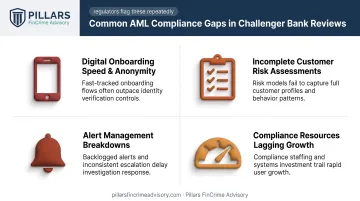
None of these gaps are exotic. They're the predictable result of a business model built for speed running into a compliance function that wasn't resourced to match it.
Building a Scalable AML Monitoring Program: Core Components
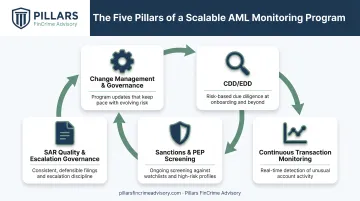
A program that worked fine at 50,000 customers can fall apart at 500,000 if it wasn't designed to scale. Five components matter most.
Customer Due Diligence (CDD) and Enhanced Due Diligence (EDD). Go beyond identity verification. Capture income, occupation, and purpose of account. Set clear EDD triggers for politically exposed persons and other high-risk customer types, and document the rationale every time EDD gets applied or waived.
Continuous transaction monitoring and alert tuning. Detection scenarios need calibration for challenger bank typologies: P2P transfers, instant payments, and crypto on/off-ramps. Generic rules built for traditional checking accounts miss the patterns that matter here. Tune periodically so false positives don't bury analysts in noise.
Sanctions, PEP, and adverse media screening. Screen in real time at onboarding, then rescreen against updated watchlists on an ongoing basis as customer risk profiles evolve.
SAR quality and escalation governance. Document investigation rationale clearly. Build escalation workflows that don't stall. File on time. Regulators cite this area most often for "low-quality SAR" findings.
Change management and governance. Every new product feature needs a compliance review before launch, not after. Board and executive oversight of financial crime change programs keeps controls from lagging behind the roadmap.
How Pillars FinCrime Advisory Helps Challenger Banks Build Audit-Ready Programs
Building all five components in-house while shipping new features every quarter is a lot to ask of a lean compliance team. Pillars FinCrime Advisory gives those teams full lifecycle support so they are not building alone.
Pillars covers policy development, risk assessments, and transaction monitoring optimization. Challenger banks use that support to scale compliance without slowing product growth. Founder Joshua Douglas is CAMS-certified with 12+ years of financial crime experience. He advises boards and executives on translating regulatory expectations into frameworks that fit the actual business, not a generic template from a legacy bank playbook.
A compliance program copied from a 50-year-old regional bank rarely fits a company processing instant P2P transfers at fintech scale.
Compliance Audits, Exam Readiness & the Compliance Department's Role
What a Compliance Audit Involves for Challenger Banks
Independent testing evaluates whether your AML policies, procedures, and controls actually work and stay aligned with BSA requirements. Per the FFIEC's BSA/AML manual, that typically covers governance, risk assessments, CDD and EDD execution, transaction monitoring effectiveness, and the adequacy of SAR filings.
Challenger banks typically face three kinds of review:
- Internal audits run by your own compliance or audit team
- Independent third-party reviews conducted by outside consultants free of program conflicts
- Regulator-led exams carried out by your primary federal or state regulator
Proactive internal audits catch problems before a regulator does. Exam readiness goes one step further: stage board minutes, risk assessments, SAR decision files, and monitoring documentation so examiners can trace each control from policy to evidence without delay.
Core Responsibilities of the Compliance Department
That file trail only holds up when the compliance department clearly owns these duties:
- Appointing and empowering a BSA/compliance officer
- Maintaining written policies that reflect the actual business, not a generic template
- Conducting and updating risk assessments as products and customer bases change
- Overseeing transaction monitoring and resolving alerts with documented rationale
- Filing SARs accurately and on time
- Delivering staff training that's relevant to current typologies
Beyond day-to-day work, compliance reports program health to the board and C-suite. Examiners increasingly test that governance layer, so boards need evidence the program is mature—not just present on paper.
Frequently Asked Questions
What are the compliance requirements for challenger banks?
Challenger banks must meet the same BSA, PATRIOT Act, and AMLA obligations as traditional banks. That includes a written AML program, CDD/EDD procedures, ongoing transaction monitoring, and timely SAR filing.
What is a compliance audit for challenger banks?
It's an independent review testing whether AML policies and controls are operating effectively and meeting regulatory standards. It can be run internally, by a third party, or by a regulator during an exam.
What are the responsibilities of the compliance department in challenger banks?
Core duties include owning written policies, maintaining risk assessments, overseeing monitoring and alert resolution, filing SARs, delivering staff training, and reporting program health to the board.
How is AML compliance different for challenger banks vs. traditional banks?
The legal obligations are identical. Challenger banks face amplified risk from digital-only onboarding, faster transaction speeds, and typically leaner compliance teams relative to their transaction volume.
What technology do challenger banks need for AML transaction monitoring?
You need real-time sanctions and PEP screening, configurable rules calibrated to your specific product typologies, and case management tools that scale as transaction volume grows.
How often should a challenger bank review or update its AML program?
At minimum, run independent testing annually. Update the program immediately whenever products, customer segments, or regulations change materially, rather than waiting for the next scheduled review.