Sanctions regimes are expanding fast. New Russia, Iran, and Venezuela-related designations arrive with little warning, and OFAC's 2025 enforcement actions alone totaled $265,746,819 across 14 cases. For fintechs, payments companies, and financial institutions, vendor selection can't be a checkbox exercise anymore.
This guide breaks down the exact factors, common mistakes, and evaluation framework you need to compare vendors objectively, not based on marketing claims.
Key Takeaways
- Weigh data coverage, matching accuracy, integration, and total cost of ownership over feature checklists.
- False positive rates swing wildly between basic and advanced matching technology.
- Ignoring staff time and implementation effort is the most expensive buying mistake.
- Fit with your risk profile and growth trajectory matters more than vendor popularity.
What Is Sanctions Screening?
Sanctions screening is the process of checking customers, transactions, and counterparties against government-issued watchlists, including OFAC, the UN, the EU, and other regional authorities, to prevent prohibited dealings.
The stakes are real. Effective January 15, 2025, the maximum civil penalty for an IEEPA-based sanctions violation reaches $377,700 per violation, and separate caps apply under other authorities like the Trading with the Enemy Act. Multiply that across thousands of unscreened transactions, and the exposure adds up quickly.
Types of Sanctions Screening
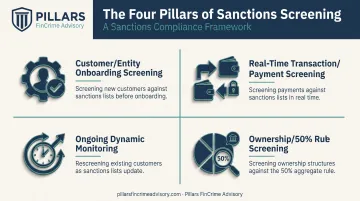
Most vendors don't cover every screening type equally well. Evaluate them against these four categories:
- Customer/entity onboarding screening — checking new customers and counterparties before they're approved
- Real-time transaction/payment screening — scanning wire and payment instructions as they flow through
- Ongoing dynamic monitoring — rescreening the existing customer base as watchlists change
- Ownership/50% rule screening — identifying entities owned 50% or more by a sanctioned party
Vendors frequently specialize. A platform excellent at onboarding screening might be mediocre at real-time payment screening, or skip the 50% rule entirely.
Manual, In-House, and Third-Party Vendor Approaches
How you run those checks usually evolves in three stages:
- Manual — Public OFAC list checks work at very low volume, but they don't scale and leave no defensible audit trail
- In-house tools — Full control for large institutions, at the cost of dedicated engineering and data science most fintechs lack
- Third-party vendors — Where most scaling fintechs and financial institutions land once real transaction volume hits
That vendor path has the clearest cost-benefit tradeoff for regulated companies—and it's the focus of this guide.
What to Consider When Comparing Sanctions Screening Vendors
Effective vendor comparison focuses on capabilities that reduce risk exposure and cut operational drag, not on feature checklists. The following factors connect technical specifications to measurable audit and efficiency outcomes.
Data Coverage & List Accuracy
Comprehensive coverage across OFAC, UN, EU, and relevant state or regional lists closes the blind spots that create regulatory exposure. Coverage claims vary widely, and vendors don't measure it the same way:
| Vendor | Published coverage claim |
|---|---|
| LSEG World-Check | 57,000+ active sanctions records across 300+ programs |
| LexisNexis Risk Solutions | 1,700+ watchlists |
| Sanctions.io | 75+ sanctions lists |
| ComplyAdvantage | OFAC, HMT, EU plus 60+ additional jurisdictions |
These figures aren't apples-to-apples. Some count records, others count lists or jurisdictions. Don't take a coverage number at face value.
KPI to request: the rate of missed-match (false negative) findings surfaced during independent audits. That number tells you more than any marketing figure.
Update Frequency & Real-Time Monitoring
Sanctions lists change constantly. OFAC updates its SDN List frequently but on no fixed schedule. Additions and removals happen whenever necessary. Infrequent vendor updates leave exposure windows open between an official change and when your system reflects it.
Published vendor cadences range from hourly refreshes to continuous monitoring of major lists. Ask for specifics rather than accepting "real-time" as a description.
KPI to request: the time lag between an official list update and the vendor reflecting it in your system, ideally backed by a contractual SLA, not just a marketing claim.
Matching Technology & False Positive Management
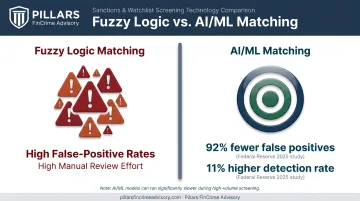
This is where vendors differentiate most. Two approaches dominate:
- Fuzzy logic catches name variations but creates high alert volume
- AI/ML models with secondary identifiers (date of birth, ownership data) cut false positives without missing real matches
A 2025 Federal Reserve study found LLM-based matching produced 92% fewer false positives and an 11% higher detection rate than the best fuzzy-matching baseline. The tradeoff: those models ran more than four orders of magnitude slower, a real constraint for high-volume payment screening.
KPI to request: analyst hours spent on manual alert review per screening cycle. If that number isn't dropping after implementation, the matching technology isn't earning its keep.
Integration & Workflow Fit
A powerful screening engine that doesn't talk to your existing systems creates its own risk. API and SDK compatibility with your KYC platform, AML case management system, and CRM determines how fast you implement and whether analysts actually adopt it.
KPI to request: implementation timeline and the reduction in manual data re-entry once integration is live.
Scalability & Customization
Your vendor needs to handle rising transaction volumes and expanding jurisdictional complexity without forcing a full re-platform. It should also let you configure risk thresholds by business unit rather than applying one blunt setting company-wide.
KPI to request: cost-per-screening at scale, plus confirmation the vendor supports rule customization by risk appetite.
Total Cost of Ownership & Vendor Accountability
The sticker price on a vendor quote hides the real cost. Factor in:
- Staff time spent reviewing false positives
- Implementation and integration hours
- Ongoing upgrade and maintenance costs
- Training time for compliance analysts
Some vendors back their accuracy claims with financial guarantees or SLAs tied to false positive rates or uptime. Ask for those terms directly. A vendor confident in its technology will put it in writing.
Common Mistakes to Avoid When Selecting a Vendor
The buying process breaks down in predictable ways. Watch for these:
- Comparing price or features in isolation. A cheaper quote often hides higher total cost once you factor in manual review time and remediation risk from missed matches.
- Treating screening as a standalone tool. Sanctions screening needs to connect to your broader AML program, including CDD, transaction monitoring, and case management. Isolated tools create audit gaps examiners will find.
- Taking "quick setup" claims at face value. Underestimating implementation and change management effort is common. A proof-of-concept validates the claim before you sign anything.
- Leaving compliance leadership out of the decision. When the board or CCO isn't involved, configuration choices often end up misaligned with the organization's actual risk appetite.
How Pillars FinCrime Advisory Can Help
Vendor sales teams have every incentive to make their platform look like the obvious choice. Pillars FinCrime Advisory is an independent, vendor-agnostic advisor that helps fintechs, payments companies, and financial institutions run objective evaluations instead of relying solely on a sales pitch.
Founder Joshua Douglas brings 12+ years of financial crime experience and nearly 20 years across financial services, backed by CAMS certification. He translates regulatory expectations into a practical, defensible RFP and scorecard framework, matched to your risk profile, transaction volume, and budget.
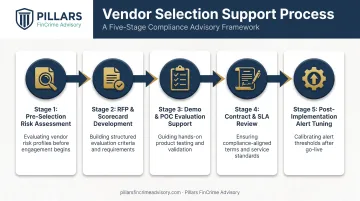
Pillars supports the selection process across several stages:
- Pre-selection risk assessment to define what your organization actually needs before you talk to a single vendor
- RFP and scorecard development so comparisons are structured, not anecdotal
- Demo and proof-of-concept evaluation support to pressure-test fit before you commit
- Contract and SLA review before you sign
- Post-implementation alert tuning once the vendor is live
The priority is ensuring whichever platform you choose integrates into a scalable, audit-ready compliance program rather than sitting as a disconnected tool.
If you're heading into a vendor evaluation, schedule a consultation with Pillars FinCrime Advisory before you sign a contract.
Conclusion
Choose the sanctions screening vendor that fits your risk profile, growth trajectory, and existing tech stack. Popularity and feature count matter less than operational fit.
Vendor selection isn't a one-time decision. Review false positive rates, coverage gaps, and workflow fit as your business and the regulatory landscape evolve. Independent guidance during that evaluation reduces the odds of a costly misstep and helps you walk into your next exam prepared rather than exposed.
Frequently Asked Questions
What is sanctions screening?
Sanctions screening is the process of checking individuals, entities, and transactions against government watchlists such as OFAC, the UN, and the EU to prevent prohibited dealings. It applies at onboarding, during transactions, and through ongoing monitoring.
What are the different types of sanctions screening?
The core types are customer/entity onboarding screening, real-time transaction/payment screening, ongoing dynamic monitoring, and ownership screening under the 50% rule. Most vendors specialize in only some of these.
What are the best tools for sanctions screening?
The "best" tool depends on your data coverage needs, integration requirements, and risk profile. An independent evaluation against a structured scorecard is more reliable than generic vendor rankings.
How often should sanctions watchlists be updated?
OFAC updates its lists as needed, with no fixed schedule, so continuous or near-real-time vendor updates are becoming the practical standard. Ask vendors for their contractual refresh timelines, not just marketing language.
What is a good false positive rate for sanctions screening software?
Legacy tools have historically operated with false positive rates of 90% or higher considered acceptable, while advanced AI/ML matching can bring that down significantly. There's no single universal benchmark, so ask vendors for audited figures.
Should we build an in-house solution or use a third-party vendor?
In-house tools generally suit large organizations with dedicated engineering resources and mature data infrastructure. Most growing fintechs and financial institutions benefit more from third-party vendors for speed, accuracy, and ongoing compliance support.