
Introduction
Ask a growing fintech team whether they're "compliant," and you'll often get one answer for two very different questions. PCI DSS and AML compliance get lumped together constantly, yet they protect against completely different threats.
Many growth-stage payments companies assume that passing a PCI audit somehow covers their anti-money laundering obligations. Others don't learn they're expected to run both until a sponsor bank stalls diligence or an examiner flags the gap.
Below: what each framework covers, where they diverge, and how to tell whether you need one, the other, or both.
Key Takeaways
- PCI DSS protects cardholder data through contractual security rules set by card brands.
- AML compliance is a legal requirement to detect and report financial crime, enforced by federal regulators.
- Card processors, digital wallets, and BaaS platforms typically need mature programs for both.
- PCI failures risk fines and lost processing privileges; AML failures can carry civil penalties and criminal liability.
PCI vs AML: Quick Comparison
| Category | PCI DSS | AML |
|---|---|---|
| Regulatory nature | Contractual industry standard | Federal law and regulation |
| Primary purpose | Protect cardholder data | Detect and prevent financial crime |
| Who enforces it | Card brands, acquiring banks | FinCEN, OCC, Federal Reserve |
| Who must comply | Anyone storing, processing, or transmitting card data | Banks, MSBs, and other regulated financial entities |
| Non-compliance consequences | Fines, loss of processing privileges | Civil penalties, consent orders, criminal liability |
The distinction matters because these two regimes answer entirely different questions. One asks: is the card data secure? The other asks: is the money clean?
A business can ace one and completely fail the other.
What Is PCI DSS?
PCI DSS (Payment Card Industry Data Security Standard) is a set of security requirements created by the PCI Security Standards Council, whose founding members include Visa, Mastercard, American Express, Discover, and JCB. It applies to any business that stores, processes, or transmits cardholder data.
The core benefit is straightforward: reduce the risk of a costly breach while keeping the ability to accept card payments. Card brands can revoke processing privileges from businesses that fail to remediate serious gaps, which makes compliance a business continuity requirement.
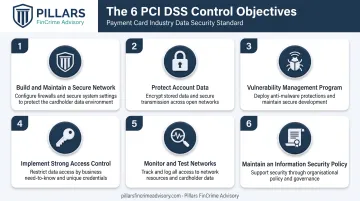
The current standard, PCI DSS v4.0.1, organizes 12 requirements under six control objectives:
- Build and maintain a secure network: network security controls and secure configurations
- Protect account data: data protection and strong cryptography in transit
- Maintain a vulnerability management program: anti-malware and secure software development
- Implement strong access control: need-to-know access, authentication, and physical restrictions
- Monitor and test networks regularly: logging and ongoing security testing
- Maintain an information security policy: documented organizational policies and programs
Validation Depends on Transaction Volume
Not every merchant faces the same scrutiny. Smaller merchants typically complete a Self-Assessment Questionnaire (SAQ), while high-volume merchants and service providers need a formal Report on Compliance (ROC) signed off by a Qualified Security Assessor (QSA). Card brands, not the PCI Security Standards Council itself, set the specific volume thresholds and decide which validation path applies.
Where PCI DSS Shows Up in Practice
PCI compliance touches nearly every stage of a payments company's lifecycle, from choosing PCI-compliant vendors during product design to completing annual attestation once live. It's central to:
- Card processors and payment gateways
- Ecommerce platforms
- Point-of-sale providers
- Digital wallets
IBM's 2024 research found that breaches in the financial industry cost an average of $6.08 million, roughly 22% above the global average across all sectors. A cardholder data breach triggers remediation costs and can bring noncompliance assessments passed down through your acquiring bank.
What Is AML Compliance?
AML compliance covers the laws, regulations, and internal controls that require regulated entities to detect, prevent, and report money laundering and terrorist financing. Those requirements are rooted in the Bank Secrecy Act, the USA PATRIOT Act, and FinCEN rulemaking.
It applies broadly to banks and to many fintechs operating as money services businesses (MSBs).
Unlike PCI, AML maturity isn't just about avoiding penalties. It directly affects whether a fintech can secure and keep a banking partnership, pass a regulatory exam, or expand into new products without regulatory pushback.
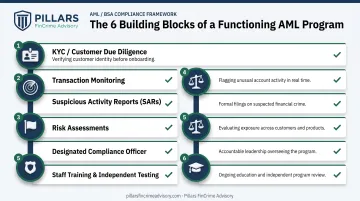
A functioning AML program typically includes:
- KYC/customer due diligence to verify identities and understand customer purpose
- Ongoing transaction monitoring to flag unusual activity
- Suspicious Activity Reports (SARs) for qualifying suspicious activity (thresholds vary by entity type; often $2,000+ for MSBs), generally filed within 30 days of detection
- Risk assessments calibrated to the business's actual exposure
- A designated compliance officer overseeing the program
- Staff training and independent testing to confirm the program actually works
Building and calibrating an audit-ready AML program takes specialized expertise. Pillars FinCrime Advisory works directly with fintech, payments, and financial institution leadership to design policies, run risk assessments, and optimize transaction monitoring so alert quality improves and operational friction drops.
Where AML Scrutiny Concentrates
AML obligations tend to surface hardest during licensing, banking-as-a-service (BaaS) partnership onboarding, and regulatory examinations. Industries facing the heaviest scrutiny include:
- Money transmitters
- Virtual asset and crypto platforms
- Neobanks
- BaaS sponsor bank programs
Recent enforcement actions show how expensive gaps can get. FinCEN assessed Binance a $3.4 billion civil money penalty in November 2023 for willful BSA violations, plus a five-year monitorship.
Around the same period, the OCC assessed TD Bank a $450 million penalty over deficiencies spanning risk assessment, customer due diligence, and transaction monitoring. These aren't outliers; they're a signal of how closely regulators are now watching bank-fintech arrangements.
PCI vs AML: Do You Need Both?
The answer comes down to two questions:
- Does your business touch cardholder data?
- Does it move money, or otherwise qualify as an MSB or financial institution?
How those answers map to requirements:
- Card payments only (no money transmission): PCI DSS alone likely covers you
- Money transmission, lending, or BaaS: AML applies whether or not you touch card data
- Both (processors, digital wallets, full-stack fintechs): You need mature programs on both tracks at once
Neither program substitutes for the other. A clean PCI audit says nothing about whether your transaction monitoring would catch a structuring pattern. A strong AML program says nothing about whether your card data is encrypted in transit.
A Growing Payments Company's Dual Compliance Wake-Up Call
Picture a payments company two years into rapid growth. Transaction volume tripled, new card products launched quarterly, and the compliance team never grew to match. Then two audits land in the same quarter.
The PCI assessment flags gaps in cardholder data segmentation and stale vendor access controls. Almost simultaneously, an AML review finds transaction monitoring rules that haven't been recalibrated since launch, producing high alert volume but low-quality flags.
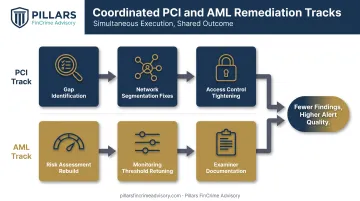
The response has to happen on two tracks at once:
- Security specialists remediate the PCI gaps, tightening network segmentation and access controls
- A FinCrime advisory partner rebuilds AML risk assessments, retunes monitoring thresholds, and documents the program for examiners
Run in parallel, the two workstreams cut open findings over subsequent exam cycles and raise alert quality at the same time. PCI and AML stay distinct, but growing payments companies build both tracks side by side—not one after the other.
If your organization is under this kind of dual pressure, Pillars FinCrime Advisory supports the AML track end to end—from risk assessments through transaction monitoring optimization. That keeps the compliance foundation paced with growth instead of trailing it.
Conclusion
PCI DSS protects the data moving through a payment system. AML protects against the illicit use of the funds themselves. They're built on different legal foundations, enforced by different authorities, and measured by different standards of evidence. Treating one as a stand-in for the other is a common, and costly, mistake among growing payments companies.
Most fintechs, payment processors, and financial institutions that handle both card data and money movement need mature programs for both—not one traded off for the other. Dual programs protect more than fine exposure:
- Banking sponsor relationships stay intact
- Card brand and regulatory penalty risk stays lower
- Examiners and customers see credible operational control
If you're building or maturing either side, Pillars FinCrime Advisory helps fintechs and payments companies design practical AML/BSA programs that scale with growth and hold up under exam scrutiny.
Frequently Asked Questions
What are the 5 stages of KYC?
There isn't an official five-stage standard. FinCEN and FATF both describe four core components: customer identification, identity verification, risk assessment and due diligence, and ongoing monitoring.
Is PCI DSS a legal requirement?
No. PCI DSS is a contractual standard enforced by card brands and acquiring banks, not a federal law. A handful of states, including Nevada, reference PCI DSS directly in their data security statutes.
Does PCI DSS compliance satisfy AML requirements?
No. PCI and AML address entirely different risks, cardholder data security versus financial crime. Meeting one framework doesn't fulfill your obligations under the other.
Who enforces PCI DSS compliance versus AML compliance?
Card brands and acquiring banks enforce PCI DSS through contractual agreements. AML compliance is enforced by federal regulators like FinCEN, the OCC, and the Federal Reserve.
Do fintech and payments companies need both PCI and AML compliance?
Most do, if they handle card data and move money. The exact requirement depends on your specific business model and whether you qualify as an MSB or financial institution.
What happens if a company fails a PCI or AML compliance audit?
PCI failures risk fines and potential loss of card processing privileges. AML failures can trigger civil penalties, consent orders, growth restrictions, and in serious cases, criminal liability.