Analysts spend hours clearing alerts that were never real matches in the first place. Onboarding stalls. Payments sit in review queues. Leadership starts asking why compliance is slowing down growth instead of protecting it.
Here's the reality: most sanctions screening false positives have identifiable causes, and identifiable causes can be fixed. Understanding why your system keeps flagging the wrong "John Smith" is the first step toward a program that's both efficient and audit-ready.
This guide covers what actually drives false positives, what happens when teams ignore the problem, and the specific strategies that reduce alert noise without opening the door to real sanctions risk.
Key Takeaways
- False positives usually trace back to fuzzy matching, poor data quality, legacy systems, or overly cautious thresholds, not one single cause
- Ignoring the problem drives up costs, delays onboarding, and can bury genuine matches in the noise
- Cutting false positives safely means better data and calibration, not loosening controls
- Regulators reward documented, risk-based calibration decisions over blanket alert suppression
- Lasting results require ongoing monitoring, training, and governance, not a one-time fix
Common Causes of Sanctions Screening False Positives
A false positive happens when your screening system flags a legitimate customer or transaction as a potential sanctions match, and further investigation clears it. Most of the time, these aren't random glitches. They stem from a predictable mix of technical, data, and policy decisions.
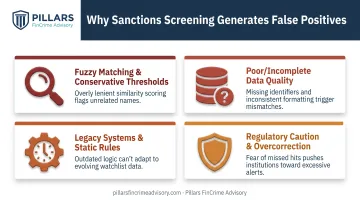
Fuzzy Matching and Overly Conservative Thresholds
Fuzzy logic exists for good reason. It catches spelling variations, transliterations, and aliases that a strict exact-match system would miss. According to the Wolfsberg Group's sanctions screening guidance, fuzzy matching compares non-identical strings whose spelling, pattern, or sound is close enough to warrant review.
The problem: that same logic flags common names and pure coincidences just as readily as real risk.
Picture a customer who shares a surname with someone on a sanctions list, with no middle name, date of birth, or other identifier to rule them out. The system has no choice but to flag it, even without a real connection.
Poor or Incomplete Data Quality
Watchlist entries and internal customer records often lack the identifiers needed to separate true matches from coincidences such as date of birth, nationality, or address.
Names transliterated from non-Latin alphabets compound the issue. A single name can generate multiple spelling variants, each one capable of triggering its own separate alert.
Legacy Systems and Static Rule-Based Screening
Older screening platforms often apply one sensitivity setting across an entire customer base, regardless of actual risk profile.
The system screens a low-risk domestic customer making a routine payment with the same intensity as a high-risk cross-border wire. Unnecessary alerts pile up on exactly the population that needed the least scrutiny.
Regulatory Caution and Overcorrection
Fear of enforcement pushes many compliance teams toward thresholds far more sensitive than their actual risk profile requires.
Some programs leave thresholds untouched for years, worried that any adjustment looks like "loosening controls" during an exam, even as alert volume becomes unmanageable.
Ironically, that overcaution often creates the exact problem regulators worry about: alert fatigue that buries real risk.
What Happens If Sanctions Screening False Positives Are Ignored
Unmanaged alert volume doesn't sit quietly in a queue. It grows, and it drags everything behind it.
- New customers wait longer while analysts clear backlogs of false matches
- Legitimate payments sit in review, frustrating customers and partners
- Alert volume drives more analyst hours, overtime, and headcount just to keep pace
The scale of the problem is bigger than most teams realize. A 2025 LSEG survey of 400 senior risk and compliance leaders found that 32% experienced false-positive rates of 20% to 30% in a typical month. That figure blends sanctions and AML screening, but it still shows how much review capacity teams burn on noise each month.
Regulators aren't sympathetic to "the system generates too many alerts" as an excuse, either. OFAC and FFIEC guidance both expect screening programs to stay proportionate and risk-based. A persistently high, unaddressed false-positive rate can itself draw scrutiny during an exam, since it signals thresholds aren't calibrated to actual risk.
The most dangerous consequence is alert fatigue. When analysts wade through hundreds of near-identical false matches every day, vigilance drops. A genuine match can slip through simply because it looks like the hundred other names already cleared that morning.
Warning Signs You're Heading Toward a False Positive Crisis
- Alert queues consistently growing faster than your team's capacity to clear them
- Onboarding or payment SLAs regularly breached because of manual sanctions review
- A wide alert-to-case gap, with most alerts resolving as non-matches
How to Reduce Sanctions Screening False Positives
Reducing false positives isn't about raising thresholds until alerts stop and hoping for the best. Regulators evaluate whether your calibration decisions are defensible, not whether your alert volume is low. Treat this as a structured, risk-based exercise.
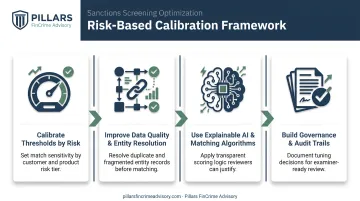
Calibrate Screening Thresholds by Customer and Transaction Risk
Instead of one uniform setting across the entire book, segment thresholds by:
- Customer risk tier (low, medium, high)
- Geography and cross-border exposure
- Transaction type and channel
This cuts noise on genuinely low-risk populations while preserving sensitivity where risk is actually elevated. Do this during periodic model validation or right after a risk assessment update, so calibration reflects current reality, not last year's profile.
Improve Data Quality and Adopt Entity Resolution
Enrich customer and watchlist data with additional identifiers, such as date of birth, nationality, and ID numbers. Then use entity resolution technology to weigh multiple data points together instead of matching on name alone.
This step matters more than most teams assume, and it needs to happen before threshold recalibration. Poor input data undermines even a perfectly tuned threshold. You'd just be applying precision settings to imprecise information.
Use Explainable AI and Advanced Matching Algorithms
Machine learning and advanced fuzzy or phonetic matching can separate genuinely risky matches from benign look-alikes, but only when the logic is explainable and validated, not a black box.
Introduce this as legacy systems are upgraded or replaced. Run a parallel-run validation period so the new system operates alongside the old one before full cutover. This gives investigators and examiners visibility into why an alert fired, not just that it fired.
Build Governance, Documentation, and Audit Trails Around Calibration
Document every threshold change, model deployment, and alert disposition decision, along with the rationale behind it. That's what turns false-positive reduction into a defensible process rather than an ad hoc cost-cutting move.
Per the OFAC Framework for Compliance Commitments, screening technology should be selected and calibrated for the organization's specific risk profile and tested routinely, with root-cause remediation for confirmed weaknesses. That expectation doesn't shrink because you're a fintech instead of a global bank.
Do this continuously, and especially ahead of any regulatory exam or independent testing cycle.
Firms without in-house expertise to design this framework often bring in specialized advisors. Pillars FinCrime Advisory, for example, works with fintechs, payments companies, and financial institutions to build risk-based calibration frameworks and audit-ready documentation tied to their actual risk profile.
Tips for Long-Term Prevention and Control
Calibration isn't a one-time project. Sanctions lists change, business models shift, and risk exposure evolves. A few practices keep programs from drifting back into false-positive overload:
- Backtest regularly – Validate thresholds against historical alert-to-case data to confirm they still catch true matches and clear noise
- Train the team – Keep investigators current on evolving typologies, list updates, and matching logic
- Document every change – Maintain a running record of calibration decisions and model changes for the next exam
- Reassess technology – Evaluate screening vendors at least annually—or when products, geographies, or volumes change—not only after something breaks
You don't need a massive team to sustain this. Build a simple operating rhythm: review, document, adjust, repeat.
Conclusion
Sanctions screening false positives aren't an unavoidable cost of doing business. They have identifiable causes: fuzzy matching without enough context, thin data, static thresholds, and overcaution born from fear of enforcement. Each one is fixable.
A risk-based, well-documented approach to calibration does two things at once. It reduces operational strain on the compliance team, and it strengthens your position with examiners, because you can show exactly how and why the program is calibrated.
Less noise with more defensibility is the real goal: not just fewer alerts, but better ones.
Frequently Asked Questions
How can I reduce false positives in sanctions screening?
Start with risk-based threshold calibration segmented by customer and transaction risk. Improve data quality and adopt entity resolution before you recalibrate. Explainable AI helps further, but documentation is what makes any of this defensible to examiners.
What are the harms of false positives in sanctions screening?
High false-positive volume drives up operational costs, delays onboarding and payments, and causes alert fatigue among analysts. Left unchecked, that fatigue increases the odds a genuine sanctions match gets buried in the noise.
What is considered a "good" false-positive rate in sanctions screening?
There's no universal benchmark regulators publish. Aim for a rate justified by your documented risk assessment, not an arbitrary industry number.
Does reducing false positives increase the risk of missing a true sanctions match?
It can if you loosen thresholds carelessly—false positives and false negatives sit on the same tradeoff curve. Careful, documented calibration, not blanket threshold cuts, is the safer path to lower alert volume.
How often should sanctions screening thresholds be reviewed?
Review thresholds during periodic risk assessments, after sanctions list updates, or following material business changes like new products or markets. A set-and-forget approach is one of the fastest ways to end up with an unmanageable alert queue.
Can smaller fintechs use the same false-positive reduction strategies as large banks?
Yes. Risk-based calibration and data quality principles scale down effectively for smaller teams. Fractional or external advisory support can fill the gap when you lack a large in-house compliance function.