Here's the problem: most compliance and risk leaders don't have a clear map connecting specific regulations, GLBA, SOX, GDPR/CCPA, the EU AI Act, fair lending laws, to concrete AI system controls. That gap is exactly where examiners find findings.
This guide breaks down the regulations that matter, a five-pillar checklist you can audit against today, the pitfalls that trip up otherwise solid programs, and how to build governance that holds up under scrutiny.
Key Takeaways
- AI compliance requires continuous, adaptive governance, not a one-time technology rollout
- Institutions must satisfy overlapping laws at the same time; a single framework is never enough
- Examiners expect explainability, human-override records, and reproducible audit trails on every AI decision
- A five-pillar checklist—governance, data, transparency, monitoring, and vendor risk—shows examiners real program maturity
Why Regulatory Compliance for AI Is Non-Negotiable in Financial Services
Financial institutions sit at the intersection of two pressures: they're the most attractive targets for cybercriminals, and they're among the most heavily supervised industries in the country. AI systems that touch customer data or credit decisions widen that exposure rather than shrink it.
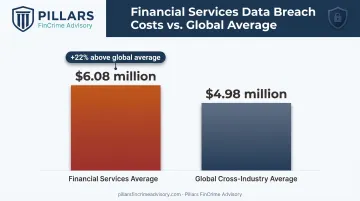
The numbers back this up. The average data breach in the financial sector cost $6.08 million in 2024, 22% above the global average across all industries. That figure comes from IBM's Cost of a Data Breach report. That figure reflects breach costs alone, not the regulatory fines, consent decrees, or remediation spend that typically follow.
Legacy compliance models weren't built for this pace. Annual risk assessments made sense when systems changed slowly. AI models drift, retrain, and shift behavior in ways that can make a point-in-time review outdated before leadership finishes reading it.
That creates dual exposure for institutions running AI without proper controls:
- Traditional penalties — BSA/AML violations, consent order remediation, civil money penalties
- AI-specific liability — algorithmic bias claims under fair lending statutes, EU AI Act enforcement for firms with EU exposure, and UDAAP actions tied to opaque decisioning
Regulators have already shown they'll pursue both tracks at once. A model that automates lending decisions without documented bias testing isn't just a fair lending risk; it's a governance failure examiners will cite regardless of intent.
Key Regulations & Frameworks Shaping Financial Services AI Compliance
No single law governs AI in financial services. Institutions have to satisfy several overlapping frameworks at the same time, each with a different focus.
| Regulation/Framework | Core AI Compliance Focus |
|---|---|
| GDPR, CCPA, GLBA Safeguards Rule | Lawful processing, data minimization, and safeguarding nonpublic personal information used to train or run models |
| BSA/AML & sanctions screening | Risk-tailored transaction monitoring, documented SAR decisions, independent testing of automated alerts |
| ECOA/Reg B, UDAAP, FCRA, TILA | Specific, non-generic adverse action reasons; bias-free underwriting; accurate credit disclosures |
| SOX Section 404 | Tamper-proof, auditable records wherever AI supports financial reporting controls |
| EU AI Act | High-risk classification for credit-scoring AI; mandatory documentation, logging, and human oversight |
| FDIC, SEC, FINRA, OCC, NYDFS | Attestations, supervised AI use, and demonstrable process visibility for AI-enabled systems |
Two areas trip teams up most often: fair lending explainability and the EU AI Act’s extraterritorial reach.
Fair Lending Rules Don't Bend for Complex Models
The CFPB has been explicit: creditors must give specific principal reasons for adverse action, and "the algorithm was too complex to explain" isn't a valid excuse. Generic sample-form reasons that don't reflect the actual decision logic expose institutions to ECOA violations, no matter how sophisticated the underlying model is.
The EU AI Act Isn't Just a European Problem
Under Article 2, the Act reaches providers placing AI systems on the EU market and firms whose AI output is used by EU-based individuals, regardless of where the company is headquartered.
Credit-scoring AI is classified high-risk under Annex III. Fraud-detection systems and pure identity-verification KYC tools are carved out. High-risk classification triggers requirements for:
- Lifecycle testing with representative training data
- Technical documentation and automatic logging
- Human oversight across the system lifecycle
Most of these obligations apply from August 2026.
The Financial Services AI Compliance Checklist
Use these five pillars to audit your current AI program. Each one maps to specific regulatory exposure covered above.
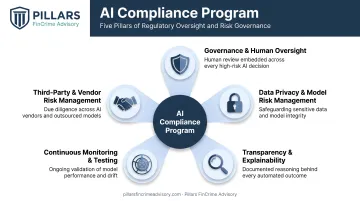
Governance & Human Oversight
- Establish an AI governance board or Center of Excellence bringing together risk, compliance, IT, and business leaders to approve every new model use case
- Assign a named, accountable owner for each AI model or agent, someone who validates outputs and retains real override authority, not just a title
- Document approval workflows so examiners can trace who signed off on what, and when
Data Privacy & Model Risk Management
- Confirm lawful basis and data minimization for every input feeding an AI model, particularly nonpublic personal information governed by GLBA, GDPR, and CCPA
- Conduct and document bias/impact testing for any model touching credit, underwriting, or account decisions
- Retest after retraining. A model that passed a bias audit six months ago isn't automatically clean today
Transparency & Explainability
- Build explainability into the model from day one, not as a retrofit. Every decision needs a traceable path back to inputs, logic, and rationale
- Maintain a mapping of AI outputs to the specific regulatory citations or control objectives they satisfy
- Ensure adverse action notices reflect the actual reason for denial, not a generic template
Continuous Monitoring & Testing
- Replace annual, static assessments with ongoing monitoring of model drift, false positive/negative rates, and emerging risk patterns
- Set clear retraining and revalidation triggers tied to performance thresholds, not arbitrary calendar dates
- Log every human override. Regulators want to see when and why a person intervened, not just that the system worked
Third-Party & Vendor Risk Management
- Vet AI/RegTech vendors' data handling, model governance, and compliance certifications before onboarding, not after a contract is signed
- Reassess vendor tools periodically. A vendor updating its underlying model without notice can change your risk profile
- Match vendor selection to your actual risk profile, transaction volume, and budget rather than defaulting to the most well-known name
Common AI Compliance Risks & Pitfalls to Avoid
Even institutions with solid intentions run into predictable traps.
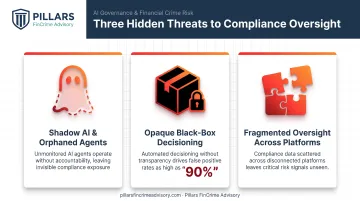
- Shadow AI and orphaned agents. Business units adopt AI tools outside the official inventory to solve immediate problems. Those unsanctioned systems create blind spots examiners will find, and "we didn't know it was running" is not a defense during an exam.
- Opaque, black-box decisioning. Models that can't produce a clear rationale erode regulatory trust fast. False positive rates are already a pain point in financial crime screening, sometimes running as high as 90%, according to Thomson Reuters. Add an unexplainable model on top of that, and investigators lose confidence in the entire alert pipeline.
- Fragmented oversight across platforms. When different business lines adopt separate AI tools independently, proving centralized control gets harder. The result is often duplicated controls in one area and coverage gaps in another—neither reassures examiners.
Building an Audit-Ready AI Governance Program
A checklist tells you where the gaps are. It doesn't close them. Sustainable compliance means embedding these controls into board-level governance, not treating them as a one-time project.
A practical path typically looks like this:
- Discover every AI use case currently running across the institution, sanctioned or not
- Assess each one against the five-pillar checklist to find specific gaps
- Build a remediation roadmap prioritized by regulatory exposure and business risk
- Document everything so the program is audit-ready before an examiner asks for it, not after
Closing those gaps often calls for outside perspective. Pillars FinCrime Advisory works with fintechs, payments companies, and financial institutions to translate regulatory expectations into board-ready governance frameworks. That work spans policy development, transaction monitoring optimization, and exam readiness, covering the full lifecycle AI governance now requires.
Founder Joshua Douglas, a CAMS-certified advisor with 12+ years in financial crime and nearly two decades across financial services, built the firm to help institutions design programs that scale with the business and hold up under examination. This checklist targets that same balance.
An independent program assessment from outside your own team can surface gaps before an examiner does. That turns AI compliance from a reactive scramble into a strength your board and regulators can both trust.
Frequently Asked Questions
What is the difference between AI governance and AI compliance in financial services?
Governance refers to the structures, ownership, and oversight mechanisms that manage AI risk. Compliance means meeting specific regulatory requirements. You need both working together; governance without compliance targets lacks direction, and compliance without governance lacks enforcement.
Which regulations apply specifically to AI used in KYC and transaction monitoring?
BSA/AML and GLBA govern these use cases directly. AI tools must still satisfy suspicious activity reporting standards, independent testing requirements, and due diligence obligations. Automation doesn't reduce the underlying regulatory duty.
Do U.S. fintechs need to worry about the EU AI Act?
Yes, if they serve EU customers or their AI output is used by individuals in the EU. Firms using systems classified as high-risk, such as credit scoring, may fall under its scope even without a physical EU presence.
How often should financial institutions audit their AI compliance controls?
Continuous monitoring should run in the background at all times, supplemented by periodic formal audits. Annual-only reviews leave too large a gap given how quickly AI models drift and regulatory expectations evolve.
What documentation do regulators expect for AI-driven decisions?
Examiners want traceable inputs and outputs, documented human override records, and explainability materials that show the rationale behind each decision. Generic descriptions of "how the model works" generally aren't sufficient.
Can off-the-shelf compliance software fully meet AI regulatory requirements?
Commercial platforms typically cover a majority of standard needs. However, proprietary models or institution-specific risk scenarios often still require custom oversight and independent evaluation to close remaining gaps.