FinCEN received roughly 4.8 million SARs in fiscal year 2025 alone, continuing a steady climb from 4.3 million in FY2022 to 4.7 million in FY2024. Regulators no longer treat high SAR volume as proof of a vigilant program. Many now read it as a warning sign of weak internal controls, not a safe harbor against enforcement.
This article breaks down why defensive filings happen, what they cost institutions, and how newly clarified FinCEN guidance is reshaping the calculus. We'll also cover practical steps for building a SAR program grounded in genuine risk judgment instead of fear.
Key Takeaways
- Defensive SARs are driven by penalty fear, not true suspicion—and FinCEN increasingly treats high volumes as a sign of weak controls.
- October 2025 FinCEN FAQs confirm structuring SARs, mandatory post-filing reviews, and exhaustive no-SAR memos are not automatic requirements.
- Low-value filings dilute law enforcement data, raise costs, and can invite the scrutiny they were meant to avoid.
- Risk-based monitoring, clear documentation standards, and staff training are the strongest defense against defensive filing culture.
What Is a Defensive SAR Filing?
A defensive SAR filing happens when an institution submits a report mainly to protect itself from regulatory criticism, not because it genuinely believes the activity is suspicious. The filing exists to cover the compliance team, not to flag real risk to law enforcement.
US examiners flag the same problem, and international regulators have put it in writing. The Central Bank of the UAE draws a sharp line: its rulebook states that defensive filings do not report activity the institution truly considers suspicious, even when some element of a transaction creates a passing sense of unease. The CBUAE discourages the practice outright because it dilutes the value of every legitimate report filed alongside it.
Defensive SARs vs. Genuine SARs
The difference comes down to investigative rigor, not paperwork:
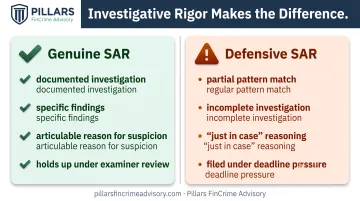
- Genuine SAR: Built on a documented investigation, specific findings, and an articulable reason for suspicion that would hold up under examiner questioning.
- Defensive SAR: Filed on a partial pattern match, an incomplete investigation, or "just in case" reasoning that never got fully tested.
Common triggers for defensive filings include:
- A transaction that loosely resembles a known typology but lacks corroborating evidence
- Missing documentation from a customer that the analyst never chases down
- A filing deadline creeping up before the investigation is actually finished
None of these situations prove suspicious activity occurred. They usually mean the analyst ran out of time, information, or confidence, and filed anyway rather than push the investigation further or make a documented no-SAR call.
What Causes Financial Institutions to File Defensive SARs?
Defensive filing rarely comes from one bad decision. It builds up from a mix of institutional pressure and system gaps that push analysts toward the safest-looking option instead of the most accurate one.
Fear of enforcement. In 2005, Federal Reserve Governor Susan Schmidt Bies noted that institutions had started filing defensively to avoid criticism of their judgment and sanctions for missing suspicious activity. That same fear still drives behavior two decades later.
Several structural issues compound the problem:
- Outdated, rules-based monitoring systems generate excessive false positives and bury investigators in low-quality alerts
- Evolving money laundering typologies make it hard for analysts to rule out suspicion with confidence
- Ambiguous no-SAR documentation expectations (prior to 2025) pushed teams to over-document non-filings or abandon the analysis altogether
- Weak escalation procedures and inconsistent risk assessments leave analysts without a clear path to resolve uncertainty
- Insufficient staff training on typology recognition leaves junior analysts unable to separate real red flags from routine customer behavior
Add tight regulatory deadlines and a low institutional risk appetite to the mix, and teams end up filing before an investigation is truly complete. It's the path of least resistance, even when it isn't the right call.
The Consequences of Defensive SAR Filings
Every low-value SAR filed "just in case" adds to a pile that law enforcement has to sift through to find the reports that actually matter. With 4.8 million SARs reported to FinCEN in a typical year, the signal-to-noise ratio matters, and defensive filing pushes that ratio in the wrong direction.
Regulatory and Operational Fallout
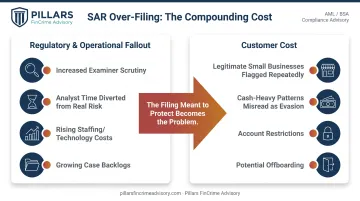
U.S. regulators view a pattern of defensive filings as a sign of inefficient transaction monitoring and weak internal controls. That pattern can invite closer supervisory attention rather than deflect it. The irony is hard to miss: the filing meant as a shield often becomes the reason examiners look harder.
Operationally, the costs stack up fast:
- Analysts spend disproportionate time on low-suspicion filings instead of high-risk investigations
- Staffing and technology budgets grow to handle volume rather than quality
- Backlogs form, delaying attention to cases that actually deserve it
The Customer Cost
Structuring-adjacent behavior illustrates the human cost well. Small businesses with cash-heavy deposit patterns near common reporting thresholds have long been prime targets for repeated defensive filings, even when there's no real evidence of deliberate evasion.
Over time, that pattern can make a legitimate customer look like a liability. Account restrictions or offboarding become more likely—an outcome no one set out to cause.
The 2025 FinCEN Guidance: A Shift Away from Defensive Filing Culture
In October 2025, FinCEN and the federal prudential regulators issued a joint FAQ on SAR reporting requirements that directly addresses years of defensive, low-value filing habits. Three clarifications stand out.
Structuring is not an automatic SAR trigger. A transaction or series near the $10,000 CTR threshold doesn't require a SAR on its own. Institutions only need to file when they know, suspect, or have reason to suspect deliberate evasion of reporting requirements. Proximity to a round threshold alone is not enough.
Continuing-activity reviews are no longer mandatory. Institutions don't have to run a separate manual review after every SAR filing just to check whether the activity continued. Risk-based internal policies can now govern that ongoing monitoring instead of a rigid, one-size-fits-all cycle.
No-SAR documentation isn't exhaustive by default. The FAQ confirms there's no blanket requirement to document every decision not to file. Institutions that document those decisions can scale that documentation to what their risk-based policies require.
These clarifications favor program effectiveness over rigid, defensive process. Compliance teams should revisit internal SAR policies now, rather than wait for the next exam cycle to force the conversation.
Best Practices to Reduce Defensive SAR Filings
Fixing defensive filing culture requires changes to systems, processes, and mindset, not just a policy update.
- Tune transaction monitoring systems with risk-based scenarios and customer segmentation. Generic thresholds applied across every account type generate false positives that overwhelm analysts and push them toward filing instead of investigating.
- Build clear escalation and investigation procedures. Analysts need a documented path for resolving ambiguity, so uncertain cases go to further review rather than an automatic SAR.
- Invest in staff training focused on typology recognition and narrative writing quality. Filings should reflect real investigative findings, not compliance-driven caution.
- Run periodic independent program reviews to catch gaps in monitoring, documentation, and governance before they show up as defensive filing patterns or examiner findings.
- Formalize the 2025 FinCEN FAQ clarifications into updated internal policies rather than treating them as informal guidance.
Putting these changes in place often requires extra capacity. Pillars FinCrime Advisory, founded by CAMS-certified compliance professional Joshua Douglas, works with fintechs, payments companies, and financial institutions across the full SAR lifecycle.
Support covers transaction monitoring optimization, risk assessments, case investigation, and narrative writing. That end-to-end work helps teams build scalable, audit-ready SAR decisioning instead of filing out of caution when a case gets murky.

Frequently Asked Questions
What triggers a SAR filing?
A SAR is triggered when an institution knows, suspects, or has reason to suspect that a transaction involves illicit funds, evades reporting requirements, or has no apparent lawful purpose. The suspicion must be specific, not just a vague feeling.
What are the requirements to file a SAR?
Institutions must identify suspicious activity through monitoring or due diligence and document the investigation that supports that conclusion. They then submit the report through the appropriate filing system within required timeframes.
How soon does a SAR need to be filed?
The standard deadline is 30 calendar days from initial detection, extendable to 60 days if no suspect has been identified. The 2025 FinCEN guidance clarifies that continuing-activity reviews follow risk-based internal policies rather than a mandatory 90-day cycle.
What happens if a SAR is filed?
The report is transmitted confidentially to FinCEN and law enforcement for potential investigation. The subject is never notified, due to anti-tipping-off rules, and the institution retains ongoing monitoring obligations for that customer relationship.
What is the difference between a defensive SAR and a genuine SAR?
A genuine SAR reflects a documented, investigated basis for suspicion. A defensive SAR is filed primarily to avoid regulatory criticism despite weak or incomplete evidence of actual wrongdoing.
Can filing too many defensive SARs get a financial institution in trouble?
Yes. Regulators increasingly view high volumes of defensive filings as a sign of weak transaction monitoring and internal controls, which can trigger targeted audits, supervisory findings, or enforcement action.