Many founders assume a "real" compliance function means a six-figure Chief Compliance Officer hire and an enterprise GRC platform. That assumption is expensive in more ways than one. It usually delays action until a bank partner or examiner forces the issue, and by then the fix costs far more than building it right the first time.
This article breaks down the exact steps, cost drivers, common mistakes, and staffing models — in-house, outsourced, or hybrid — for building a right-sized compliance function without burning through your seed round.
Key Takeaways
- A risk-based program matched to your actual exposure beats a full department you don't need yet
- Spend first on policies, one accountable owner, and a risk assessment before buying technology
- Fractional compliance expertise delivers senior guidance at a fraction of a full-time CCO's salary
- Bank partners judge controls, staffing depth, and governance against relationship complexity—not headcount (federal interagency guidance)
How to Build a Compliance Function on a Startup Budget
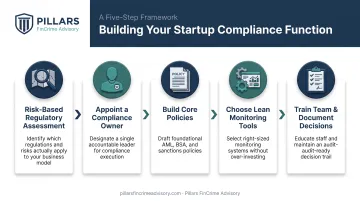
Step 1: Conduct a Risk-Based Regulatory Assessment
Before spending a dollar, figure out which regulations actually apply to your product, customer base, and geography. Not every fintech needs everything a chartered bank needs.
Start by asking:
- Are you moving money as a business? If so, you may fall under FinCEN's money services business definition, which applies regardless of transaction volume
- Do you operate in states that require money transmitter licensing?
- Does your customer base include cross-border transactions or higher-risk countries that trigger sanctions screening obligations?
FinCEN is explicit that no minimum activity threshold exempts a money transmitter from AML program requirements. Your obligations follow the activity you're conducting, not your funding stage or team size.
Once you know what applies, rank the risks by materiality. A domestic peer-to-peer payment app has a very different risk profile than a cross-border remittance platform. Budget should follow the highest-risk areas first, not an arbitrary checklist.
Bring in an experienced advisor for this initial assessment. Getting it wrong in either direction is costly. Overbuilding wastes runway on controls you don't need yet, while underbuilding creates gaps that surface during your first bank partner review or exam.
Step 2: Appoint a Compliance Owner (Without a Six-Figure Hire)
Compliance can't be everyone's job, because that makes it no one's job. Designate one accountable individual, even if it's a part-time or fractional role, rather than leaving the responsibility scattered across founders, ops, and legal.
This is where the fractional compliance model earns its keep. Firms like Pillars FinCrime Advisory provide CAMS-certified executive guidance through a Fractional CCO/BSA Officer service, giving startups senior-level oversight and program accountability without the payroll commitment of a full-time leadership hire.
A few things matter regardless of who fills this role:
- The owner needs direct escalation authority to founders or the board, not a filtered reporting line through another department
- Issues must surface early, before they become regulatory findings
- The role should be documented, not informal. Examiners want to see a named, accountable person
Step 3: Build Core Policies Using Practical, Scalable Frameworks
Your foundational policies (AML/BSA, KYC/CIP, sanctions screening, and complaint handling) don't need to be written from scratch. Use regulatory guidance and proven frameworks as your starting point, then adapt them to your actual business.
The mistake most startups make here is relying on generic boilerplate. A policy that reads like it was copied from a bank's manual won't hold up when an examiner asks how it applies to your specific product flow. Write policies in plain, operational language tied to your real customer journey:
- How does a customer onboard, and where does identity verification happen?
- What does a suspicious transaction actually look like on your platform?
- Who reviews an alert, and what happens next?
Avoid buying an enterprise GRC platform before your policies and processes even exist. Software manages a program; it doesn't create one. Get the documentation right first.
Step 4: Choose Lean, Scalable Monitoring Tools Over Enterprise Software
Match your monitoring and screening tools to your current transaction volume, not to what a $10 billion bank runs. Buying bank-grade systems for a company processing a fraction of that volume is one of the fastest ways to burn cash on compliance technology you can't fully use.
Early on, semi-manual review processes are often sufficient. Automate incrementally as volume and risk actually grow, rather than front-loading every automation investment before you know your real alert patterns.
Cost pressure here is real across the industry, not just for startups. LexisNexis Risk Solutions found that financial crime compliance costs reached $61 billion across the US and Canada in 2023, with 99% of surveyed institutions reporting increased costs.
Small institutions reported labor as their biggest cost driver: 78% saw rising labor costs, compared to 63% at larger institutions. That tells you where to prioritize spend: people and process before more software.
Step 5: Train Your Team and Document Every Decision
Compliance training isn't just for your compliance owner. Build short, role-specific training so customer support, product, and operations teams each recognize the red flags relevant to their function.
Documentation is where most startups fall short, and it's also what actually gets reviewed:
- Risk assessments and how conclusions were reached
- Escalation decisions and who made them
- Remediation steps and their outcomes
Regulators and bank partners judge program maturity by documentation, not headcount. A one-person compliance function with a clean, consistent audit trail will outperform a five-person team with sloppy records every time.
When Should You Invest More in Your Compliance Program?
Compliance spending should scale with risk and growth stage, not a fixed percentage-of-revenue formula that ignores what you're actually exposed to.
- Pre-launch/early stage: A minimal viable program is often enough — core policies plus one accountable owner
- Post-funding or post-bank-partnership: Time to formalize monitoring and reporting, and consider your first dedicated compliance hire
Certain trigger points require immediate investment:
- Entering new states with different licensing requirements
- Launching a higher-risk product line
- Receiving specific compliance requirements from a banking or payments partner
Don't wait for a calendar milestone. Wait for a risk signal, then act on it immediately.
Key Cost Drivers Behind Your Compliance Budget
A handful of factors explain most of the variance in what companies spend on compliance:
- Regulatory scope and licensing complexity: Operating across multiple states or needing money transmitter licenses adds significant legal and compliance costs.
- Product risk profile: Cross-border payments, crypto, and cash-intensive services demand more robust AML controls and higher spend than a simple domestic payments app.
- Growth stage and transaction volume: Rising volume pushes you toward automated monitoring, which directly affects technology costs.
- Talent market rates: Experienced, certified compliance professionals command a premium, and labor is typically the largest financial crime compliance cost category.
- Build-vs-buy technology decisions: Choosing point solutions versus enterprise GRC platforms creates significant cost variance depending on your actual needs.
No single dollar figure fits every company. The variables above decide whether your first-year compliance budget looks like a modest advisory retainer or a much larger program.
Common Mistakes Startups Make on a Compliance Budget
A few patterns show up again and again in early-stage companies:
- Waiting for someone else to force the issue. Building only after a bank partner, investor, or regulator flags a gap puts you in reactive mode, which is always more expensive.
- Overspending on software before process exists. An enterprise platform can't fix policies that haven't been written yet.
- No clearly accountable owner. Shared responsibility means gaps go unnoticed until they become findings.
- Treating training as a checkbox. A single onboarding session, never repeated or updated, doesn't hold up against evolving typologies or regulatory expectations.
The cost of getting this wrong isn't hypothetical. In January 2025, state regulators fined Block, Inc. $80 million over BSA/AML deficiencies tied to Cash App, citing gaps in customer due diligence, identity verification, and suspicious activity reporting.
Block also had to bring in an independent consultant and fix deficiencies on a set timeline. That remediation alone costs far more than building the program right the first time.
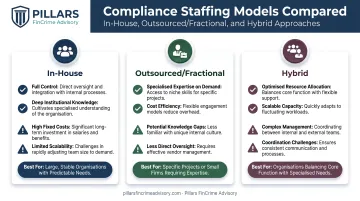
In-House vs. Outsourced vs. Hybrid: Choosing the Right Compliance Model
The right staffing model depends on your stage, risk profile, and budget. There's no single correct answer, but understanding the tradeoffs helps you pick deliberately instead of by default.
In-House Compliance Team
Pros:
- Full-time presence and direct daily oversight
- Deep institutional knowledge of your product and customers
- Immediate availability for time-sensitive decisions
Cons:
- High fixed payroll cost, especially for senior-level talent
- Hiring risk in a competitive market for certified professionals
- Single point of failure if the hire underperforms or leaves
Best for: Later-stage startups with steady volume and budget for a dedicated hire.
Outsourced/Fractional Compliance Advisory
Pros:
- CAMS-certified expertise without a full-time salary commitment
- Flexibility to scale engagement up or down as risk changes
- Senior-level guidance at a cost that fits a startup budget
Cons:
- Less day-to-day presence than an internal hire
- Needs clear scope and communication expectations upfront to avoid gaps
Firms like Pillars FinCrime Advisory support the full lifecycle: policy development, risk assessments, transaction monitoring optimization, and audit readiness.
Best for: Early-stage fintechs and payments companies that need senior expertise before a full-time hire makes sense.
Hybrid Model
Pros:
- Internal owner runs daily operations; advisor supports policy, remediation, and audit prep
- Combines institutional knowledge with specialized expertise on demand
Cons:
- Needs a clear split of responsibilities so nothing falls through the cracks
Best for: Teams with an internal compliance owner that still need specialized depth for exams, remediation, or program build-out.
Frequently Asked Questions
What are the 7 elements of a compliance program?
Regulators don't define a universal seven-element list. Core components typically include governance and leadership buy-in, written policies and controls, risk assessment, training, monitoring and testing, reporting, and adequate resourcing. These apply regardless of company size.
How much should a startup budget for compliance in the first year?
Cost depends entirely on your regulatory scope and risk profile. Most early-stage programs prioritize a fractional advisor and core policy development over building a full internal department in year one.
Can one person run a compliance program for a small fintech?
Yes, at early-stage risk levels. A single accountable owner, supported by outsourced expertise for specialized needs, is often sufficient until volume or risk profile changes materially.
When do I need to hire a dedicated Chief Compliance Officer?
The decision should follow growth triggers: a funding round, new licensing requirements, or a bank partner's specific demands—not a fixed headcount or revenue threshold.
What happens if I don't build a compliance function early enough?
You risk losing bank partnerships, stalling investor due diligence, and facing regulatory penalties. Enforcement cases have resulted in fines exceeding $80 million plus mandatory independent remediation.
Is outsourcing compliance a good option for startups?
Yes. Outsourcing provides senior-level expertise at a fraction of the cost of a full-time hire, making it a practical fit for resource-constrained startups that still need a defensible, examiner-ready program.