Regulators know this. OFAC, the UN Security Council, the EU, and the UK's OFSI all maintain lists that change constantly, and payment processors are expected to keep pace. High transaction volumes and real-time rails leave a narrow window to catch a violation before funds settle. Add fast-moving updates tied to Russia, Iran, and North Korea, and the margin for error shrinks further.
This article walks through a practical checklist: what you need before you build a program, how screening actually works across the customer lifecycle, how to read the results, and where most compliance programs quietly fall apart.
Key Takeaways
- A defensible program rests on five pillars: management commitment, risk assessment, internal controls, testing, and training
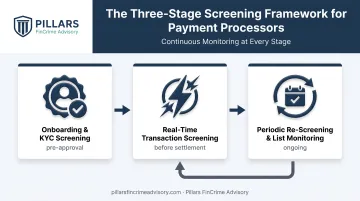
- Screening happens at three points: onboarding, real-time transaction processing, and periodic re-screening
- Examiners check for documented escalation workflows and audit trails, not just the presence of a screening tool
- Most failures trace back to stale lists, weak fuzzy matching, or missed beneficial ownership chains, not bad intent
What You Need Before Building a Sanctions Compliance Checklist
A checklist only works if the underlying inputs are solid. Before you can run a single screen, you need the right data, the right list coverage, and the right technology and people behind it.
Data and Identifiers Required
Screening quality depends entirely on what data you're feeding it. At minimum, collect these for both senders and beneficiaries:
- Full legal name and known aliases
- Date of birth
- Residential or business address
- Government-issued identification number
- Account and routing numbers
Incomplete records cause problems in both directions. Missing a date of birth or address inflates false positives on common names, while thin data on a beneficiary can let a true match slip through undetected.
Beneficial ownership data matters just as much. Without it, you can't apply OFAC's 50% rule. That rule blocks any entity owned 50% or more, in aggregate, by one or more blocked persons, including through indirect ownership chains (OFAC FAQ 401). A customer can look clean on paper while sitting one ownership layer away from a designated party.
Sanctions Lists and Regimes to Cover
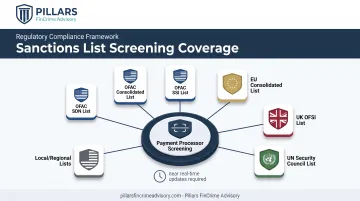
Your screening program should cover at least:
- OFAC's Specially Designated Nationals (SDN) List
- OFAC's Consolidated Sanctions List (non-SDN lists)
- OFAC's Sectoral Sanctions Identifications (SSI) List
- UN Security Council Consolidated List
- EU Consolidated List of financial sanctions targets
- UK OFSI Sanctions List
- Any local lists relevant to your operating corridors
OFAC updates its lists with no fixed schedule. Names get added or removed as circumstances warrant, sometimes multiple times a week (OFAC FAQ 20). Manual, periodic checks simply can't keep up. You need a vendor feed or subscription service delivering near real-time updates.
Technology, Team, and Governance Preconditions
Generic screening software with default settings rarely fits a payment processor's actual risk profile. You need matching logic that handles fuzzy name variations and transliteration, calibrated to your customer base and corridors, not left on factory settings.
Many processors don't have this expertise in-house, which is why they bring in a financial crime advisory partner to select and tune these tools properly. Pillars FinCrime Advisory, for instance, works with payments companies to match screening calibration to actual transaction volume and risk exposure rather than a one-size-fits-all configuration.
You also need a named sanctions compliance officer with a direct line to senior leadership. OFAC's Framework for Compliance Commitments treats management commitment as foundational, and this role is how that commitment shows up in day-to-day operations.
How Payment Processors Perform Sanctions Checks: Core Methods
Sanctions screening isn't one check. It's a layered set of methods applied at different points in the customer and transaction lifecycle, chosen based on risk level and processing speed.
Method 1: Onboarding and KYC Screening
This is your first line of defense: screening new customers, merchants, and their beneficial owners before you activate their account.
What it takes: identity verification data, access to consolidated sanctions lists, and a fuzzy or phonetic matching engine.
- Collect and validate identifying data for the customer and any beneficial owners
- Screen all parties against applicable lists using fuzzy matching to catch spelling and transliteration variations
- Escalate potential matches for manual review before account approval
Onboarding screening stops bad actors before they ever gain access. Its blind spot: it does nothing to catch a customer who becomes sanctioned after they've been approved.
Method 2: Real-Time Transaction Screening
This method screens payment message fields (originator, beneficiary, intermediary bank) before funds settle. It's the only method that can actually stop a violation before money moves, which makes it critical on instant payment rails.
What it takes: payment message parsing capability, a low-latency screening engine built into the payment flow, and an exception-hold workflow.
- Parse every field in the payment instruction, including originator and beneficiary details
- Screen the transaction in real time before settlement
- Hold or block the transaction pending investigation if a potential hit returns
The catch is speed. Under the EU's instant payment rules, execution windows can be as tight as 10 seconds. A flagged payment held for analyst review can collide directly with that limit (ACAMS, 2025).
Building infrastructure that screens without introducing unacceptable delay is a real engineering problem, not just a compliance one.
Method 3: Periodic Re-Screening and List Monitoring
A clean customer today can become a sanctioned party tomorrow. Periodic re-screening closes that gap by re-checking your existing customer base whenever lists update or on a fixed schedule.
What it takes: batch screening capability, automated list-update tracking, and audit trail documentation.
- Trigger automatic re-screening whenever OFAC, UN, EU, or OFSI lists update
- Set re-screen frequency by risk tier, with higher-risk customers on more frequent cycles
- Document every result and route new matches through the same investigation workflow as real-time hits
Regulatory guidance doesn't mandate a fixed cadence. Lower-risk populations are commonly checked weekly, monthly, or quarterly.
The tradeoff is volume. Re-screening closes the point-in-time gap left by onboarding checks, but without clean underlying data it can flood your investigation team with alerts.
How to Interpret Sanctions Screening Results
Running the screen is only half the job. What your team does with the result matters equally: misreading an alert can block a legitimate customer or, worse, let a prohibited transaction through.
True or confirmed match. Multiple identifiers align: name, date of birth, government ID, and address. When that happens, take these steps:
- Block or reject the transaction and freeze the account
- File the required report with OFAC
- Submit blocked-property and rejected-transaction reports within 10 business days
False positive. Usually caused by common names, incomplete customer data, or weak matching logic that generates low-value alerts. Dismissing the alert alone is not enough. Document your rationale and clear it with a defensible audit trail an examiner can review later.
Potential or partial match. This is the gray zone: shared surnames, transliteration variance, or partial data overlap. Escalate these cases to senior compliance staff. They gather corroborating data and set a firm investigation deadline before releasing any held funds.
The middle category is where programs most often stumble. Treating every partial match like a true hit freezes legitimate customers and damages the business. Treating it like a false positive without documentation leaves no defense if an examiner asks why funds moved.
Common Errors That Undermine Sanctions Compliance
Most sanctions failures aren't the result of bad intent. They're the result of process gaps that compound over time.
- Outdated list versions. Relying on infrequent update cycles instead of near-real-time feeds means newly designated parties slip through undetected for days or weeks.
- Weak or absent fuzzy matching. Missing name variations and transliterations lets true matches pass as clean.
- Ignoring the 50% rule. Failing to trace beneficial ownership chains means a customer can look clean while sitting behind a blocked entity.
- Inconsistent alert documentation. No audit trail means no evidence of program effectiveness when examiners come asking.
These aren't hypothetical. OFAC's 2021 settlement with Payoneer cited 2,220 apparent violations tied to weak screening algorithms, failure to screen bank identifier codes, and automatic release of flagged payments during processing backlogs, resulting in a $1,385,901.40 settlement (OFAC enforcement release, 2021).
The pattern repeats across the industry: it's rarely a single catastrophic failure, but a stack of small process gaps left unaddressed.
Governance, Best Practices, and Building an Audit-Ready Program
Everything above should ladder up to OFAC's five compliance pillars, because that's the framework examiners actually measure programs against:
- Management commitment — a named sanctions officer with direct access to senior leadership
- Risk assessment — understanding your specific exposure by customer type, corridor, and product
- Internal controls — the screening methods and escalation workflows covered above
- Testing and auditing — independent review of whether controls work as designed
- Training — ongoing education for staff who handle alerts and escalations
Sanctions screening should integrate with your broader BSA/AML program, but keep OFAC reporting and SAR filing distinct. They serve different regulatory purposes and follow different timelines.
Regular independent testing matters more than most processors realize. Demonstrated good faith, including documented remediation after identifying gaps, is a primary factor in how regulators treat violations when they do occur. A qualifying voluntary self-disclosure cuts the base penalty amount in half under OFAC's enforcement guidelines.
Not every processor has the in-house capacity to build, calibrate, and test these controls from scratch. A specialized financial crime advisory partner can close that gap without forcing a full internal build.
Pillars FinCrime Advisory, founded by CAMS-certified compliance veteran Joshua Douglas, helps fintechs and payments companies turn examiner expectations into scalable, audit-ready sanctions programs—from policy design and screening calibration to transaction-monitoring optimization and exam preparation.
A documented, tested checklist is what separates a program that satisfies examiners from one that only looks good on paper. A screening tool alone won't get you there.
Frequently Asked Questions
What should a sanctions compliance checklist for payment processors include?
A complete checklist covers governance and written policy, full list coverage, screening at onboarding, real-time, and periodic stages, documented escalation procedures, and recordkeeping that satisfies audit requests.
How do payment processors perform sanctions checks?
Processors use a layered approach: screening at onboarding, real-time screening of payment messages before settlement, and periodic re-screening when lists update or on a set schedule.
What are the sanctions compliance requirements for payment processors?
Processors must screen against OFAC, UN, EU, and OFSI lists and maintain a five-pillar compliance program. They must also file blocked or rejected transaction reports within 10 business days and retain records for at least five years under OFAC rules.
What is OFAC's 50% rule and why does it matter for payment processors?
Any entity owned 50% or more, in aggregate, by one or more blocked parties is itself blocked, even through indirect ownership chains. That makes beneficial ownership due diligence essential during onboarding and re-screening.
How often should sanctions screening lists be updated?
OFAC updates its lists with no fixed schedule, often multiple times a week. Processors need near real-time feeds plus automatic re-screening triggered by every list change.
What happens if a payment processor misses a sanctions match?
A missed match can trigger civil penalties, mandatory blocked or rejected transaction reporting, and damage to banking relationships and reputation. If you discover a miss after the fact, prompt voluntary self-disclosure can cut the base penalty in half.