Introduction
Fraud detection systems exist to catch criminals. Too often, they catch everyone else instead.
Legitimate customers get declined at checkout. Long-time account holders find their transfers frozen. Analysts spend their shifts clearing alerts that were never fraud to begin with. This is the paradox at the center of financial crime compliance: the tighter you tune a system for safety, the more noise it tends to generate.
That noise has a real cost. In one widely cited study, 19 U.S. financial institutions reviewed nearly 16 million alerts in a single year but filed just over 640,000 SARs.
According to a Bank Policy Institute study on BSA/AML compliance resources, the vast majority of flagged activity never became a confirmed suspicious activity report.
This guide breaks down why false positives happen, what they cost institutions that ignore them, and the governance-backed strategies that cut noise without letting real fraud through.
TL;DR
- False positives are legitimate transactions or customers wrongly flagged as suspicious
- Root causes include rigid rules, poor data quality, missing context, and stale tuning
- Ignoring them costs revenue, drives customer attrition, and burns out analysts
- The fix: risk-based rules, contextual data, continuous tuning, and independent review
- Ongoing work: treat false-positive reduction as continuous tuning, not a one-time system change
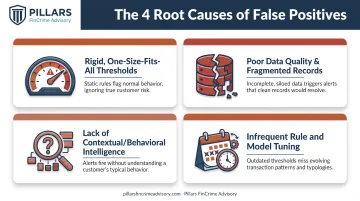
Common Causes of False Positives in Fraud Detection
A false positive is a legitimate transaction or customer flagged as suspicious when no real risk exists. Its opposite, a false negative, is genuine fraud or money laundering that slips through undetected. Both carry real costs, but they show up differently: one frustrates good customers, the other invites regulatory and financial loss.
Most false positives trace back to a handful of recurring, fixable issues in how monitoring systems are built and maintained.
Cause 1: Rigid, One-Size-Fits-All Rule Thresholds
Static rules, like a flat $10,000 threshold applied to every account, don't account for normal variation in customer behavior. A retailer's seasonal sales spike, a payroll run, or a one-time large purchase can all trip the same wire as an actual laundering attempt.
Cause 2: Poor Data Quality and Fragmented Customer Records
Outdated KYC data and disconnected systems create an incomplete customer picture. If a business customer's profile isn't updated after a change in ownership or revenue model, their normal activity suddenly looks anomalous against stale records.
Cause 3: Lack of Contextual and Behavioral Intelligence
Systems that only weigh raw transaction amounts, without customer history or relationship context, flag activity in isolation. A long-standing customer sending a larger-than-usual transfer might be flagged even though it fits a pattern they've repeated for years.
Cause 4: Infrequent Rule and Model Tuning
Rules configured at go-live often go untouched for years. Meanwhile, customer behavior evolves, new products launch, and regulations shift. Institutions expanding into new markets without recalibrating their detection logic frequently see alert volumes spike overnight.
What Happens If False Positives Are Ignored
Unmanaged false positives carry a compounding cost. According to Celent's 2018 report on financial crime management, investigating a single false positive typically takes 5 to 30 minutes of analyst time. Multiply that across thousands of monthly alerts, and labor cost climbs fast. Time that should go toward genuine threats gets spent clearing noise instead.
Customer experience takes a hit too. Frequent false declines and frozen accounts erode trust. Customers who hit repeated friction on legitimate purchases or transfers don't wait around — they move to a competitor with fewer false alarms.
There's also a dangerous overcorrection risk. Teams under pressure to cut false positives sometimes loosen thresholds too aggressively, which can let real fraud through.
Regulators notice when programs swing too far in either direction. New York's Department of Financial Services found that Block, Inc. used unsupported alert thresholds that allowed exposure to terrorism-connected wallets. Its alert backlog grew from roughly 18,000 in 2018 to more than 169,000 by 2020, and average investigation start times stretched to 70 days, according to the NYDFS consent order against Block, Inc.. The penalty: $40 million.
Warning Signs You're About to Experience a False Positive Surge
Watch for these indicators before the problem gets worse:
- Rising alert volumes with no matching increase in confirmed fraud cases or SAR filings
- Growing analyst backlog and longer average investigation time per alert
- More customer complaints about declined transactions or frozen accounts
How to Reduce False Positives in Fraud Detection
Reducing false positives requires a structured process that balances catching real fraud against keeping legitimate customers moving.
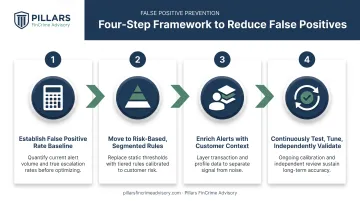
Prevention Measure 1: Establish a False Positive Rate Baseline
Calculate your false positive rate: false positives divided by total negatives, tracked over a consistent period. This baseline tells you whether future rule changes actually improve accuracy or just shift the problem around.
- Run this calculation before making any rule changes
- Revisit the number quarterly to track trend direction over time
- Document the methodology so results stay comparable across periods
Prevention Measure 2: Move to Risk-Based, Segmented Rules
Replace blanket thresholds with tiered rules based on customer risk profile, product type, and transaction channel. A high-volume, low-risk retail account shouldn't trigger the same scrutiny as a higher-risk correspondent relationship.
This reduces noise on legitimate, everyday activity while keeping real scrutiny where it belongs. Pair this shift with a documented risk assessment update so the new thresholds hold up under examiner review.
Prevention Measure 3: Enrich Alerts with Customer Context
Integrate KYC data, transaction history, and behavioral patterns into a single customer view before an alert reaches an analyst. Added context helps both systems and humans tell unusual-but-legitimate activity apart from genuine risk in seconds instead of hours.
Pair this with a regular KYC refresh cycle . Stale customer data is one of the fastest ways to reintroduce false positives you just eliminated.
Prevention Measure 4: Continuously Test, Tune, and Independently Validate Rules
Test rules against real outcomes in a repeatable feedback loop involving compliance, fraud operations, and data teams. What worked at launch rarely still fits two years and three product lines later.
Periodic independent review catches blind spots internal teams tend to miss. It also prepares your program for regulatory exams before an examiner finds the gap first.
Pillars FinCrime Advisory provides this transaction monitoring optimization support to fintechs, payments companies, and financial institutions. A CAMS-certified outside review of rule logic and alert performance sharpens alert quality without opening the door to missed fraud.
Set review cadence on a fixed schedule:
- Semi-annually is a common baseline
- Trigger an off-cycle review after any material product launch
- Review again after new market entry or regulatory change
Building Long-Term Control Over False Positives
Sustainable false positive reduction comes from habits and governance, not a one-time system overhaul. Programs that hold up over time share a few common practices:
- Schedule routine performance reviews instead of waiting for a spike in complaints to force action
- Invest in ongoing analyst training on emerging typologies and escalation criteria so judgment stays consistent across the team
- Document every rule change and its rationale so examiners can trace why thresholds moved and what data supported the change
- Keep human review in the loop alongside automation. No model accounts for every business context on its own.
Joshua Douglas founded Pillars FinCrime Advisory on this approach: hands-on program design paired with governance that keeps monitoring accurate as the business scales.
Conclusion
False positives have identifiable, fixable root causes. Rigid thresholds, weak data, missing context, and stale tuning are not inevitable. A baseline measurement, risk-based rules, enriched context, and continuous tuning bring the problem down to a manageable, monitored level.
Proactive, well-governed programs save costs, protect customer relationships, and hold up better under regulatory exams. If your team is ready to raise alert quality and reduce operational friction, partnering with an experienced financial crime advisory firm like Pillars FinCrime Advisory can help you build a program that's scalable and audit-ready from day one.
Frequently Asked Questions
What does a false positive mean in fraud detection?
A false positive is a legitimate transaction or customer incorrectly flagged as suspicious by a fraud or AML monitoring system. It creates unnecessary investigation work and can inconvenience genuine customers.
How do you reduce false positives in fraud detection?
Start by baselining your current false positive rate, then shift to risk-based, segmented rules instead of blanket thresholds. Enrich alerts with customer context and continuously test and tune your rules against real outcomes.
What is an acceptable false positive rate in fraud detection?
There's no universal benchmark. Acceptable rates vary by risk appetite, industry, and regulatory expectations. Tracking the trend direction of your own rate over time matters more than chasing a single external number.
What's the difference between a false positive and a false negative in fraud detection?
A false positive flags legitimate activity as suspicious; a false negative misses actual fraud or laundering entirely. Both carry real costs: one in operational friction and customer trust, the other in financial loss and regulatory exposure.
How often should fraud detection rules be reviewed and tuned?
Most programs benefit from a fixed review cadence, such as semi-annually, plus off-cycle reviews triggered by new products, new markets, or regulatory changes. Waiting years between reviews is one of the most common causes of alert overload.
Can AI or machine learning eliminate false positives entirely?
AI and machine learning can meaningfully reduce false positives by adding pattern recognition and context that static rules miss. They can't eliminate them entirely. Human oversight and governance remain essential to catch what the models don't.