Introduction
Fraud isn't a rounding error anymore. Scams and bank-fraud schemes drove $485.6 billion in projected global losses in 2023, according to the Nasdaq Verafin 2024 Global Financial Crime Report. For fintechs, payments companies, and financial institutions, that figure means regulatory pressure and balance-sheet risk.
This guide draws on hands-on work from Pillars FinCrime Advisory, led by CAMS-certified founder Joshua Douglas, who brings nearly two decades in financial services. The aim is practical: turn regulatory expectations into strategies you can implement.
We'll cover what fraud risk management means, the seven fraud types every regulated entity should track, and the core components of a fraud risk framework. You'll also get the practices that separate audit-ready programs from ones that scramble in an exam.
Key Takeaways
- Fraud risk management runs as a continuous cycle: identify, assess, prevent, detect, and respond
- Seven fraud types fall into two camps: internal (employee-driven) and external (outsider-driven)
- Sound fraud risk assessments cover five parts: identification, scoring, control mapping, prioritization, and monitoring
- Layered controls, anti-fraud culture, technology, and expert guidance keep programs examiner-ready
What Is Fraud Risk Management?
Fraud risk management is the systematic process of identifying, assessing, preventing, detecting, and responding to fraud across an organization. As an operating discipline, it spans governance, staffing, technology, and reporting.
For regulated entities, this discipline carries weight beyond good business sense. The OCC expects banks to maintain fraud risk management systems calibrated to their size, complexity, and risk profile—with policies, processes, and controls that identify, measure, monitor, and control fraud exposure.
Fintechs partnering with sponsor banks inherit similar expectations, even without a direct charter.
The Real Cost Isn't Just the Loss
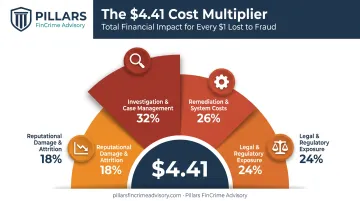
Every dollar lost to fraud triggers a chain reaction of secondary costs. North American financial institutions incur $4.41 in total cost for every $1 lost to fraud, according to a LexisNexis Risk Solutions study of 346 fraud and risk executives.
That multiplier includes:
- Investigation labor and case management time
- Remediation and system reconfiguration costs
- Legal exposure and potential regulatory penalties
- Reputational damage and customer attrition
A single incident rarely costs what it looks like on paper.
7 Types of Fraud Every Fintech and Financial Institution Should Know
Fraud generally sorts into two buckets: threats that originate inside the organization and threats that come from outside it. Both categories require distinct controls, and most mature programs monitor for all seven simultaneously.
Internal Fraud Risks
- Financial statement fraud: Manipulation of reported earnings, revenue, or expenses to mislead investors or regulators. ACFE's 2024 Report to the Nations found it in only 5% of cases, with a median loss of $766,000—the highest of any category.
- Asset misappropriation: Employee theft or misuse of funds, inventory, or equipment. Watch for inventory shrinkage, lifestyles beyond means, and reluctance to take vacation.
- Procurement and vendor fraud: Fictitious vendors, inflated invoices, kickbacks, or payment for goods never delivered. Billing schemes appear in roughly 22% of ACFE-tracked cases.
External Fraud Risks
- Payment and transaction fraud: Card-not-present fraud, chargeback abuse, and account takeover. Federal Reserve data showed remote-card fraud rising from $3.40B in 2015 to $4.57B in 2016, a baseline e-commerce growth has since amplified.
- Cyber fraud and business email compromise (BEC): Phishing, ransomware, and executive impersonation used to wire funds or steal credentials. The FBI's IC3 recorded over 21,000 BEC complaints and $2.77 billion in losses in 2024 alone.
- Identity theft and synthetic identity fraud: Criminals combine real and fabricated identity elements to open accounts. Risk peaks at onboarding, so KYC and KYB checks are the first line of defense for fintechs.
- First-party fraud: Account holders who exploit products through false disputes, bust-out credit schemes, or intentional default. Harder to flag than third-party fraud because the customer initially looks legitimate.
Key Components of a Fraud Risk Management Framework
A complete framework doesn't stop at policy documents. It functions as a continuous loop: assessment, prevention, detection, investigation, and response, feeding back into itself as new risks emerge.
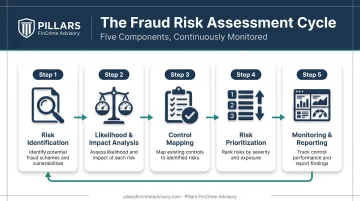
The 5 Components of a Fraud Risk Assessment
- Risk identification — Map business processes end-to-end and pinpoint exactly where fraud could realistically occur.
- Likelihood and impact analysis — Score each identified risk on probability of occurrence and severity of financial or reputational damage.
- Control mapping — Match existing controls against each identified risk to expose coverage gaps before an examiner does.
- Risk prioritization — Rank residual risks so limited resources target the highest-exposure areas first.
- Monitoring and reporting — Document assessment results and report findings to leadership and the board on a defined cadence.
Prevention, Detection & Response Controls
Preventive controls stop fraud before it happens. Common examples include:
- Segregation of duties (the person who approves payments shouldn't also reconcile them)
- Authorization thresholds on payments and account changes
- Dual controls on high-value transactions
Detective and investigative controls catch what prevention misses. Transaction monitoring, exception reports, and SAR filing obligations form the core of this layer.
Banks must file a SAR within 30 days for transactions of $5,000 or more that meet suspicious activity criteria; money services businesses face a $2,000 threshold. Both carry a 5-year recordkeeping requirement.
Once an incident is confirmed, response controls drive recovery and remediation: contain the loss, document the case file, and feed lessons learned back into the risk assessment.
Best Practices & Strategies to Strengthen Fraud Risk Management
Strong fraud programs are built on clear ownership, layered controls, and the discipline to keep both current. The practices below are what separate teams that pass exams from teams that scramble before them.
Establish Governance and an Anti-Fraud Culture
Regulators expect documented accountability. That means a written fraud risk management framework with clear roles, defined escalation paths, and genuine board-level oversight, not a policy binder that sits untouched between exams.
Tone at the top matters more than most compliance teams admit. Pair leadership commitment with protected whistleblower channels so employees feel safe reporting suspicious activity without fear of retaliation.
Layer Controls, Analytics, and Ongoing Training
No single control should carry the full weight of fraud prevention. Combine preventive measures (dual approval, authorization limits) with detective ones (monitoring, exception reporting) so a failure in one layer doesn't expose the whole organization.
Static, rules-based monitoring also struggles against fast-evolving fraud patterns. In a Swift experiment involving 13 global financial institutions and 10 million synthetic transactions, a collaboratively trained AI model proved twice as effective at identifying known fraud compared to a model trained on a single institution's data.
Programs that hold up under regulatory examination don't get built the week before the exam. Ongoing staff training and consistently updated documentation across governance, risk assessment, and control activities keep a program defensible year-round.
Partner With Specialized Financial Crime Advisors
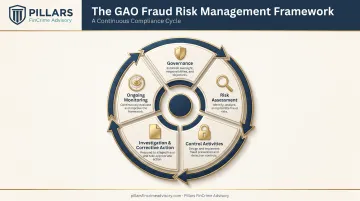
Lean fintech and payments compliance teams often can't staff every function in-house. A firm like Pillars FinCrime Advisory builds fraud programs around the five components of the GAO Fraud Risk Management framework:
- Governance
- Risk assessment
- Control activities
- Investigation and corrective action
- Ongoing monitoring
That structure moves organizations from reactive fraud response to a proactive, board-level program, including policy development, risk assessments, and transaction monitoring optimization.
Common Challenges in Fraud Risk Management
Fraud teams face pressure on several fronts at once:
- Evolving techniques: Static detection lags AI-generated documents and deepfakes. FinCEN has flagged rising SARs tied to deepfake media since 2023, especially at account opening.
- Friction vs. experience: Too many verification steps and legitimate customers abandon onboarding; too few and fraud gets through.
- Silos and fragmented data: Growing fintechs often split fraud and cybersecurity across disconnected systems, so nobody holds a unified risk view—the gap fraudsters exploit.
Frequently Asked Questions
What does fraud risk management do?
Fraud risk management identifies, assesses, prevents, detects, and responds to fraud to protect an organization's financial assets, data integrity, and regulatory standing. It is a continuous process, not a one-time project.
What are the 5 components of fraud risk assessment?
Risk identification, likelihood/impact analysis, control mapping, risk prioritization, and monitoring/reporting. Together they turn a general fraud policy into a targeted, measurable program.
What are the 7 types of fraud?
Internal types include financial statement fraud, asset misappropriation, and procurement/vendor fraud. External types include payment and transaction fraud, cyber fraud/BEC, identity theft, and synthetic identity fraud.
How often should a company update its fraud risk management strategy?
Review the program at least annually. Update sooner if your business model, systems, or the threat landscape changes materially—static programs age quickly against new fraud tactics.
What's the difference between fraud risk management and AML compliance?
Fraud risk management focuses on deception for financial gain; AML compliance addresses laundering illicit funds. The two overlap heavily in monitoring and SAR reporting, but they're not interchangeable programs.
What tools do fintechs use for fraud detection?
Fintechs typically rely on transaction monitoring platforms, data analytics tools, and AI/ML-based behavioral analysis systems that flag anomalies faster than manual review.